
INVESTMENT QUESTIONS
Can I start investing with little money?
Short answer: Yes. Investing with little money is possible in Canada because many funds, ETFs and online platforms accept small purchases, and automatic contributions as low as a few dollars a payday are common. The keys are keeping fees low relative to the amount, choosing a diversified option and staying consistent.
In this guide: Why starting small still matters · Where small amounts can go · Watch the fees closely · A simple plan to start with little money · Finding the money · When to hold off · Common mistakes with small accounts · What to ask before opening an account · How small amounts can add up over time · FAQ

Many people put off investing because they think they need thousands of dollars to begin. In reality, investing with little money is how a large number of Canadians get started. The amount you begin with matters less than the habit you build and the costs you pay along the way. This guide explains how small amounts can work, where they can go and what to watch for.
Why starting small still matters
Small, regular contributions do two useful things. First, they build the habit of investing before you have a large amount at stake, which is when mistakes are cheaper. Second, they give money more time to grow. Our guide to compound growth explains why time can matter as much as the amount, though growth is never guaranteed.
Where small amounts can go
- High-interest savings or a TFSA savings account: a simple first step while you learn.
- Mutual funds with low minimums: some fund companies allow pre-authorized contributions of small amounts each month.
- ETFs through an online brokerage: you can buy as few as one unit, and some platforms allow fractional units.
- Robo-advisors: many accept small opening deposits and invest automatically in a diversified portfolio.
- Workplace plans: group RRSPs or pension plans may take contributions straight from your pay, sometimes with an employer match.
If your employer matches contributions, find out how the match works. Leaving a match unused is a common missed opportunity.
Watch the fees closely
Fees matter at every size, but they can bite harder on small accounts. A flat fee that seems minor on a large balance can take a noticeable share of a small one.
- Trading commissions: some brokerages charge per trade, while others offer free ETF purchases. Check before buying in small pieces.
- Account fees: some accounts charge an annual fee below a certain balance.
- Management expense ratio (MER): the ongoing cost of a fund, taken from its returns each year.
- Currency conversion: buying U.S.-listed investments can involve conversion costs.
Example (hypothetical): Suppose two people each invest $50 a month. One uses a platform that charges $10 per purchase, the other a platform with no commission on ETF purchases. The first person loses 20% of every contribution to fees before any growth. The figures are illustrative, but they show why cost matters most when amounts are small.
A simple plan to start with little money
- Choose one goal, such as retirement or a home, so the money has a purpose.
- Pick the account: often a TFSA for flexibility, an RRSP for retirement or an FHSA if you are an eligible first-time buyer.
- Choose one diversified, low-cost option rather than many small holdings.
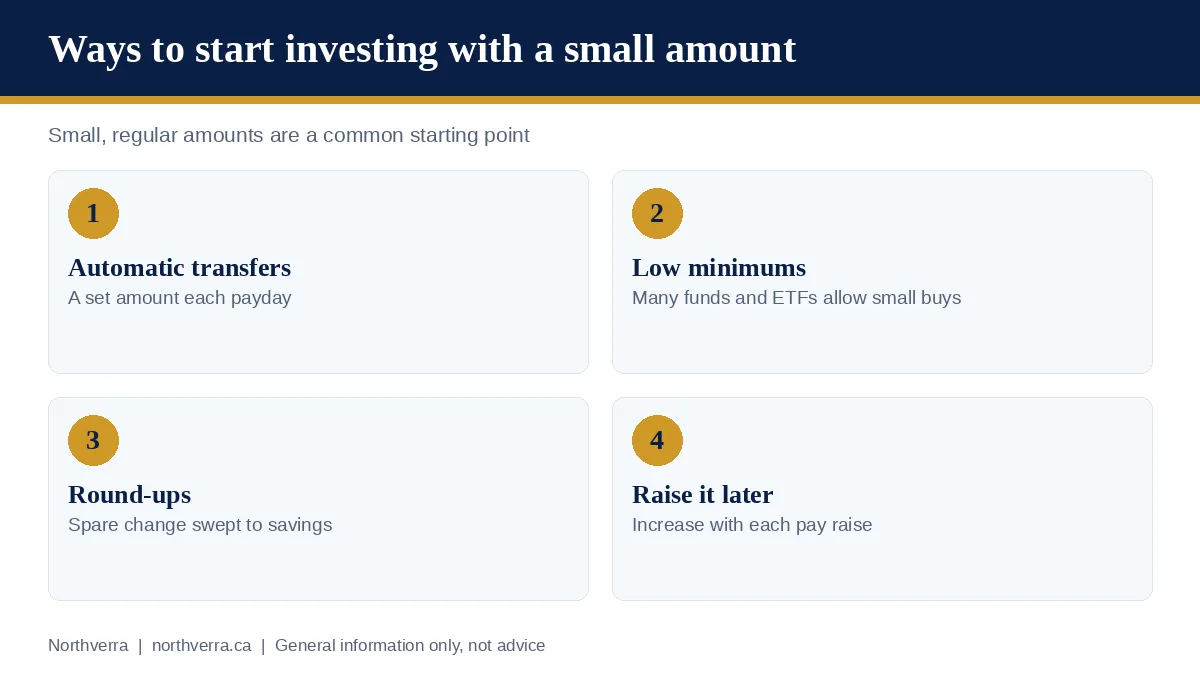
- Set an automatic contribution on payday, even if it is small.
- Raise the amount each time your income rises, for example by half of any raise.
- Review once a year.
Finding the money
Most people do not discover spare money; they create it. A quick review of subscriptions, banking fees and regular spending often frees up a small amount. Our budgeting basics for Canadian households guide can help, and the pay yourself first habit makes it automatic.
When to hold off
Investing with little money is a good habit, but not always the first priority. If you carry credit card debt or have no emergency savings at all, putting money there first is often wiser. See paying off debt vs investing.
Common mistakes with small accounts
- Buying many different investments in tiny amounts, which adds cost and complexity.
- Choosing speculative investments to “grow it faster”, which can also lose it faster.
- Stopping contributions after a market drop.
- Ignoring account and trading fees.
- Withdrawing from a TFSA and re-contributing in the same year without checking room, which can lead to over-contribution.
What to ask before opening an account
- What is the minimum to open and to contribute?
- Are there account fees, trading fees or inactivity fees?
- What does the fund or portfolio cost each year?
- Can I set up automatic contributions?
- Is the firm a member of the Canadian Investor Protection Fund (CIPF) or otherwise protected?
How small amounts can add up over time
It is easy to underestimate small, steady contributions. Someone who invests a modest amount every payday for many years builds both a balance and a habit, and each increase in the contribution makes a noticeable difference over time. Growth, if any, depends on the investments chosen and market conditions, and returns are never guaranteed. What you can control is how regularly you contribute, how much you pay in fees and whether you stay invested through ups and downs instead of reacting to them.
A realistic path from small to steady
- Year one: start with an amount you will not miss and automate it.
- Year two: raise it when your pay rises or a debt is paid off.
- Year three and beyond: add new goals, such as a home or retirement, as your income allows.
Treat each step as progress. A small, sustained plan usually beats a large plan that stops after a few months.
Next step
Want help choosing a simple, low-cost way to start? Tell us what you can set aside and what you are saving for.
More questions people ask
Is $25 a month worth investing?
It can be, especially as a way to build the habit, provided fees do not eat a large share of it. The amount can grow as your income does.
Should I buy individual stocks with a small amount?
Putting a small amount into one or two companies concentrates risk. A diversified fund spreads it across many holdings in a single purchase.
Can I start with a TFSA if I have little money?
Yes. A TFSA has no minimum contribution set by the government, although the financial institution or the investment may have its own minimums.
Are fractional shares a good idea?
They let you buy part of a share or ETF unit, which can help small accounts stay diversified. Check the platform’s rules and costs.
Related guides
Have a question? Start a conversation
Tell us a little about your situation. We will reply within one business day.
By submitting this form you agree that Northverra may contact you about your enquiry. Please do not include account numbers, health details or other sensitive information. See our Privacy Policy.
Important information. Investing involves risk, including the possible loss of the amount invested. The value of investments can go down as well as up, and past performance does not guarantee future results. Nothing on this page is a recommendation or a promise of any return. Diversification and asset allocation do not ensure a profit or protect against loss. See our Disclosures.