
INVESTMENT QUESTIONS
What is a non-registered account, and when should I use one?
Short answer: A non-registered account is an investment account with no special tax status, sometimes called a taxable or cash account. There are no contribution limits or withdrawal restrictions, but interest, dividends and capital gains earned in it are generally taxable each year. Many Canadians use one after they have used their TFSA, RRSP and other registered room, or for goals that do not fit those accounts.
In this guide: How it works · How each type of income is generally taxed · Tax slips you may receive · When a non-registered account makes sense · Asset location: which investments go where · Record keeping · Joint accounts and attribution · Common mistakes · Withdrawing from a non-registered account · FAQ

Registered accounts such as TFSAs and RRSPs get most of the attention, but a non-registered account is often an important part of a plan, especially for people with higher incomes, larger savings or business proceeds to invest. This guide explains how one works, how its income is taxed and when it makes sense to use one. It is general information, not tax advice, so speak with a tax professional about your situation.
How it works
You open a non-registered account at a bank, brokerage or investment firm, deposit money and buy investments such as GICs, bonds, stocks, mutual funds or ETFs. You can add or withdraw money whenever you like, without contribution room, deadlines or penalties. The trade-off is that income and gains are generally taxed in the year they are earned or realized, rather than being sheltered.
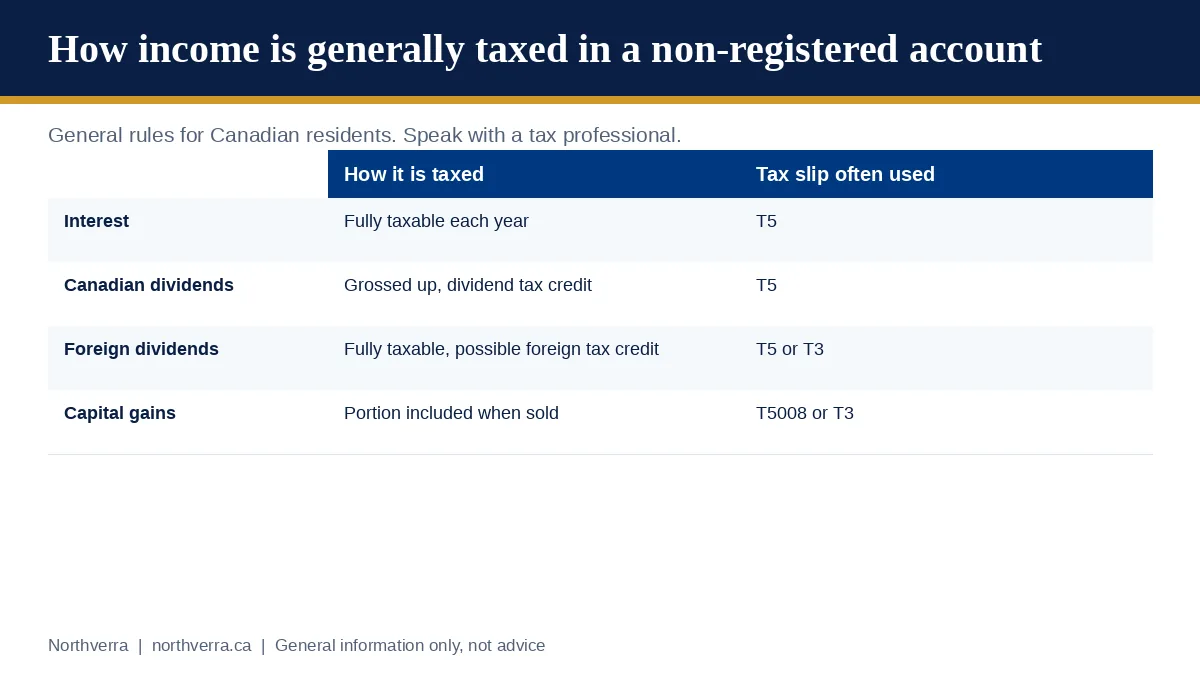
How each type of income is generally taxed
Interest
Interest from savings, GICs and bonds is fully taxable at your marginal rate, generally each year as it accrues, even on compounding GICs that pay out only at maturity.
Canadian dividends
Eligible dividends from Canadian corporations are grossed up and then reduced by the dividend tax credit, which often makes them more tax-efficient than interest. See dividend investing in Canada.
Foreign income
Dividends from foreign companies are generally fully taxable, and foreign tax may be withheld. A foreign tax credit may offset some of it.
Capital gains
When you sell an investment for more than its adjusted cost base, only a portion of the gain is included in your income. Losses can offset gains under the rules. See capital gains in Canada.
Return of capital
Some funds pay distributions that are partly a return of your own money. These are not taxed when received but lower your adjusted cost base, which increases the gain when you sell.
Tax slips you may receive
Your institution will usually send slips such as a T5 for interest and dividends, a T3 for income from trusts including many mutual funds and ETFs, and a T5008 for sales of securities. Keep them, and keep your own records too, because the T5008 may not show your correct adjusted cost base.
When a non-registered account makes sense
- You have used your available TFSA room and, where it suits you, your RRSP room.
- You need flexibility to withdraw without affecting contribution room.
- You are investing a large sum, such as an inheritance or business sale proceeds.
- You want to hold investments jointly with a spouse, within the rules on attribution.
- You are building savings for a goal that does not fit a registered account.
Before you open one, read RRSP vs TFSA basics to make sure you are using the sheltered options first, if they fit.
Asset location: which investments go where
Because different income is taxed differently, some people consider where to hold each type of investment. For example, interest-paying investments are often placed in registered accounts, while Canadian dividend payers or growth investments may be held in a non-registered account. This is called asset location. It can be helpful but should never override the right overall mix for your goals.
Example (hypothetical): Aisha has filled her TFSA and contributes to an RRSP through work. She opens a non-registered account for extra savings and holds a broad Canadian equity ETF there, while keeping her bond fund inside her RRSP. Each year she receives a T3 slip for the ETF distributions. This illustration is not a recommendation.
Record keeping
- Keep purchase confirmations showing date, price, number of units and commissions.
- Track reinvested distributions, which add to your adjusted cost base.
- Record return of capital, which reduces it.
- Keep annual tax slips and statements.
- If you hold the same security in several accounts, track the cost base across all non-registered holdings of that security.
Joint accounts and attribution
Opening an account jointly with a spouse can be convenient, but Canada has attribution rules that may tax income and gains in the hands of the person who contributed the money. Gifts to minor children can raise similar questions. A tax professional can explain how the rules apply to you.
Common mistakes
- Using a non-registered account while TFSA room sits unused.
- Losing track of the adjusted cost base.
- Holding high-interest investments here when they could be sheltered.
- Forgetting that mutual fund and ETF distributions are taxable even if reinvested.
- Assuming a joint account splits income evenly for tax.
Withdrawing from a non-registered account
One advantage of a non-registered account is that withdrawals themselves are not taxed. When you take money out, you are generally just selling investments or moving cash. Tax arises from the income earned and from any capital gain on the investments you sell to raise the cash. This can make a non-registered account a useful source of flexible money in retirement, alongside RRIF withdrawals and TFSA funds. Planning which account to draw from each year can help manage your taxable income, which a tax professional or planner can help with.
Next step
Investing beyond your TFSA and RRSP? We can help you think through account choices and the tax basics with your accountant.
More questions people ask
Is a non-registered account the same as a margin account?
A margin account is a type of non-registered account that lets you borrow to invest. A cash account does not. Borrowing to invest increases both potential gains and losses.
Do I pay tax if I do not sell anything?
You may. Interest, dividends and fund distributions are generally taxable in the year received, even if reinvested.
Can I transfer investments from a non-registered account to a TFSA?
Yes, as a contribution in kind, within your room. Transferring an investment with a gain is treated as a sale for tax, while a loss on such a transfer generally cannot be claimed.
Is there a limit on how much I can put in?
No. There are no contribution limits for non-registered accounts.
Related guides
Have a question? Start a conversation
Tell us a little about your situation. We will reply within one business day.
By submitting this form you agree that Northverra may contact you about your enquiry. Please do not include account numbers, health details or other sensitive information. See our Privacy Policy.
Important information. Investing involves risk, including the possible loss of the amount invested. The value of investments can go down as well as up, and past performance does not guarantee future results. Nothing on this page is a recommendation or a promise of any return. Diversification and asset allocation do not ensure a profit or protect against loss. See our Disclosures.