
INVESTMENT QUESTIONS
How does capital gains tax in Canada work?
Short answer: In Canada, a capital gain is the profit when you sell or are considered to have sold property, such as shares, funds or a cottage, for more than its adjusted cost base plus selling costs. Only part of the gain is included in your taxable income; the CRA currently administers a one-half inclusion rate. Losses can offset gains, and gains inside a TFSA or RRSP are treated differently.
In this guide: What counts as a capital gain · How a gain is calculated · The inclusion rate · Capital losses · Exemptions and special cases · Registered accounts change the picture · Records to keep · Questions to ask your accountant · Common mistakes · Timing a sale · FAQ

Capital gains tax in Canada is not a separate tax. Instead, part of your gain is added to your income and taxed at your regular rates. Understanding the basics helps you keep the right records, avoid surprises and have better conversations with your accountant. This article is general information, not tax advice, and tax rules can change, so confirm the current rules with the CRA or a tax professional.
What counts as a capital gain
A capital gain can arise when you dispose of capital property for more than it cost you. Common examples include:
- Shares, ETFs and mutual fund units held in a non-registered account.
- Capital gains distributions paid by mutual funds and ETFs.
- A rental property or a cottage that is not your designated principal residence. See real estate vs stocks for other trade-offs of owning property.
- Certain transfers or gifts, which can be treated as a sale at fair market value.
At death, a person is generally considered to have sold their capital property at fair market value, unless it passes to a spouse or common-law partner, which can defer the tax. Our estate planning with life insurance guide explains how some families plan for this.
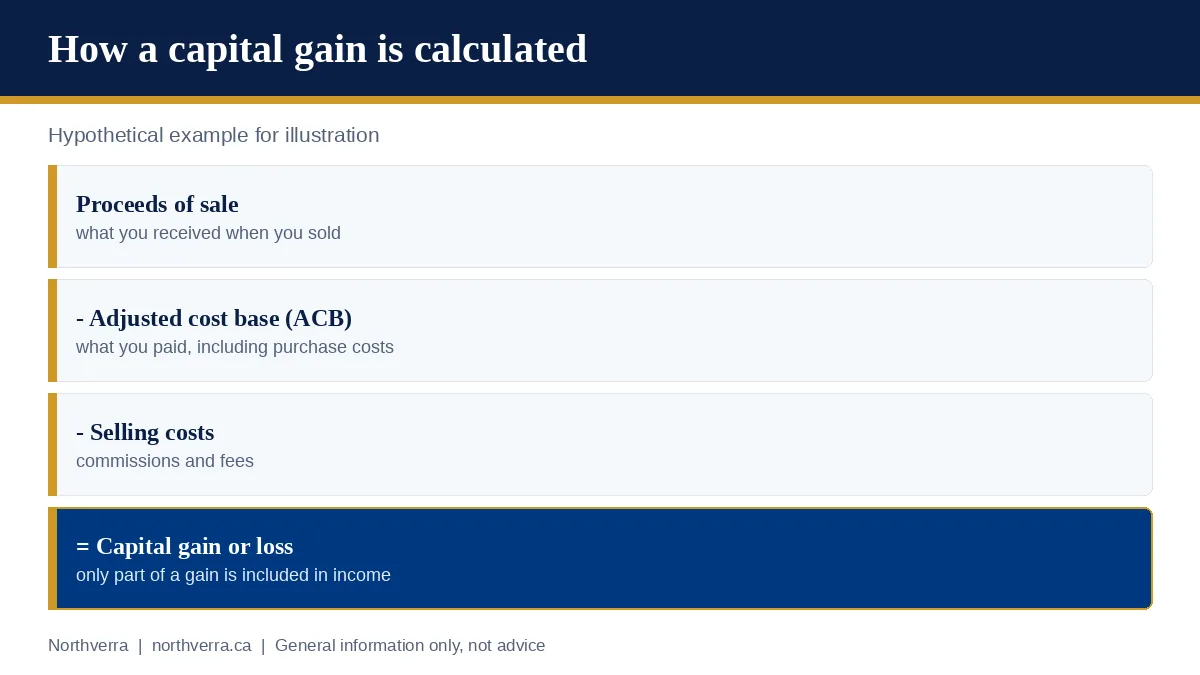
How a gain is calculated
- Start with the proceeds of disposition, the amount you received.
- Subtract the adjusted cost base (ACB), generally what you paid plus purchase costs, adjusted for things like reinvested distributions and return of capital.
- Subtract outlays and expenses of selling, such as commissions.
- The result is your capital gain or capital loss.
- Multiply a gain by the inclusion rate to find the taxable capital gain added to your income.
Example (hypothetical): Suppose you bought 100 units of an ETF for $5,000, including commission, and sold them years later for $8,000, paying a $10 commission. Your capital gain would be $2,990. At a one-half inclusion rate, $1,495 would be added to your taxable income for the year. This is a simplified illustration; actual tax depends on your income and province.
The inclusion rate
For individuals, the CRA currently administers a capital gains inclusion rate of one-half. A proposal to raise the rate on some gains was announced in 2024 and later cancelled. Because tax policy can change, check the current rate in the year you sell.
Capital losses
If you sell for less than your adjusted cost base, you have a capital loss. Allowable capital losses can generally be used to reduce taxable capital gains in the same year, carried back up to three years or carried forward indefinitely. They cannot usually be used against other income such as employment income, except in limited cases such as the year of death.
The superficial loss rule
If you sell an investment at a loss and you, or an affiliated person such as your spouse, buy the same or an identical property within 30 days before or after the sale and still hold it 30 days after the sale, the loss can be denied. The denied loss is generally added to the cost base of the new purchase. This rule surprises many investors, so plan carefully.
Exemptions and special cases
- Principal residence: a gain on a home you designate as your principal residence may be fully or partly exempt, if conditions are met. You must still report the sale.
- Lifetime capital gains exemption: may be available on qualifying small business shares and qualified farm or fishing property, subject to conditions.
- Donations: donating certain publicly listed securities to a registered charity can eliminate the capital gain on them.
Registered accounts change the picture
- TFSA: gains are generally not taxed, and losses cannot be claimed. See RRSP vs TFSA basics.
- RRSP and RRIF: gains are not taxed inside the plan, but withdrawals are taxed as regular income, so the capital gains treatment does not apply.
- FHSA: growth is sheltered, and qualifying withdrawals are tax-free.
See non-registered investment accounts for how taxable accounts work.
Records to keep
- Purchase and sale confirmations.
- Reinvested distributions, which add to the ACB.
- Return of capital amounts, which reduce it.
- Tax slips such as T3, T5 and T5008.
- For property, receipts for improvements that may add to its cost.
Questions to ask your accountant
- What is my adjusted cost base for this holding?
- Could selling now or next year change the tax?
- Do I have past capital losses available to use?
- Would a donation of securities make sense for my giving?
- How would capital gains at death affect my estate?
Common mistakes
- Using the T5008 amount as the cost base without checking it.
- Forgetting reinvested distributions, which can lead to paying tax twice.
- Triggering the superficial loss rule by rebuying too soon.
- Assuming a cottage is tax-free like a home.
- Letting tax alone drive an investment decision.
Timing a sale
Because capital gains are taxed in the year you sell, the timing of a sale can affect how much tax you pay. Selling in a year when your other income is lower, such as early retirement, may mean the taxable portion is taxed at a lower rate. Spreading large sales over several years can have a similar effect. Tax should not be the only reason to sell or hold, but it is worth reviewing before a large sale.
Next step
Selling investments or property this year? We can help you organise the information to review with your tax professional.
More questions people ask
Do I pay capital gains tax on my home in Canada?
If the home qualifies and is designated as your principal residence for all years owned, the gain is generally exempt. You must report the sale on your return.
Is a capital gain taxed at 50%?
No. Under the current one-half inclusion rate, half of the gain is added to your income and taxed at your marginal rate, so the effective rate is lower.
Are mutual fund capital gains distributions taxable?
Yes, in a non-registered account, even if reinvested. They are reported on a T3 slip.
Can I avoid capital gains tax by holding investments in a TFSA?
Gains inside a TFSA are generally not taxed, within the rules and your contribution room.
Related guides
Have a question? Start a conversation
Tell us a little about your situation. We will reply within one business day.
By submitting this form you agree that Northverra may contact you about your enquiry. Please do not include account numbers, health details or other sensitive information. See our Privacy Policy.
Important information. Investing involves risk, including the possible loss of the amount invested. The value of investments can go down as well as up, and past performance does not guarantee future results. Nothing on this page is a recommendation or a promise of any return. Diversification and asset allocation do not ensure a profit or protect against loss. See our Disclosures.