
INVESTMENT QUESTIONS
Real estate vs stocks: which is the better investment?
Short answer: Neither is better for everyone. Real estate can offer rental income, a tangible asset and growth through a mortgage, but it needs a large down payment, is slow to sell and takes time to manage. Stocks, usually through diversified funds, can be bought in small amounts, sold quickly and spread across thousands of companies, but their value can swing sharply. Many Canadians own both, often through their home and their registered accounts.
In this guide: What you are really buying · Comparing the key factors · Taxes in brief · Real estate investment trusts (REITs) · Your home is a special case · Questions to ask before choosing · Common mistakes · Doing both in a balanced way · FAQ

The real estate vs stocks debate in Canada often turns personal, because many families have stories of a home that rose in value or a market crash that hurt. A fair comparison looks beyond headline price changes to the costs, risks, effort and taxes involved. This guide sets out the trade-offs so you can decide what role each plays in your plan.
What you are really buying
With an investment property you own a single, physical asset in one location, financed in most cases with a mortgage. Your return comes from rent, minus expenses, plus any change in the property’s value. With stocks you own small pieces of many businesses, usually through funds, and your return comes from dividends plus any change in share prices.
Comparing the key factors
Money needed to start
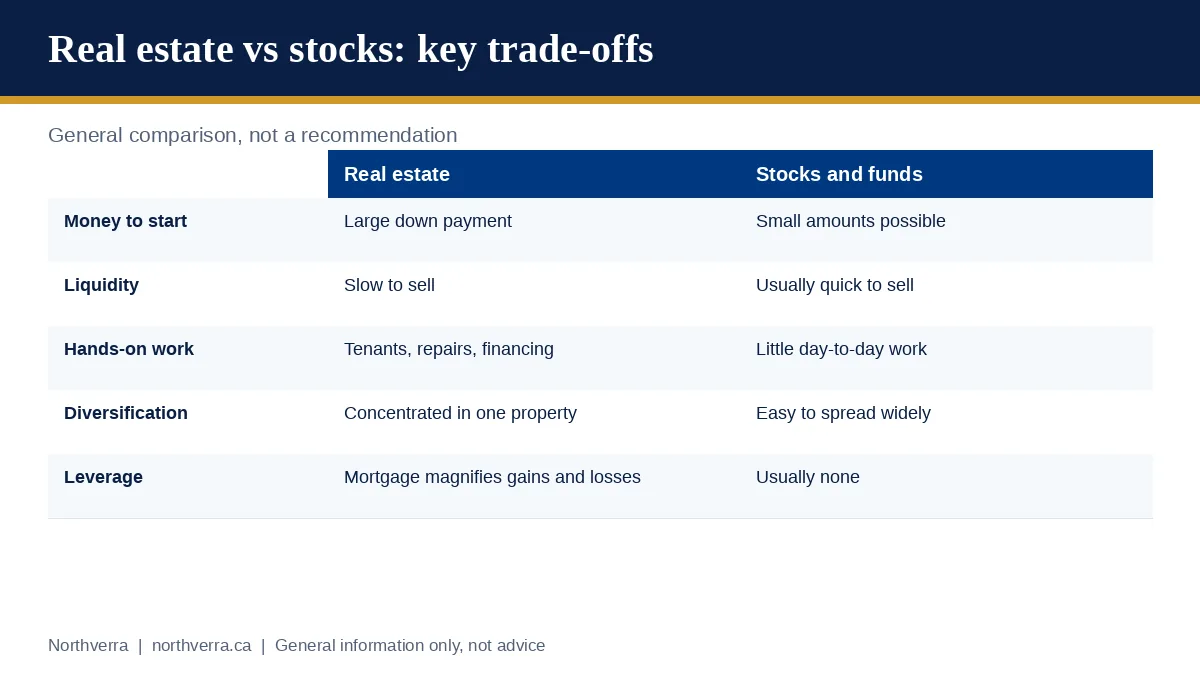
Buying a rental property usually requires a sizeable down payment, plus closing costs such as legal fees, land transfer or title fees and inspections. Rental properties can also require a larger minimum down payment than a home you live in. Stocks and funds can be bought in small amounts. See investing with little money.
Leverage
A mortgage lets you control a large asset with a smaller amount of your own money. That magnifies gains if the property rises, but it also magnifies losses, and the mortgage payments continue whether or not you have a tenant. Our guide to how mortgage interest rates work explains how rate changes can affect payments.
Liquidity
Selling a property can take weeks or months and involves commissions and legal costs. You cannot sell one room if you need some cash. Most stocks and ETFs can be sold within a trading day.
Effort
Being a landlord involves finding tenants, maintenance, repairs, insurance, bookkeeping and following Alberta’s residential tenancy rules. A property manager can help for a fee. A diversified fund needs little day-to-day attention.
Diversification
A single property concentrates your money in one building, one neighbourhood and one local economy. A broad index fund can spread money across many companies, industries and countries.
Costs you may not see at first
For property: property taxes, insurance, condo fees, maintenance, vacancies and periodic big repairs. For funds: management fees and trading costs. Both reduce your net return.
Taxes in brief
Your own home may qualify for the principal residence exemption. Rental income is taxable, but eligible expenses can be deducted, and a gain on sale is generally a capital gain. Stocks held in a TFSA, RRSP or FHSA have their own tax treatment, while gains in a non-registered account are partly taxable. See capital gains in Canada. Speak with a tax professional before buying a rental.
Example (hypothetical): Two investors each have $80,000. One uses it as the down payment and closing costs on a rental condo, with a mortgage for the rest. The other invests it in a diversified portfolio of ETFs across a TFSA and an RRSP. The landlord’s outcome depends heavily on rent, interest rates, repairs and the local market; the ETF investor’s on broad market returns. Either could do better over a given period, and both carry risk. This is an illustration only.
Real estate investment trusts (REITs)
REITs and real estate funds let you own a share of many properties, such as apartments, offices or warehouses, through the stock market. They offer liquidity and diversification within real estate, but their prices move with markets and interest rates, and they do not give you control over the properties.
Your home is a special case
Most Canadians’ largest real estate holding is the home they live in. It provides shelter first and an investment second. Because you cannot easily spend its value without selling or borrowing, it is usually considered separately from your investment mix. If you already own a home, adding a rental property increases your exposure to the same local market. Our mortgage financing page explains home financing options.
Questions to ask before choosing
- How much of my net worth is already in real estate?
- Could I cover the mortgage if the unit sat empty for several months or rates rose?
- Do I have the time and temperament to be a landlord?
- How quickly might I need access to this money?
- What are the full costs and tax implications of each option?
Common mistakes
- Comparing property price gains with stock returns without counting costs and leverage.
- Underestimating repairs, vacancies and interest rate risk.
- Concentrating most of your wealth in one local market.
- Assuming stocks are too risky while ignoring the concentration of a single property.
- Buying a rental without an emergency fund.
Doing both in a balanced way
For many households the practical answer is not real estate or stocks but how much of each. A home provides shelter and may build equity, while registered accounts invested in diversified funds offer liquidity and broad exposure. If you are considering a rental property, look at how it would change your overall balance. A property that represents most of your net worth, financed with a large mortgage, is a concentrated bet on one asset and one local economy. Some investors prefer to gain real estate exposure through REITs or real estate funds instead, which can be added in small amounts. Others are comfortable with a rental because they enjoy managing property and have a solid cash cushion. Either way, review the full picture before committing.
Next step
Considering a rental property or wondering how it compares with investing? We can look at the numbers and the risks with you.
More questions people ask
Is real estate safer than stocks?
Not necessarily. Property prices are reported less often, so they can feel more stable, but leverage, vacancies and concentration create real risks.
Can I hold real estate in an RRSP or TFSA?
You generally cannot hold a rental property directly, but you can hold REITs and real estate funds.
Is it better to pay down my mortgage or invest?
It depends on your rate, your other debts and your comfort with risk. See debt repayment vs investing.
Does owning my home count as investing?
It can build equity over time, but because you live in it, most planners treat it separately from your investment portfolio.
Related guides
Have a question? Start a conversation
Tell us a little about your situation. We will reply within one business day.
By submitting this form you agree that Northverra may contact you about your enquiry. Please do not include account numbers, health details or other sensitive information. See our Privacy Policy.
Important information. Investing involves risk, including the possible loss of the amount invested. The value of investments can go down as well as up, and past performance does not guarantee future results. Nothing on this page is a recommendation or a promise of any return. Diversification and asset allocation do not ensure a profit or protect against loss. See our Disclosures.