
MORTGAGE QUESTIONS
What is a HELOC and how does it work?
Short answer: A HELOC, or home equity line of credit, is a revolving line of credit secured by your home. You can borrow, repay and borrow again up to a set limit, and you pay interest only on what you use, usually at a variable rate tied to prime. In Canada, a HELOC can generally be up to 65% of your home’s value, and total borrowing against the home up to 80%.
In this guide: How a HELOC works · How much you can borrow · Standalone HELOCs and readvanceable mortgages · Common uses of a HELOC · The risks to understand · Using a HELOC responsibly · HELOCs and your mortgage renewal · Common mistakes to avoid · HELOC or personal line of credit? · FAQ
What is a HELOC, and is it a good idea? A home equity line of credit can be one of the most flexible ways to borrow, and one of the easiest to misuse. Because it is secured by your home, rates are usually lower than on unsecured credit. Because it is revolving and often allows interest-only payments, balances can linger for years. Understanding the rules and the risks helps you use it deliberately.
How a HELOC works
A HELOC is registered against your home, like a mortgage. The lender approves a credit limit, and you can draw on it at any time, through cheques, transfers or a card, up to that limit. As you repay, the available credit returns. Interest is charged only on the balance you use, and the rate is usually variable, expressed as prime plus a margin. For reference, the Bank of Canada reported a prime rate of 4.45% as of September 30, 2026.
Minimum payments are often interest-only. That keeps payments low, but it means the balance does not go down unless you choose to pay more. The Financial Consumer Agency of Canada has highlighted that many HELOC users carry balances for long periods.
How much you can borrow
Federally regulated lenders generally follow these limits:
- The revolving HELOC portion can be up to 65% of your home’s value.
- Your total borrowing secured by the home, including your mortgage and HELOC, can generally be up to 80% of its value.
You must also qualify, including the mortgage stress test and the lender’s debt service ratios.
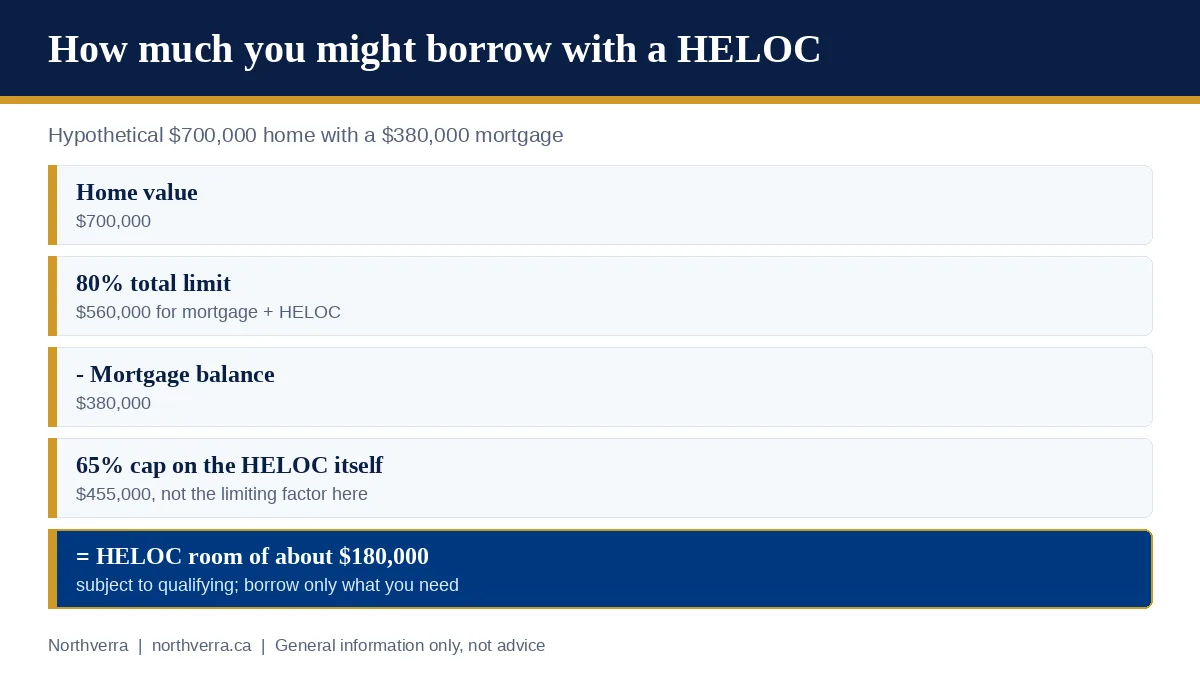
Example (hypothetical): Jenna’s home is worth $700,000 and she owes $380,000 on her mortgage. Under the 80% total limit, she could borrow up to $560,000 in total, leaving room for about $180,000 more. Because that is well below 65% of the home’s value ($455,000), a HELOC of up to about $180,000 might be possible if she qualifies. She asks for a $50,000 limit for planned renovations instead of the maximum. These are hypothetical figures.
Standalone HELOCs and readvanceable mortgages
A HELOC can be a standalone line, or part of a combined product often called a readvanceable mortgage. In a combined product, your amortizing mortgage and your HELOC sit under one registered limit. As you pay down the mortgage, the HELOC limit can grow automatically, up to the 65% cap. This can be convenient, but it also means your available credit keeps increasing unless you ask the lender to cap it.
Common uses of a HELOC
- Renovations and repairs, especially ones done in stages.
- A backup for emergencies, alongside cash savings.
- Bridging timing gaps, for example between buying and selling a home.
- Consolidating higher-interest debts, with a firm repayment plan.
- Some people borrow to invest using a HELOC. This adds risk, can magnify losses and has tax implications, so it deserves professional advice first.
For a one-time lump sum, compare a HELOC with a full refinance; see when refinancing makes sense.
The risks to understand
- Variable rates: if prime rises, your interest cost rises.
- Interest-only payments: the balance can stay high for years.
- Your home is security: if you cannot repay, the lender can take action against the property.
- The lender can change terms: HELOCs are generally payable on demand, and lenders can reduce limits, for example if your home’s value falls.
- Easy access: available credit can make it tempting to spend.
Using a HELOC responsibly
- Decide what the HELOC is for before you open it, and ask for a limit that matches.
- Set a repayment plan that includes principal, not just interest.
- Keep a cash emergency fund as well; a HELOC can be frozen or reduced. See how to build an emergency fund.
- Review the balance at least once a year, and at each mortgage renewal.
- Ask whether automatic limit increases on a readvanceable mortgage can be turned off.
HELOCs and your mortgage renewal
Because a HELOC is often registered as a collateral charge, switching your mortgage to another lender later may require new legal work. Ask how the HELOC and mortgage are registered before you sign, and review both at mortgage renewal.
Common mistakes to avoid
- Treating available credit as savings.
- Paying only interest for years without a plan.
- Borrowing to invest without understanding the risks.
- Forgetting that the rate is variable.
- Taking the maximum limit “just in case” and then using it.
HELOC or personal line of credit?
An unsecured personal line of credit works in a similar way, but it is not registered against your home. That usually means a higher rate and a lower limit, but your home is not at risk in the same way if you cannot repay. For smaller or short-term needs, an unsecured line may be enough. For larger projects, a HELOC’s lower rate can save a meaningful amount of interest, provided you have a plan to repay it. Whichever you choose, the discipline is the same: borrow for a specific purpose, pay down principal regularly and avoid treating the limit as spending money.
Next step
If you are thinking about a HELOC for a renovation or as a backup, we can help you compare it with other options and set it up with a limit and repayment plan that fit your goals.
More questions people ask
Is a HELOC the same as a second mortgage?
Not exactly. A HELOC is a revolving line of credit secured by your home. A second mortgage is usually a lump-sum loan registered behind your first mortgage, often at a higher rate.
Can I get a HELOC with less than 20% equity?
Generally not with a federally regulated lender, because total borrowing secured by the home is typically limited to 80% of its value.
Do I have to pay principal on a HELOC?
Many HELOCs require only interest payments, but paying principal is what reduces the debt. A plan to pay it down is important.
Can my HELOC limit be reduced?
Yes. Lenders generally reserve the right to change or reduce HELOC limits, so do not rely on one as your only emergency source.
Related guides
Have a question? Start a conversation
Tell us a little about your situation. We will reply within one business day.
By submitting this form you agree that Northverra may contact you about your enquiry. Please do not include account numbers, health details or other sensitive information. See our Privacy Policy.
Important information. Mortgage approval, interest rates, terms and eligibility depend on the lender, your financial profile, the property and current market conditions, and are not guaranteed. Mortgage products and rates change. Nothing on this page is a commitment to lend or a quote of any rate. See our Disclosures.