
MORTGAGE QUESTIONS
What should I do if I can’t pay my mortgage?
Short answer: If you can’t pay your mortgage, contact your lender as early as possible, ideally before you miss a payment. Lenders have options that may help, such as payment deferrals, extending the amortization, adding arrears to the balance or a temporary change to your payments. Review your budget, seek free credit counselling if debts are heavy and get legal advice if you receive a demand letter.
In this guide: Step 1: contact your lender early · Step 2: understand the options lenders may offer · Step 3: review your budget and other debts · Step 4: consider bigger changes if the problem is long-term · What happens if you fall behind in Alberta · Protect yourself for the future · Common mistakes to avoid · What to say when you call your lender · FAQ

If you are thinking “I can’t pay my mortgage”, you are not alone, and you have more options than it might feel like right now. Job loss, illness, separation, a business slowdown or a sharp rise in payments at renewal can happen to anyone. The most important thing is to act early. The sooner you talk to your lender, the more choices you are likely to have.
Step 1: contact your lender early
Lenders generally prefer to work with borrowers rather than move toward enforcement. Call before you miss a payment if you can. Be ready to explain what happened, whether it is temporary or long-term and what you can afford. Ask what relief options are available. Federally regulated lenders are expected to offer relief measures to borrowers at risk of default in exceptional circumstances, and the Financial Consumer Agency of Canada publishes information on what to expect.
Step 2: understand the options lenders may offer
- Extending the amortization to lower your regular payment.
- A payment deferral or skip-a-payment, where interest is usually added to the balance.
- Changing the payment schedule, for example to match your pay dates.
- Adding missed payments (arrears) to the balance, sometimes called capitalization.
- Waiving certain fees or adjusting a prepayment you made earlier.
- Converting a variable mortgage to a fixed rate, or the reverse, to stabilize payments.
Each option has a cost, usually more interest over time. Ask for the details in writing and make sure you understand the new payment and how long the change lasts. Our guide to mortgage amortization explains how an extension affects total interest.
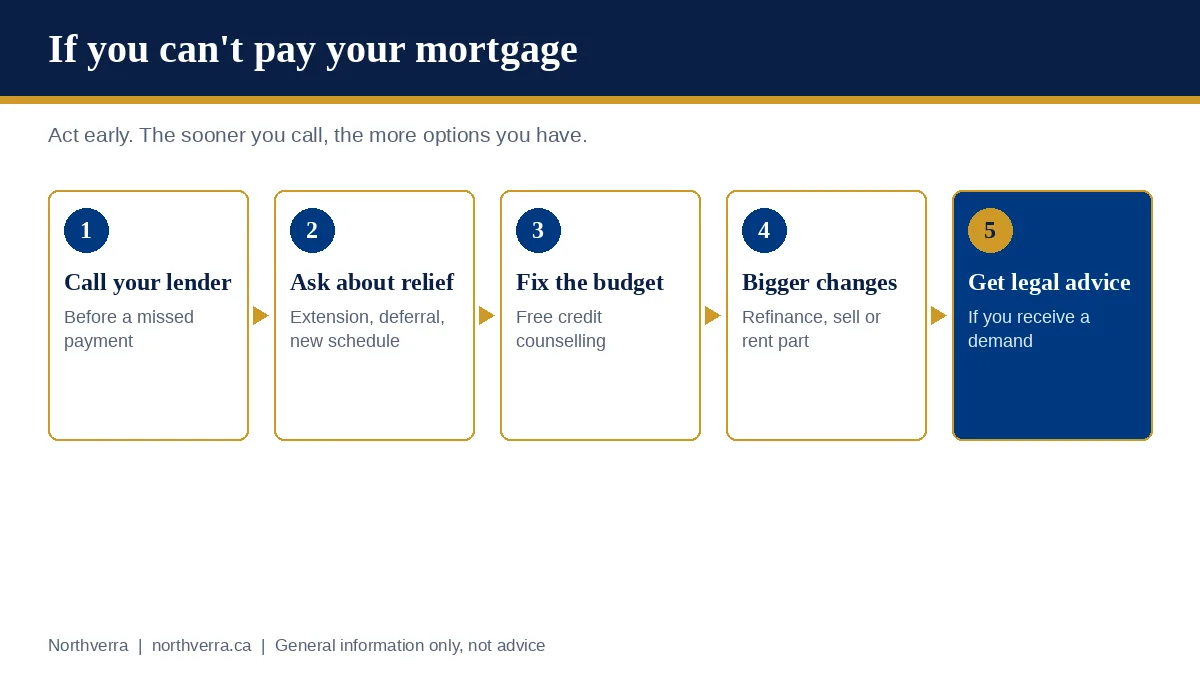
Step 3: review your budget and other debts
List your income, essential costs and all debts. Look for expenses you can pause, and consider whether any savings, such as a TFSA, could bridge a short gap. Our article on budgeting basics has a simple framework. If unsecured debts such as credit cards are part of the problem, a non-profit credit counselling agency can review your situation, often without charge. Be cautious of companies that promise to “stop foreclosure” for a fee.
Example (hypothetical): Alicia’s hours were cut, and her mortgage payment rose at renewal. Before missing a payment, she calls her lender, which offers to extend her remaining amortization from 20 to 25 years for the new term. Her payment drops enough to fit her reduced income. She also cancels two subscriptions, pauses a savings transfer and books a free credit counselling appointment to deal with a credit card balance. When her hours return, she plans to increase her payment again. This is a hypothetical example.
Step 4: consider bigger changes if the problem is long-term
If your income will not recover enough to carry the mortgage, it may be better to make a plan while you still have choices:
- Refinancing or consolidating other debts, if you have equity and qualify. See when refinancing makes sense.
- Selling the home on your own timeline, which often gives a better result than a forced sale.
- Renting out part of the home where it is legal and safe.
- Speaking with a Licensed Insolvency Trustee about a consumer proposal or other options if your total debts are unmanageable.
What happens if you fall behind in Alberta
If payments are missed, the lender will usually send reminders and then a formal demand. If the default is not resolved, the lender can start legal proceedings. In Alberta, foreclosure is a court process, and homeowners usually have an opportunity to respond, catch up on arrears or sell before the process concludes. Alberta law also has specific rules about whether a lender can pursue a borrower personally for any shortfall after a sale, and those rules depend on the type of mortgage, including whether it is insured. Because the details matter, speak with a lawyer as soon as you receive a demand letter or court documents.
Protect yourself for the future
- Build an emergency fund once you are back on track. See how to build an emergency fund.
- Review whether your insurance would cover the mortgage if you could not work or passed away.
- At each renewal, test what a higher rate would mean for your budget.
Common mistakes to avoid
- Waiting until several payments are missed before calling the lender.
- Using high-interest credit cards or payday loans to make mortgage payments.
- Ignoring letters or court documents.
- Paying for “foreclosure rescue” services without checking who they are.
- Agreeing to a relief option without understanding its long-term cost.
What to say when you call your lender
Before you call, write down a few facts: what changed, when it started, how long you expect it to last, your current income and the payment you could realistically afford. Have your mortgage number ready. Ask the lender to explain each option, the cost in added interest, the effect on your credit report and whether you need to apply in writing. Take notes, including the name of the person you spoke with and the date, and ask for any agreement to be confirmed in writing. If English is not your first language, or the conversation feels overwhelming, it is reasonable to ask a trusted person or professional to join you.
Next step
If you are worried about your mortgage payments, we can help you understand your options and prepare for the conversation with your lender. For legal questions, please speak with a lawyer.
More questions people ask
Will my lender work with me if I can’t pay?
Many lenders have relief options and prefer to find a solution. Contacting them early improves your chances.
Does a payment deferral affect my credit?
It depends on how the lender reports it and whether payments were missed. Ask the lender before you agree.
How long before foreclosure starts in Alberta?
There is no single timeline. It depends on the lender, the mortgage and the court process. Get legal advice as soon as you receive a demand.
Can I sell my home if I am behind on payments?
Usually yes, and selling before a court-ordered sale often gives you more control. Speak with your lender and a lawyer.
Related guides
Have a question? Start a conversation
Tell us a little about your situation. We will reply within one business day.
By submitting this form you agree that Northverra may contact you about your enquiry. Please do not include account numbers, health details or other sensitive information. See our Privacy Policy.
Important information. Mortgage approval, interest rates, terms and eligibility depend on the lender, your financial profile, the property and current market conditions, and are not guaranteed. Mortgage products and rates change. Nothing on this page is a commitment to lend or a quote of any rate. See our Disclosures.
Important information. The information on this page is general in nature, is provided for educational purposes only, and is not personalized financial, insurance, legal, tax or mortgage advice. Your circumstances are unique. Please speak with a properly licensed professional before making decisions. See our Disclosures.