
INVESTMENT GUIDE
How Much Money Do You Need to Retire in Canada?
Short answer: There is no single number. How much you need to retire in Canada depends on what you will spend each year, how much CPP, OAS and any pension will cover, how long retirement lasts, and inflation. Estimate your yearly spending, subtract your expected guaranteed income, and work out how much savings it takes to fill the gap.
Quick facts
- Many planners use 50% to 80% of pre-retirement income as a rough spending range, but your own budget is more reliable.
- Government benefits such as CPP and OAS usually cover only part of most people’s retirement spending.
- Retirement can last 25 to 30 years or more, so planning for a long life is prudent.
- Inflation means you will need more dollars each year to buy the same things.
- Rules of thumb like the 4% guideline are starting points, not promises.
In this guide: Step 1: Estimate your retirement spending · Step 2: Add up your guaranteed income · Step 3: Find the gap · Step 4: Turn the gap into a savings target · What can change your number · How to close a gap · Revisit your number regularly · FAQ

“How much do I need to retire?” is one of the most common money questions Canadians ask, and headline answers vary widely. The honest answer is that it depends on you. This guide gives you a practical way to estimate your own number, explains the rules of thumb you will hear, and shows how government benefits and pensions fit in.
Step 1: Estimate your retirement spending
Start with what you spend now, then adjust for retirement. Some costs often fall, such as commuting, work clothes, saving for retirement and possibly your mortgage. Others may rise, such as travel, hobbies and health care. If you have no budget, a common rough range is 50% to 80% of your pre-retirement income, but your own numbers are more reliable. Our guide to budgeting basics can help.
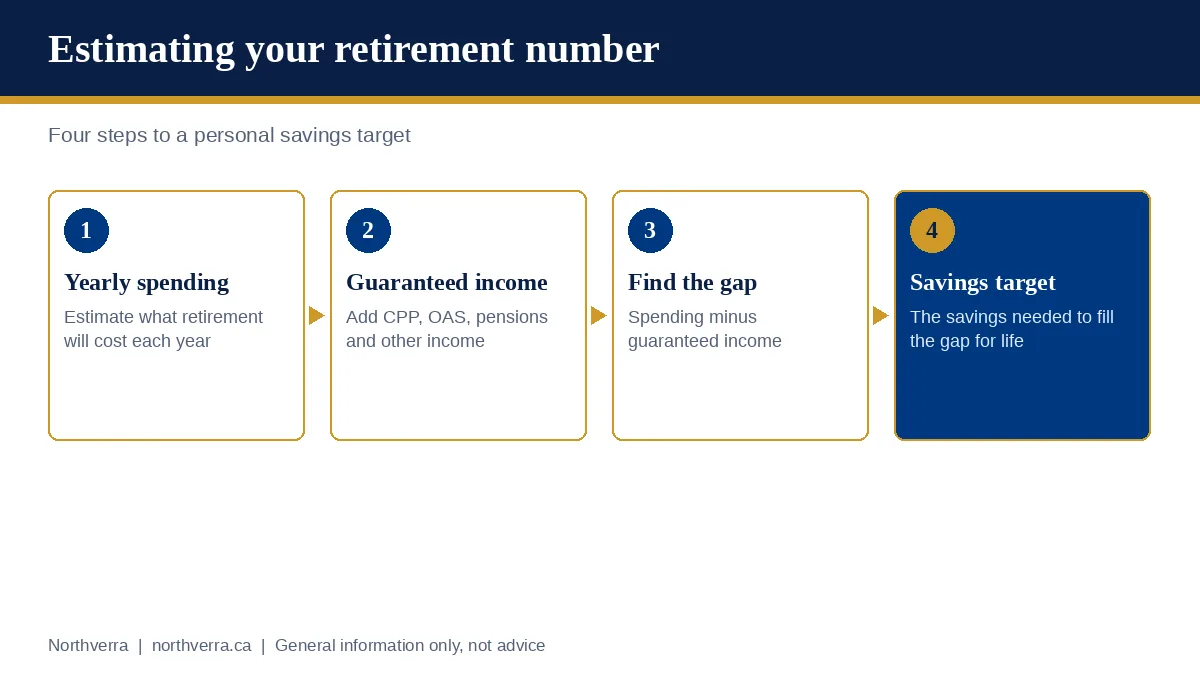
Step 2: Add up your guaranteed income
Next, estimate the income you will receive regardless of markets:
- CPP: check your estimate in your My Service Canada Account.
- OAS: based mainly on years lived in Canada after age 18.
- Workplace pension: your pension statement shows estimated payments.
- Other income: rental income, part-time work or an annuity.
Our guide to retirement income sources explains each one.
Step 3: Find the gap
Subtract your guaranteed income from your expected spending. What remains is the yearly amount your own savings must provide, before tax.
Step 4: Turn the gap into a savings target
There are a few common ways to estimate how much savings it takes to fund that gap:
| Method | How it works | Keep in mind |
|---|---|---|
| Withdrawal rate | Divide the yearly gap by a withdrawal rate, such as 4% | Based on historical data; not a guarantee |
| Multiple of spending | Multiply the yearly gap by about 25 | Equivalent to a 4% withdrawal rate |
| Detailed projection | Model returns, inflation, taxes and lifespan year by year | More accurate; usually done with an advisor or planning software |
Example (hypothetical): Suppose a couple expects to spend $70,000 a year in retirement and estimates that CPP, OAS and a small pension will provide $40,000 a year. Their gap is $30,000. Using a 4% withdrawal rate as a starting point, they would aim for about $750,000 in savings. These figures are hypothetical and before tax; their own plan would adjust for taxes, inflation and timing.
What can change your number
- When you retire: retiring earlier means fewer years of saving and more years of withdrawals.
- How long you live: planning to age 90 or beyond is common.
- Inflation: prices tend to rise over time. See how inflation affects your savings.
- Investment returns: a more conservative portfolio may require a larger target.
- Taxes: registered withdrawals are taxable; TFSA withdrawals are not.
- Health and care costs: later in life, these can rise.
- Debt: entering retirement debt-free lowers the amount you need.
How to close a gap
If your estimate shows a shortfall, you have levers to pull:
- Save more each month, starting now. See how much to invest each month.
- Retire a little later, or work part time in early retirement.
- Delay CPP or OAS for a larger payment.
- Pay off high-interest debt before you retire.
- Adjust your spending goals.
Revisit your number regularly
Your retirement target is an estimate based on assumptions that will change. Review it every year or two, and whenever your income, family or health changes significantly. Our guide on retirement planning in Alberta covers the timing decisions that affect your plan.
Key takeaways
- Start with your expected spending, not a headline number.
- Subtract the income you expect from CPP, OAS and pensions to find your gap.
- Your savings target is the amount that can sustainably fill that gap for life.
- Retiring later, working part time or spending less can reduce the target.
- Revisit your estimate every year or two; it will change.
Who this guide is for
- Canadians who want a personal retirement savings target.
- People in their 40s and 50s checking whether they are on track.
- Couples with different ages, pensions or retirement dates.
- Anyone who has heard a headline number and wondered whether it applies to them.
Questions to ask a financial advisor
- What is a realistic yearly spending target for my retirement?
- What can I expect from CPP, OAS and my pension?
- How much can I safely withdraw from my savings each year?
- How would retiring two years later change the plan?
- How do taxes affect what I actually have to spend?
Frequently asked questions
Is one million dollars enough to retire in Canada?
It might be more than enough for some people and not enough for others. A household with modest spending, a paid-off home and a workplace pension needs far less than a household with high spending and no pension. Working through your own spending and income is more useful than comparing yourself with a headline number.
What is the 4% rule?
It is a rule of thumb suggesting that withdrawing about 4% of your savings in the first year of retirement, then adjusting for inflation, may help savings last around 30 years. It comes from historical research, is not a guarantee, and may need adjusting for your situation and market conditions.
How much will CPP and OAS pay me?
It depends on your contribution history, the age you start and, for OAS, how long you have lived in Canada and your income. You can see your estimated CPP in your My Service Canada Account. Check the Government of Canada website for current OAS amounts.
Do I need less money if my house is paid off?
Usually yes, because housing is one of the largest costs. You still need to budget for property taxes, insurance, utilities and maintenance. Some people also consider their home as a backup source of money later in life.
How does inflation affect how much I need to retire?
Inflation raises the cost of living each year. Over a 25-year retirement, even moderate inflation can significantly increase the amount you need. See how inflation affects your savings.
What if I am behind on retirement savings?
Options include increasing your savings rate, working a few years longer, delaying CPP to get a larger payment, reducing debt, planning part-time work in early retirement and adjusting your spending goals. Small changes made early can add up.
Should I count my home in my retirement savings?
Most plans do not count your home as income-producing savings, because you need somewhere to live. It can still be part of your overall net worth and a safety net. See tracking your net worth.
How do taxes affect my retirement number?
RRSP and RRIF withdrawals, pensions, CPP and OAS are taxable, while TFSA withdrawals are not. Your target should be based on after-tax spending, so it helps to know roughly how your income will be taxed.
Last updated: October 11, 2026
Related guides
- Retirement income in Canada: where does it come from?
- Retirement Planning in Alberta
- Planning for retirement in your 40s and 50s
- How inflation affects your savings
- How much should I invest each month?
- All investment questions, answered
Talk it through with us
Every situation is different. If you would like to talk about how this applies to you, we are happy to walk through your questions with no obligation.
Have a question? Start a conversation
Tell us a little about your situation. We will reply within one business day.
By submitting this form you agree that Northverra may contact you about your enquiry. Please do not include account numbers, health details or other sensitive information. See our Privacy Policy.
Important information. Investing involves risk, including the possible loss of the amount invested. The value of investments can go down as well as up, and past performance does not guarantee future results. Nothing on this page is a recommendation or a promise of any return. Diversification and asset allocation do not ensure a profit or protect against loss. See our Disclosures.
Important information. The information on this page is general in nature, is provided for educational purposes only, and is not personalized financial, insurance, legal, tax or mortgage advice. Your circumstances are unique. Please speak with a properly licensed professional before making decisions. See our Disclosures.