
LIFE INSURANCE QUESTIONS
Can I get life insurance with health problems?
Short answer: Often yes. Having a health condition does not automatically mean you cannot get coverage. Insurers assess each application individually, and the outcome depends on the condition, how well it is managed and the type of policy. Price and terms may differ, and some people may need alternative products.
In this guide: How underwriting works · How conditions affect the outcome · Options if you are declined or rated · Tips for applying · Why honesty matters · What underwriters look at · Examples of conditions and how insurers may approach them · What a paramedical exam involves · If you are declined · How to prepare your application · FAQ
How underwriting works
Underwriting is how an insurer decides whether to offer coverage and at what price. You answer health and lifestyle questions, and the insurer may request medical records, a paramedical exam or lab tests. Based on this, you may be offered standard rates, a higher rate (called a rating), a restricted offer, or be declined.
How conditions affect the outcome
Conditions that are well managed, stable and diagnosed some time ago are often viewed more favourably than new or unstable ones. Examples that insurers commonly assess include high blood pressure, diabetes, heart conditions, cancer history, mental health conditions and sleep apnea. Each insurer weighs them differently, so one may offer better terms than another.
Options if you are declined or rated
- Another insurer: underwriting rules vary, and a broker can compare several
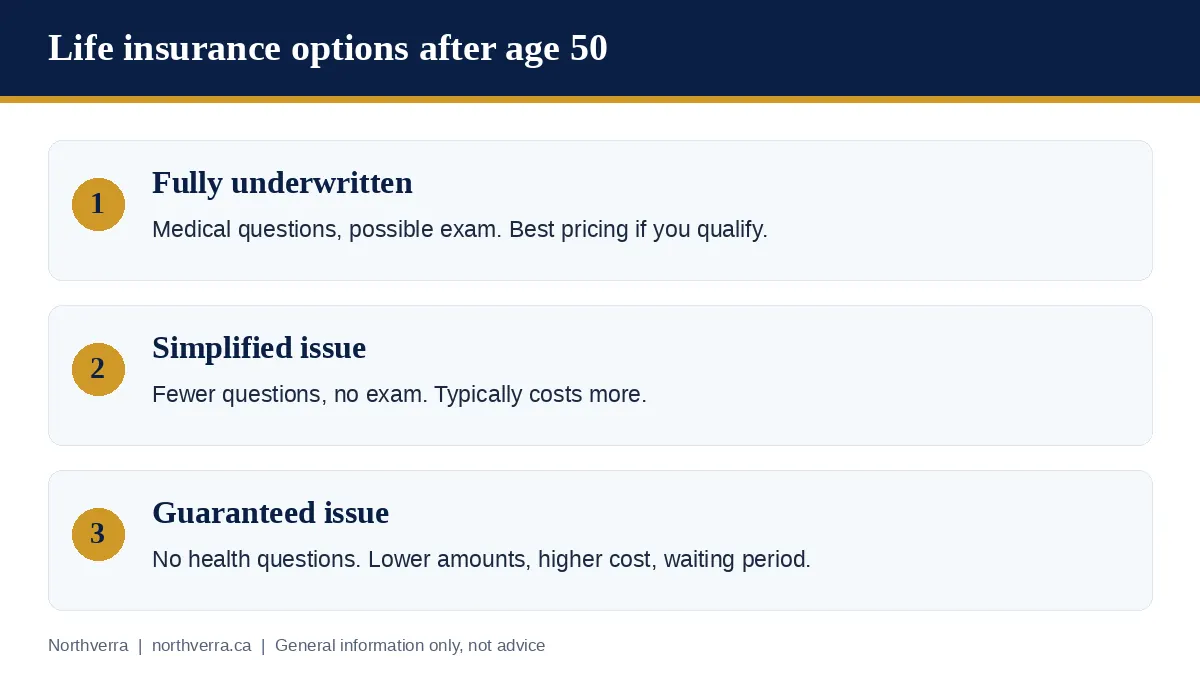
- Simplified issue: fewer questions and no exam, usually at higher cost and with lower limits
- Guaranteed issue: no health questions, typically with small coverage amounts, higher premiums and a waiting period before the full benefit is paid
- Group coverage: through an employer or association, sometimes with limited or no underwriting
Tips for applying
- Gather your medication names, diagnoses and dates
- Ask a broker which insurers tend to be more flexible for your condition
- Apply to one insurer at a time on advice, rather than submitting several declined applications
- Consider applying when your condition is stable
Why honesty matters
Always answer questions fully and accurately. If an insurer finds a material misrepresentation, it may reduce or deny a claim. Honest answers protect the people you are insuring.
If you are older, see our guide on life insurance after age 50.
Next step
Tell us about your situation and we can explain the options without judgment.
What underwriters look at
Underwriters weigh how serious a condition is, how long ago it was diagnosed, how well it is controlled and whether it has caused complications. They also look at your medications, test results, family history and lifestyle.
- Stability: a condition that has been stable for years is viewed more favourably than a new diagnosis
- Control: good test results and consistent treatment help
- Complications: related problems, such as organ effects, can raise the rating
- Age at diagnosis: a condition found early may be viewed differently from one found late
Examples of conditions and how insurers may approach them
These are general descriptions, not promises about any outcome.
- High blood pressure: well-controlled blood pressure is often insurable at standard or near-standard rates
- Type 2 diabetes: insurers consider the age at diagnosis, blood sugar control and complications
- Cancer history: many insurers want a waiting period after treatment before offering coverage, which varies by cancer type and stage
- Mental health conditions: a stable, treated condition is often insurable, and insurers look at history and work impact
- Heart conditions: assessed case by case, with the type of event and recovery being key
- Sleep apnea: treatment compliance matters
What a paramedical exam involves
Many applications include a short exam by a nurse. It may include height and weight, blood pressure, a blood sample and a urine sample, and takes under an hour. The results help the insurer confirm what you reported. Some policies skip the exam, usually in exchange for lower coverage limits or higher premiums.
If you are declined
A decline from one insurer does not mean every insurer will decline you. A broker can match your history to insurers that are more flexible with it. In some cases you may be offered a rated policy, a smaller amount, a different type or a postponement until a later date when your health has been stable for longer. For those who cannot qualify, simplified issue and guaranteed issue plans exist, as shown in our guide on coverage after age 50.
How to prepare your application
A well-prepared application can make underwriting faster and smoother.
- Write down every medication, the dose and why you take it.
- List your doctors and specialists, with the dates of recent visits and tests.
- Note the dates of any diagnosis, surgery or hospital stay.
- Gather recent results for blood pressure, cholesterol or blood sugar if you have them.
- Be ready to explain how well a condition is controlled today, since stability often matters.
Answer every question fully and honestly. An advisor who works with several insurers can often suggest which ones tend to look more favourably on your condition, before you apply.
More questions
Will asking for a quote affect my future applications?
A quote request without an application typically does not. A full application is recorded, and in some systems insurers can see that you applied elsewhere, so ask your advisor how to proceed.
Should I mention a symptom I haven’t seen a doctor about yet?
Answer questions honestly. If you have a symptom that is under investigation, an advisor can explain how it may affect timing.
What is the contestability period?
In many policies, there is a period, often two years, in which the insurer can look more closely at the application if a claim is made. Misstatements can lead to reduced or denied claims, so accuracy matters.
Can my price go down later if my health improves?
Sometimes. You may be able to ask for reconsideration, or apply for a new policy and replace the old one if you are healthier. Do not cancel your old policy until the new one is in force.
Do I have to tell the insurer about family history?
Applications usually ask about close family history of certain conditions. Answer fully and accurately.
Related guides
Have a question? Start a conversation
Tell us a little about your situation. We will reply within one business day.
By submitting this form you agree that Northverra may contact you about your enquiry. Please do not include account numbers, health details or other sensitive information. See our Privacy Policy.
Important information. Life insurance products are subject to underwriting, eligibility, exclusions, limitations and the terms of the policy contract. Coverage, premiums and availability depend on your age, health, lifestyle and other factors. Nothing on this page is an offer of insurance or a guarantee of coverage or price. See our Disclosures.