
INVESTMENT QUESTIONS
How does an RESP work?
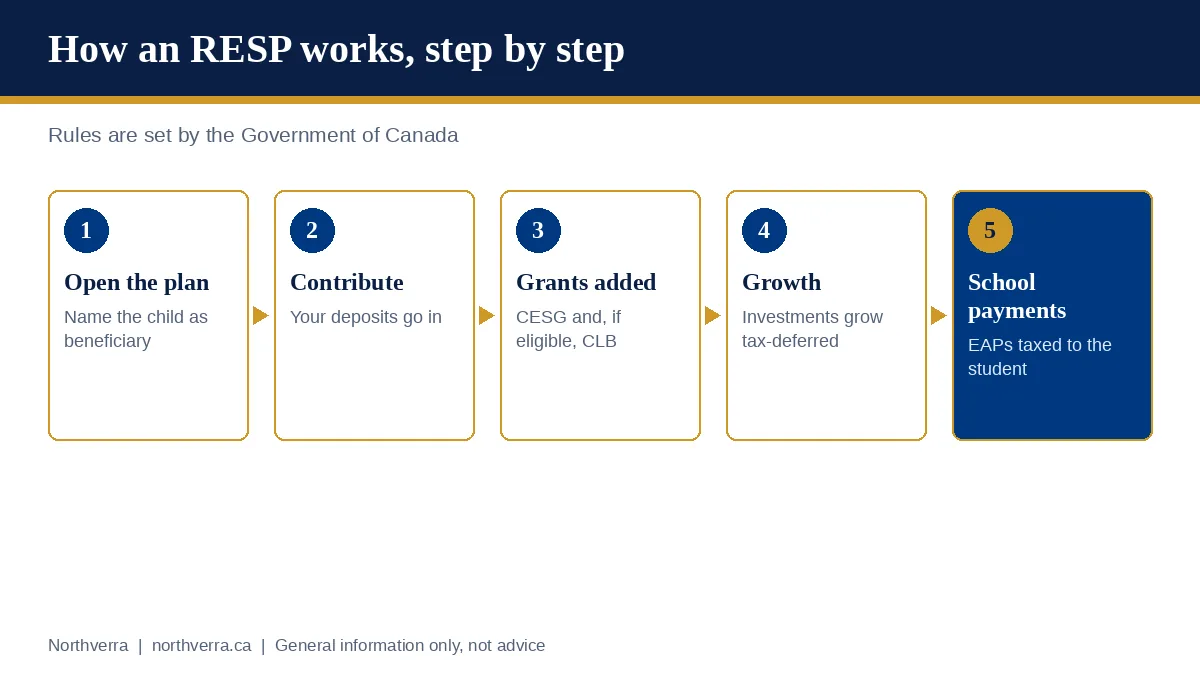
Short answer: An RESP (Registered Education Savings Plan) lets you save for a child’s education after high school. You contribute, the federal government may add grants such as the Canada Education Savings Grant (CESG), the money grows tax-deferred, and when the student enrols in a qualifying program, payments come out with the growth and grants taxed in the student’s hands, usually at a low rate.
In this guide: The basic structure · Contributions · Government grants and bonds · How the money grows · Taking money out for school · What if the child does not pursue post-secondary education? · RESP checklist · Common mistakes · FAQ

If you have children, nieces, nephews or grandchildren, you have probably heard about RESPs. But how does an RESP work in practice, and what happens if the child does not go to college or university? This guide explains the moving parts in plain language. Rules and amounts are set by the Government of Canada and can change, so confirm current details on Canada.ca or with the plan provider.
The basic structure
An RESP has three roles:
- The subscriber: the person who opens the plan and contributes, often a parent or grandparent.
- The beneficiary: the child whose education the plan is for.
- The promoter: the financial institution that offers the plan.
Plans can be individual (one beneficiary), family (one or more beneficiaries related to the subscriber by blood or adoption) or group plans, which pool money and have their own rules and fees. Read the terms carefully, especially for group plans.
Contributions
Contributions are not tax-deductible, but they also are not taxed when they come out. According to Canada.ca, the lifetime contribution limit is $50,000 per beneficiary, across all plans for that child. There is no annual limit, but the grant only matches part of each year’s contributions, so the timing of contributions matters. If you are balancing an RESP with other goals, our guide on how much to invest each month can help you set an amount.
Government grants and bonds
Canada Education Savings Grant (CESG)
The basic CESG adds 20% of the first $2,500 contributed each year for an eligible beneficiary, up to $500 a year, with a lifetime maximum of $7,200 per child. Unused grant room can generally be carried forward, and you may be able to catch up by up to $1,000 of grant in a year. Families with lower incomes may qualify for an additional amount of CESG.
Canada Learning Bond (CLB)
The CLB is for children from lower-income families. It can be paid into an RESP even if the family makes no contributions. Eligibility depends on family income and the number of children, so check Canada.ca if you think you may qualify.
Provincial programs
Some provinces have offered their own education savings incentives. Alberta does not currently offer a separate provincial RESP grant, so Alberta families typically rely on the federal programs.
How the money grows
Inside the RESP, contributions and grants can be invested in savings, GICs, bonds, mutual funds, ETFs or stocks, depending on the provider. Growth is not taxed while it stays in the plan. Because the money is needed on a known timeline, many families start with more growth investments when the child is young and shift toward more stable options as the start of school approaches. Our article on asset allocation by age explains the general idea of changing the mix over time.
Taking money out for school
When the beneficiary enrols in a qualifying post-secondary program, such as university, college, a trade school or an apprenticeship program, money can come out in two forms:
- Educational Assistance Payments (EAPs): the grants and investment growth. These are taxed as income to the student. Because many students have low incomes, the tax is often small or nil.
- Return of contributions: the money the subscriber put in. This comes out tax-free and can be paid to the subscriber or the student.
There are limits on how much EAP can be paid in the first weeks of a program, so plan the first withdrawal with your provider.
Example (hypothetical): A family contributes $2,500 a year for their daughter, which can attract the maximum basic CESG of $500 a year. When she starts college, they request EAPs to cover tuition and books, taxed to her, and the return of contributions to help with rent. Any growth figure would depend on the investments chosen and is not guaranteed. This example is illustrative.
What if the child does not pursue post-secondary education?
This is one of the most common worries. In general, you have options:
- Wait, since the plan can stay open for many years and the child may enrol later.
- Name another beneficiary, such as a sibling, within the rules.
- Withdraw your contributions tax-free. The grants must be returned to the government.
- Take the investment growth as an Accumulated Income Payment (AIP), which is taxable to the subscriber and subject to an additional tax, unless some of it can be transferred to your RRSP if you have room and meet the conditions.
Because the rules are technical, speak with the plan provider or a tax professional before closing a plan.
RESP checklist
- Get a Social Insurance Number for the child, which is required to open the plan and receive grants.
- Choose between an individual, family or group plan.
- Ask about fees, especially for group plans.
- Set up contributions that capture the annual grant.
- Check eligibility for the Canada Learning Bond.
- Review the investment mix as the child gets older.
- Plan the timing of the first withdrawal.
Common mistakes
- Waiting years to open the plan and missing grant room that is hard to fully catch up.
- Contributing more than the lifetime limit across several plans opened by different relatives.
- Keeping the money in very aggressive investments right before school starts.
- Not coordinating with grandparents who also want to contribute.
- Closing the plan without exploring transfers to a sibling or an RRSP.
Next step
Saving for a child’s education alongside other goals? We can help you decide how much to put into an RESP each year.
More questions people ask
Can grandparents open an RESP?
Yes. Anyone can open an individual plan for a child. Coordinate with the parents so the child’s total contributions stay within the lifetime limit.
Is an RESP better than a TFSA for education?
The RESP has the advantage of government grants, which a TFSA does not. A TFSA offers more flexibility. Many families use both. See RRSP, TFSA and RESP explained.
Can RESP money be used for trade school?
Generally yes, if the program qualifies under the rules. Ask the school and the plan provider to confirm.
What happens to the RESP if the subscriber dies?
It depends on the plan terms and the subscriber’s will. Naming a successor subscriber in your will is a step to discuss with a lawyer.
Related guides
Have a question? Start a conversation
Tell us a little about your situation. We will reply within one business day.
By submitting this form you agree that Northverra may contact you about your enquiry. Please do not include account numbers, health details or other sensitive information. See our Privacy Policy.
Important information. Investing involves risk, including the possible loss of the amount invested. The value of investments can go down as well as up, and past performance does not guarantee future results. Nothing on this page is a recommendation or a promise of any return. Diversification and asset allocation do not ensure a profit or protect against loss. See our Disclosures.