
How Much Life Insurance Do I Need? A Practical Way to Think About It
Short answer: There is no single number. Most Canadians arrive at an amount by adding up the income, debts and future costs their family would need to cover, then subtracting what they already have. Common rules of thumb, such as 10 times income, are only a starting point.
In this guide: A five-step method · A worked example · Rules of thumb · Common mistakes · When to review · How the amount changes with your life stage · Situations that need extra thought · Matching the term length to the need · What other benefits may already exist · FAQ
Why there is no one-size-fits-all number
Two people with the same salary can need very different amounts. A single person with no debts has little to cover. A parent with a mortgage, two young children and one income may need substantial protection. The right amount depends on who relies on you, for how long and what they would need to keep their lives on track.
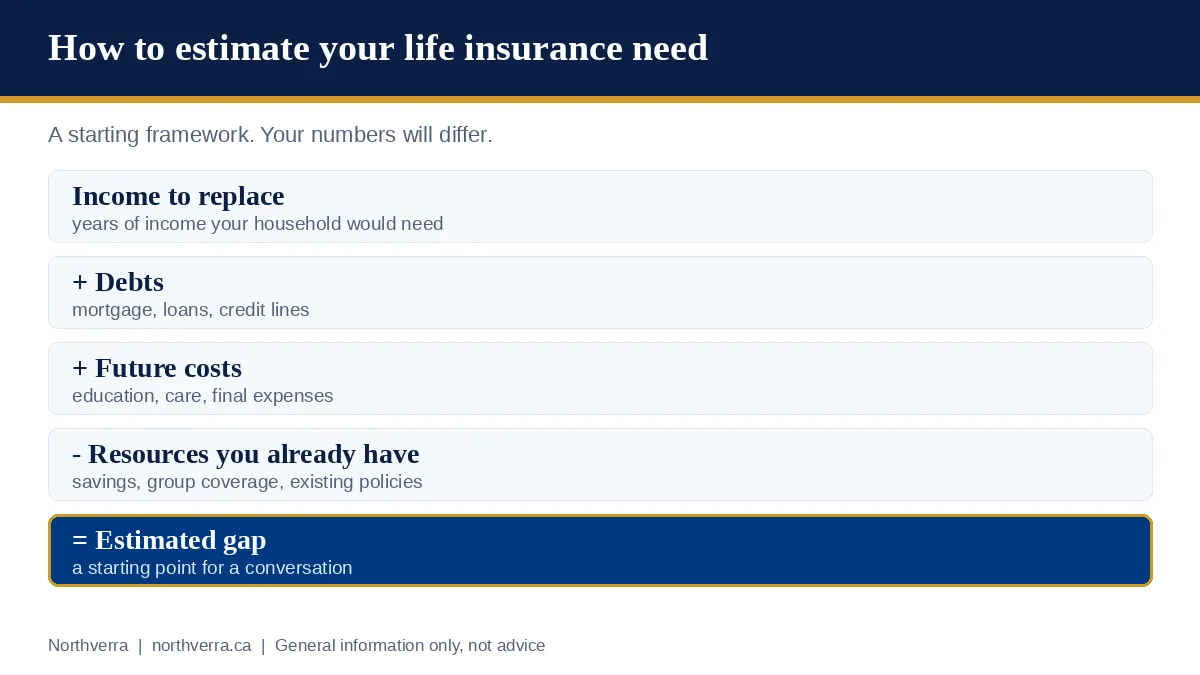
A five-step method to estimate your need
Step 1: Income replacement
Estimate how many years of your income your household would need to replace. A family with young children may need income support for 15 to 20 years or more. If a partner earns an income too, think about what they could realistically cover.
Step 2: Debts
Add your mortgage, car loans, lines of credit, credit cards and student loans. Many families choose to cover the mortgage in full so the home is secure.
Step 3: Future costs
Think about education, child care and care for a parent or a family member with special needs. Add an allowance for final expenses and estate costs.
Step 4: Subtract what you already have
Deduct savings, investments, existing life insurance and group coverage through work. Group coverage often ends if you leave your employer, so treat it with care. See our guide on employer versus private coverage.
Step 5: Add a safety margin
Inflation raises costs over time, and plans change. A margin keeps the result from being too tight.
A worked example
Imagine a 38-year-old parent earning $90,000 a year with a partner, two children, a $380,000 mortgage and $15,000 in other debts. For this illustration only, they decide to replace ten years of income ($900,000), cover the debts ($395,000), add $120,000 for education and $25,000 for final expenses, for a total need of $1,440,000. They already have $60,000 in savings and $150,000 of group coverage through work. Subtracting $210,000 leaves a gap of about $1,230,000. This is an example, not a recommendation, and your numbers will differ.
Common rules of thumb, and their limits
- 10 times your income is widely quoted. It can be a reasonable first guess but ignores your debts, goals and existing assets
- The DIME method adds Debt, Income, Mortgage and Education, which is similar to the steps above
- Per-child add-ons are sometimes used, but families differ widely
Use a rule of thumb for a quick idea, then refine it with your own numbers.
Common mistakes
- Counting only the mortgage and forgetting income replacement
- Assuming group coverage at work will always be there
- Ignoring a stay-at-home partner’s value, such as child care
- Buying once and never reviewing it
- Choosing the cheapest option without checking renewal and conversion rights
When to review your coverage
Revisit your need after a marriage, a new child, a new mortgage, a business start, a significant change in income or a divorce. A review every few years is a good habit.
How cost fits in
Once you know how much coverage may be appropriate, the next question is price. Our guide on how much life insurance costs in Alberta explains what affects premiums, and our comparison of term versus whole life helps you choose a type.
A quick cross-check: the DIME method
If you want a fast way to sanity-check your number, the DIME method adds up four needs. It is simpler than a full needs analysis, but it helps you see whether your estimate is in the right range.
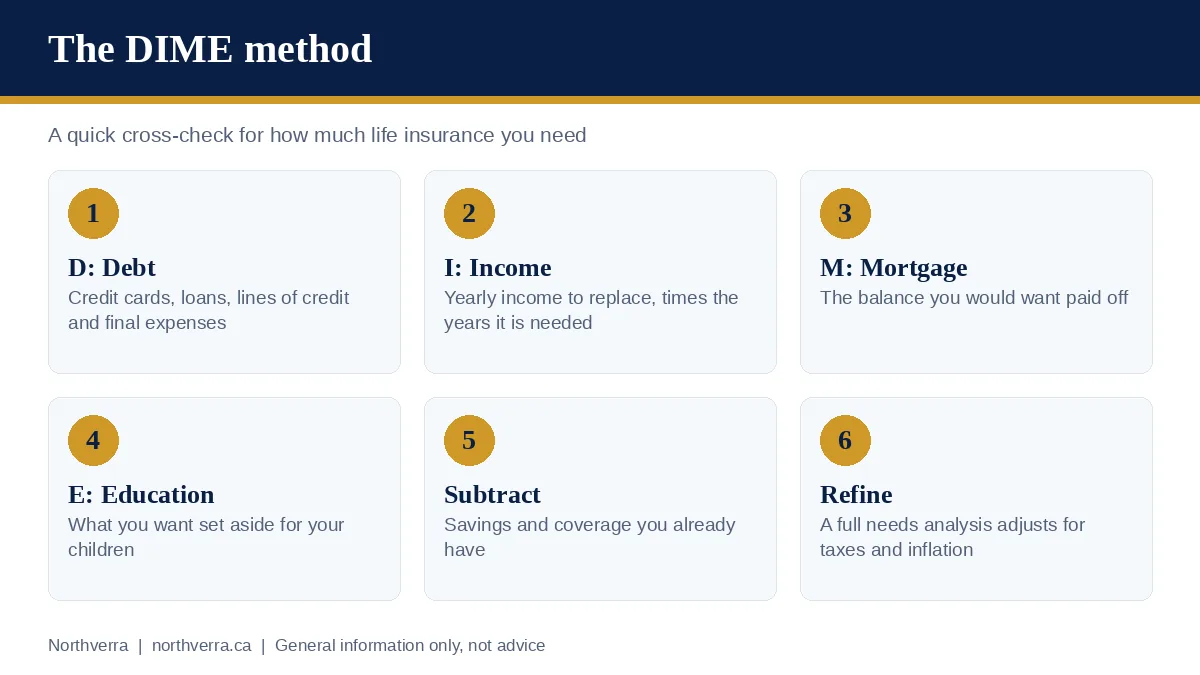
- D for debt: credit cards, car loans, lines of credit and final expenses.
- I for income: the income your family would need replaced, multiplied by the number of years they would rely on it.
- M for mortgage: the balance you would want paid off.
- E for education: what you would like to set aside for your children’s education.
Subtract savings and existing coverage that would be available, such as group life insurance at work. What remains is a rough coverage target. A full needs analysis then refines it for taxes, inflation and your family’s specific plans.
Single-income, dual-income and stay-at-home parents
Single-income households usually need the most coverage on the earner, because the family relies on one paycheque. Dual-income households often need coverage on both partners, sized to the share of costs each income supports. A stay-at-home parent may have no paycheque to replace, but the cost of child care, transportation and household help if they died can be substantial, so many families insure them too.
Next step
A short conversation can turn these steps into numbers for your household.
How the amount changes with your life stage
The number that fits at 28 rarely fits at 48. Needs tend to rise when responsibilities arrive and fall as debts shrink and children become independent.
- Single, no dependants: often a small amount to cover final expenses and any co-signed debt
- Couple, no children: enough for the survivor to manage debts, a mortgage and the loss of a second income
- Young family: usually the peak need, because income must be replaced for many years
- Empty nest: debts are lower, so the need may shift to a surviving spouse’s retirement income and estate costs
- Retirement: coverage may be about final expenses, taxes or leaving a legacy
Situations that need extra thought
Single-income households
When one partner earns most of the household income, that person’s coverage usually needs to be larger, because the family’s lifestyle depends on it.
Stay-at-home parents
A stay-at-home parent provides child care, cooking, transportation and household management. If they died, the family would need to pay for some of that work. Coverage for this parent is often smaller than for the main earner, but it is rarely zero.
Blended families and separation agreements
If you pay child support or have obligations from a separation agreement, insurance can help you meet them. Make sure beneficiaries match your intentions.
Self-employed people
Without group benefits, your personal policy is the whole safety net. Consider both your family’s needs and any business debts you have personally guaranteed.
Dependants with special needs
A lifelong need may call for permanent coverage and a properly set up trust. A lawyer who specializes in this area can advise on structure.
Matching the term length to the need
If you choose term insurance, the length should follow the length of the responsibility. A common approach is to match the term to the years until your youngest child finishes school, or to the remaining years on your mortgage, whichever is longer. Some people layer several terms, for example a 30-year policy for the mortgage and a 20-year policy for income replacement, so the total coverage steps down as responsibilities fall. Compare options in our guide on term versus whole life.
What other benefits may already exist
Before you buy more, find out what you already have. Some employers provide group life insurance, often as a multiple of salary. The Canada Pension Plan may pay a one-time death benefit and survivor benefits to eligible families, and amounts depend on contributions and eligibility, so check current details with Service Canada. These supports are usually not enough on their own to replace an income, but they belong in your calculation.
Practical questions people ask
Can I just use 10 times my income?
It is a quick starting point, but it ignores your debts, your family and your existing assets. Use it for a first guess, then refine it with the five steps above.
Should I insure my children?
Most families put their own coverage first. Insurance on a child can be considered for specific goals, but it is usually a lower priority than protecting the people who earn and care for the household.
What if I cannot afford the full amount?
A smaller policy is better than none. You can buy what fits your budget now and add more later, or use a longer-term plan with a lower amount. Ask about conversion options so you can adjust.
Can I change my coverage later?
Often you can add coverage, but a new policy requires new underwriting. Some policies include options to increase coverage at certain life events without new medical questions. Ask what is available.
Does the amount include final expenses?
It can. Many families add an allowance for funeral costs, legal fees and outstanding bills so the survivors are not forced to use savings.
How much life insurance does a stay-at-home parent need?
Estimate what it would cost to replace the work they do, such as child care, school transportation and household help, for the years your children would need it. Add any debts you would want paid off. Many families find this amount is larger than they expected.
Should my spouse and I have the same amount of coverage?
Not necessarily. Each amount should reflect what the household would need if that person died. If one partner earns more or carries more of the costs, their coverage may need to be higher.
Does my group life insurance at work count toward the total?
It can, but treat it with care. Group coverage often ends or changes when you leave the job, and the amount may be tied to your salary. Many people count it as a bonus rather than the base of their plan. See employer versus private coverage.
Last updated: October 11, 2026
Related guides
- How much does life insurance cost in Alberta?
- Do I need life insurance if I have a mortgage?
- How can life insurance help protect my family?
- Life insurance in Calgary and Canada
Have a question? Start a conversation
Tell us a little about your situation. We will reply within one business day.
By submitting this form you agree that Northverra may contact you about your enquiry. Please do not include account numbers, health details or other sensitive information. See our Privacy Policy.
Important information. Life insurance products are subject to underwriting, eligibility, exclusions, limitations and the terms of the policy contract. Coverage, premiums and availability depend on your age, health, lifestyle and other factors. Nothing on this page is an offer of insurance or a guarantee of coverage or price. See our Disclosures.