
INVESTMENT QUESTIONS
What is asset allocation by age, and how should my mix change?
Short answer: Asset allocation is how you divide your money between stocks, bonds, cash and other assets. Many people hold more growth investments when they are younger and have time to recover from market drops, then gradually shift toward more stable investments as they approach the time they will spend the money. Age is a useful guide, but your goals, timeline and comfort with risk matter more than your birthday.
In this guide: Why asset allocation matters · How the mix often changes over a lifetime · Rules of thumb and their limits · Target-date and balanced funds · Rebalancing · A simple review checklist · Common mistakes · Allocation for goals other than retirement · FAQ

Asset allocation by age is a popular way to think about investing because it is simple: the closer you are to needing the money, the less risk you may want to take. This guide explains the logic behind it, the common rules of thumb, why they are only a starting point and how to review your own mix.
Why asset allocation matters
The mix between asset classes has a large influence on how a portfolio behaves: how much it may grow, how much it may fall in a bad year and how bumpy the ride feels. Choosing individual funds matters too, but the overall balance between growth and stability is the foundation. Our article on risk and time horizon explains the two ideas behind it, and stocks vs bonds describes the main ingredients.
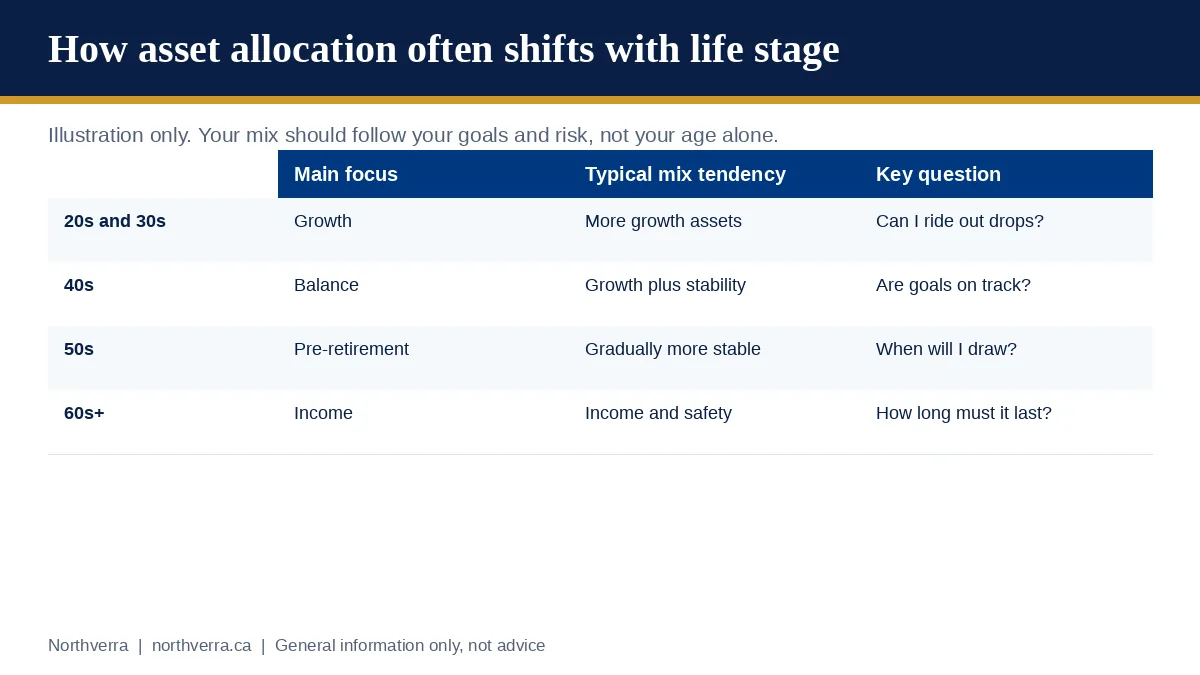
How the mix often changes over a lifetime
In your 20s and 30s
With decades before retirement, many people hold a larger share of stocks for long-term growth, because they have time to recover from downturns and are adding new money regularly. Shorter-term goals at this age, such as a home, still call for safer options. See investing in your 30s.
In your 40s
Income and responsibilities often peak. Many keep a growth focus for retirement money while adding stability, especially if a large goal, such as a child’s education, is approaching.
In your 50s and early 60s
As retirement nears, a large market drop could have a bigger impact because there is less time to recover and contributions may soon stop. Many gradually raise the share of bonds and cash. Our guide to retirement planning in your 40s and 50s covers the wider picture.
In retirement
The focus shifts to producing income that lasts. Because retirement can last thirty years or more, many retirees still keep some growth investments, alongside a cash reserve and bonds for the next few years of spending.
Rules of thumb and their limits
A well-known rule suggests holding a percentage of bonds equal to your age, so a 40-year-old would hold about 40% bonds. Some variations use 110 or 120 minus your age as the share in stocks, reflecting longer life spans. These rules are easy to remember, but they ignore important facts:
- Whether you have a defined benefit pension, which acts a bit like a large bond holding.
- How much you will rely on your savings versus CPP and OAS.
- Your other assets, such as real estate or a business.
- How you would actually behave in a market drop.
- The specific goal, since each goal has its own timeline.
Target-date and balanced funds
Some funds manage the shift for you. Target-date funds gradually move from growth to stability as a chosen year approaches. Balanced or asset allocation funds hold a fixed mix, such as conservative, balanced or growth, and rebalance automatically. They can be convenient, but check their fees and whether their assumed path matches your plan.
Example (hypothetical): Two 45-year-olds have the same savings. One has a workplace defined benefit pension that will cover most retirement costs; the other is self-employed with no pension. The first may be able to take more risk with personal savings because the pension provides a stable base; the second may want more stability because savings must do all the work. Same age, different allocation. This is an illustration only.
Rebalancing
Over time, markets move your mix away from your target. If stocks rise strongly, they become a bigger share of the portfolio than planned. Rebalancing means selling some of what has grown and buying what has lagged to restore the target, either on a schedule, such as once a year, or when the mix drifts beyond a set range. In non-registered accounts, rebalancing can trigger capital gains, so consider tax. See capital gains in Canada.
A simple review checklist
- List each goal and its timeline.
- Note your current mix of stocks, bonds and cash across all accounts.
- Compare it with your target for each goal.
- Consider pensions and other assets.
- Decide whether to rebalance, and how.
- Set a date for the next review.
Common mistakes
- Using the same mix for every goal, regardless of timeline.
- Becoming too conservative too early, which can increase the risk of outliving savings.
- Staying too aggressive just before a major withdrawal.
- Looking at one account in isolation instead of the whole picture.
- Never rebalancing, so risk grows unnoticed.
Allocation for goals other than retirement
Age-based rules focus on retirement, but many goals have nothing to do with your age. A 55-year-old saving for a car next year should keep that money stable, while a 25-year-old saving for a home in two years should usually do the same. In practice, it helps to set a separate target mix for each goal based on its own timeline. Retirement savings might follow a gradual path from growth toward stability, while a down payment or an education fund moves toward safety as the date approaches. Looking at goals one at a time keeps short-term money from being exposed to risks it cannot afford.
Next step
Want to see whether your current mix still fits your stage of life? We can review it across all your accounts.
More questions people ask
What is a good asset allocation for a 30-year-old?
There is no single answer. Many people at that age hold a larger share of stocks for retirement savings, but shorter-term goals and personal comfort with risk can change that.
Should retirees hold any stocks?
Many do, because retirement can be long and inflation can erode purchasing power. The right share depends on income needs and comfort with risk.
How often should I rebalance?
Once a year is common, or when the mix moves beyond a chosen range. More frequent trading usually adds cost without clear benefit.
Does my home count in my asset allocation?
Some people include it in their net worth, but because you live in it and it is hard to sell in part, it is usually considered separately. See net worth basics.
Related guides
Have a question? Start a conversation
Tell us a little about your situation. We will reply within one business day.
By submitting this form you agree that Northverra may contact you about your enquiry. Please do not include account numbers, health details or other sensitive information. See our Privacy Policy.
Important information. Investing involves risk, including the possible loss of the amount invested. The value of investments can go down as well as up, and past performance does not guarantee future results. Nothing on this page is a recommendation or a promise of any return. Diversification and asset allocation do not ensure a profit or protect against loss. See our Disclosures.