
INVESTMENT QUESTIONS
Stocks vs bonds: what is the difference?
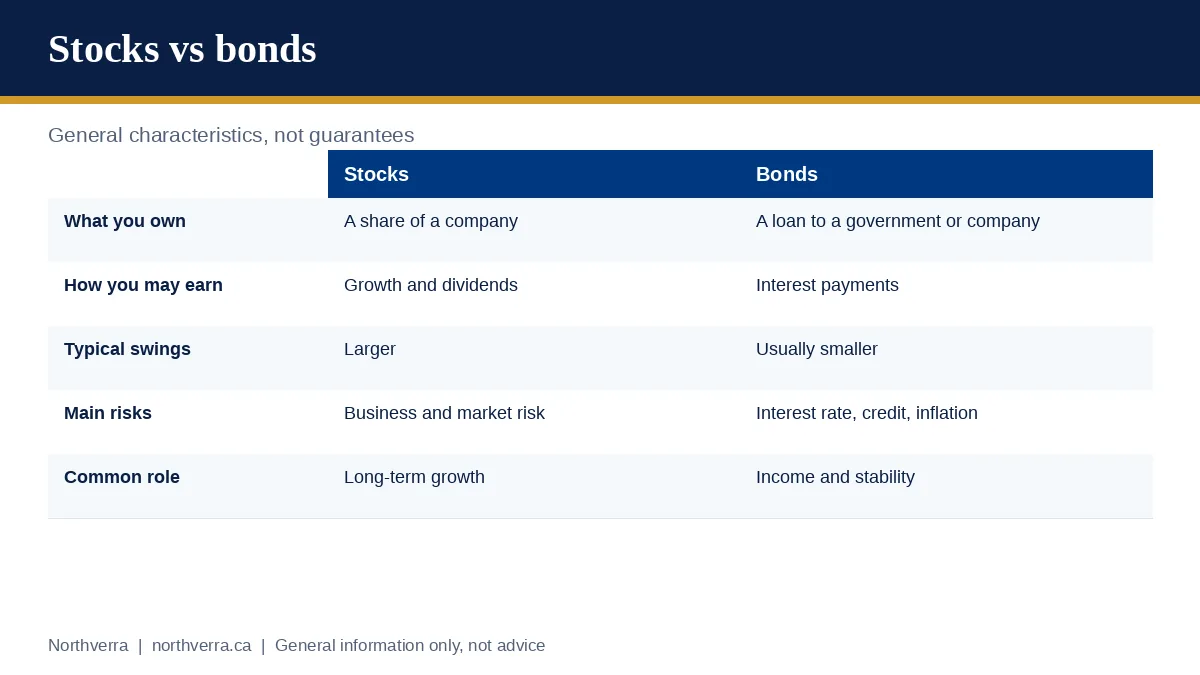
Short answer: When you buy a stock, you own part of a company and share in its growth and risks. When you buy a bond, you lend money to a government or company in exchange for interest and the return of the face value at maturity. Stocks usually offer more growth potential with bigger swings; bonds usually offer steadier income with smaller swings. Many portfolios combine both.
In this guide: What a stock is · What a bond is · How each can lose value · Why they are often combined · How to own them · How they are taxed outside registered accounts · Questions to ask about your mix · Common mistakes · Inflation and real returns · FAQ

Stocks vs bonds is one of the first comparisons new investors meet, because together they make up the core of most portfolios. They behave differently, carry different risks and play different roles. Understanding both helps you see why a mix is common and how the balance between them shapes your experience as an investor.
What a stock is
A stock, also called a share or equity, is a small piece of ownership in a company. As a shareholder you may benefit in two ways: the share price may rise if the company grows and investors value it more, and the company may pay dividends from its profits. You may also have voting rights. The downside is that shareholders are last in line. If the company fails, shares can become worthless. Our guide to dividend investing in Canada looks at the income side of stocks.
What a bond is
A bond is a loan. The issuer, such as the Government of Canada, a province, a municipality or a corporation, agrees to pay you interest, called the coupon, on a schedule, and to repay the face value on the maturity date. Bonds are often described as fixed income because the payments are set in advance. If you hold a high-quality bond to maturity and the issuer pays as promised, you know what you will receive. If you sell before maturity, the price may be higher or lower than what you paid.
How each can lose value
Stock risks
- Business risk: the company may perform poorly.
- Market risk: the whole market can fall, taking good companies with it.
- Concentration risk: owning a few companies or one sector magnifies losses.
Bond risks
- Interest rate risk: when rates rise, existing bond prices generally fall, and longer-term bonds are more sensitive.
- Credit risk: the issuer may be unable to pay; lower-rated bonds pay more because this risk is higher.
- Inflation risk: fixed payments buy less if prices rise. See how inflation affects your savings.
Why they are often combined
Stocks and bonds do not always move together. In many periods, when stocks have fallen, high-quality bonds have held up better, cushioning a portfolio, although there have been times when both fell at once. Combining them aims to give some growth from stocks and some stability and income from bonds. The proportion you hold in each is called your asset allocation, and it is one of the most important decisions in a plan. Our guides to asset allocation by age and risk and time horizon go deeper.
Example (hypothetical): Consider two hypothetical portfolios in a year when stock markets drop sharply. One holds only stocks; the other holds 60% stocks and 40% high-quality bonds. The balanced portfolio would usually fall less, though it would also usually rise less in strong years. This is a general illustration, not a prediction.
How to own them
- Individual stocks through a brokerage account.
- Individual bonds through a dealer, often in larger amounts.
- Funds and ETFs that hold many stocks, many bonds or both, which is how most individuals own bonds.
- Balanced funds that hold both in a set proportion and rebalance for you.
See mutual funds vs ETFs for how funds work.
How they are taxed outside registered accounts
In general, bond interest is fully taxable as income each year. Eligible Canadian dividends receive a dividend tax credit, and capital gains are only partly included in income when you sell. This difference can influence which account you hold each in, a practice sometimes called asset location. Our guides to non-registered accounts and capital gains in Canada explain more. A tax professional can help with your specific case.
Questions to ask about your mix
- When will I need this money, and how much could I tolerate seeing it fall?
- Do I need regular income now, or growth for later?
- How concentrated are my stock holdings?
- How sensitive are my bonds to interest rate changes?
- When was the mix last rebalanced?
Common mistakes
- Assuming bonds can never lose value.
- Holding all stocks for money needed soon.
- Chasing high-yield bonds without understanding the credit risk.
- Never rebalancing, so the mix drifts far from the plan.
- Treating a small number of stocks as a diversified portfolio.
Inflation and real returns
When comparing stocks and bonds, think about returns after inflation, sometimes called real returns. A bond paying a fixed coupon can lose purchasing power if prices rise faster than expected, and this is especially relevant for long-term bonds. Stocks have historically offered more potential to outpace inflation over long periods, but with much less certainty in any given year. Some governments issue inflation-linked bonds, which adjust for inflation, though they still carry price risk when interest rates change. Considering inflation helps explain why many long-term investors hold some stocks even when they value stability, and why bonds remain useful for money needed in the nearer term.
Next step
Not sure whether your stock and bond mix fits your goals? We can review it with you.
More questions people ask
Are bonds safer than stocks?
Generally, high-quality bonds have smaller price swings than stocks, but they still carry risk, including interest rate and credit risk, and they can lose value.
Should I own bonds when I am young?
Some younger investors hold mostly stocks for long-term goals, while others prefer some bonds for stability. It depends on your goals and comfort with risk.
What is a bond fund?
A fund that holds many bonds. Unlike a single bond, a bond fund does not have a fixed maturity date, so its price can move with interest rates indefinitely.
What are preferred shares?
A hybrid security that usually pays a set dividend and ranks ahead of common shares, but behind bonds. They have their own risks.
Related guides
Have a question? Start a conversation
Tell us a little about your situation. We will reply within one business day.
By submitting this form you agree that Northverra may contact you about your enquiry. Please do not include account numbers, health details or other sensitive information. See our Privacy Policy.
Important information. Investing involves risk, including the possible loss of the amount invested. The value of investments can go down as well as up, and past performance does not guarantee future results. Nothing on this page is a recommendation or a promise of any return. Diversification and asset allocation do not ensure a profit or protect against loss. See our Disclosures.