
INVESTMENT QUESTIONS
Mutual funds vs ETFs: what is the difference?
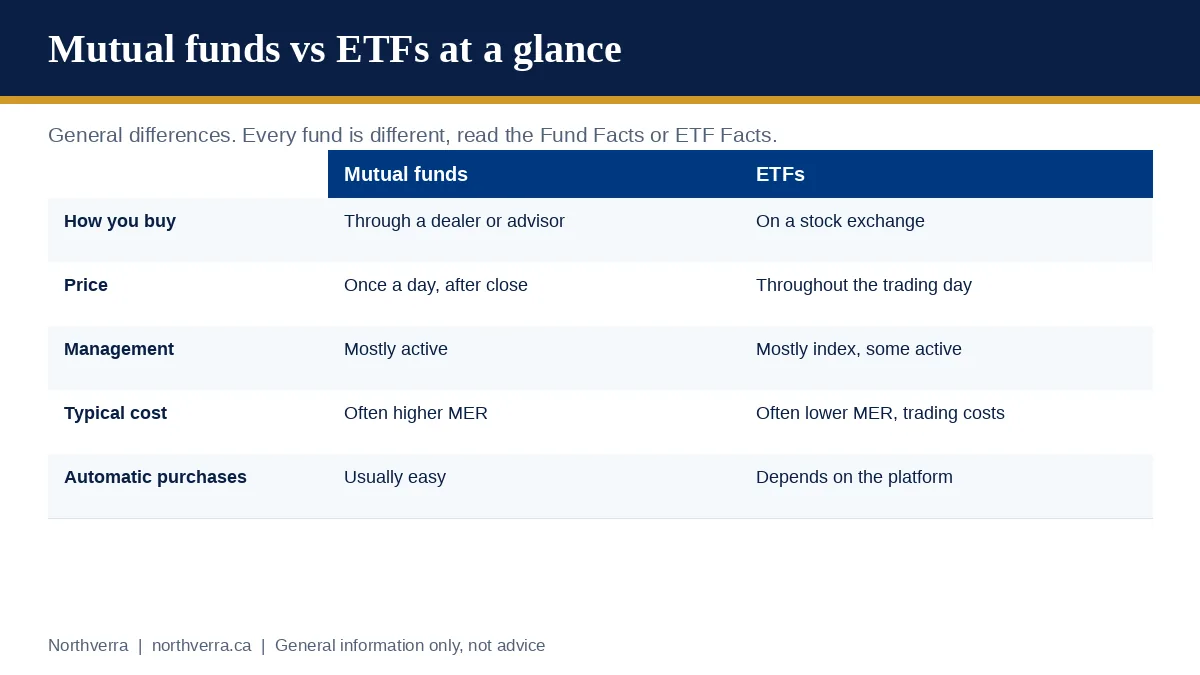
Short answer: Mutual funds and ETFs (exchange-traded funds) both pool money into a basket of investments. The main differences are how you buy them, how they are priced and what they cost. Mutual funds are bought through a dealer at one price per day, while ETFs trade on a stock exchange throughout the day and often, but not always, have lower ongoing fees.
In this guide: What they have in common · How mutual funds work · How ETFs work · Comparing costs · Active vs passive management · Which might suit you · What to check in the Fund Facts or ETF Facts · Common mistakes · How fees add up over time · FAQ

The debate over mutual funds vs ETFs comes up in almost every conversation about investing in Canada. Both can be excellent tools, and both can be poor choices if they do not suit your needs or cost too much. Understanding how they work lets you compare like with like, instead of assuming one is always better.
What they have in common
- Each fund holds a basket of investments such as stocks, bonds or both.
- Each offers built-in diversification, which can reduce the impact of any single holding.
- Each charges an ongoing fee, expressed as a management expense ratio (MER).
- Each must provide a plain-language summary: Fund Facts for mutual funds and ETF Facts for ETFs.
- Either can be held in a TFSA, RRSP, FHSA, RESP or non-registered account.
How mutual funds work
You buy mutual fund units from a fund company or through a dealer, such as a bank, investment firm or advisor. The price, called the net asset value per unit, is calculated once a day after markets close. Mutual funds make it easy to set up automatic monthly purchases in exact dollar amounts, which suits regular savers. Many are actively managed, meaning a portfolio manager chooses the holdings in an effort to meet the fund’s objectives.
Mutual funds may come in several series with different fee structures. Some include a payment to the dealer or advisor for advice, sometimes called a trailing commission. Ask which series you are buying and what is included in the fee.
How ETFs work
An ETF trades on a stock exchange like a share. You buy and sell it through a brokerage account at the market price during the trading day. Many ETFs follow an index, such as a broad Canadian or global stock index, which tends to keep costs lower. Others are actively managed or focus on a theme, sector or strategy. Some complex ETFs use leverage or derivatives and can behave very differently from what the name suggests, so read the ETF Facts carefully.
Comparing costs
The MER is taken from the fund’s assets, so you never see a separate bill, but it reduces your return every year. ETFs often have lower MERs than comparable mutual funds, especially index ETFs, but you may pay trading commissions and a small difference between buying and selling prices, called the bid-ask spread. Mutual funds may have no trading costs but higher MERs, and some older purchase options carried redemption charges. Compare the total cost, not just one number.
Example (hypothetical): Imagine a $20,000 investment. A fund with an MER of 2% costs roughly $400 a year, while one with an MER of 0.25% costs about $50 a year. Over many years, that difference compounds. The rates here are examples only; actual fees vary widely, and a lower fee does not guarantee a better result.
Active vs passive management
This is often the real question behind mutual funds vs ETFs. Active management tries to outperform a benchmark or reduce risk through selection. Passive or index management aims to match a market index at low cost. Active funds may outperform in some periods and underperform in others, after fees. Whether paying for active management is worthwhile is a judgement that depends on the fund, its fees and your goals.
Which might suit you
Mutual funds may suit you if
- You want automatic contributions in exact dollar amounts.
- You prefer to work with an advisor who handles the purchases.
- You value a specific active manager’s approach.
ETFs may suit you if
- You are comfortable using a brokerage account.
- You want low-cost, broad market exposure.
- You make larger, less frequent purchases, or your platform offers free ETF trades.
A robo-advisor usually builds portfolios from ETFs and handles the purchases for you. See robo-advisor vs financial advisor.
What to check in the Fund Facts or ETF Facts
- The fund’s objective and what it invests in.
- The risk rating, which reflects historical volatility.
- The MER and any other fees.
- Past performance, remembering it does not predict the future.
- Who the fund may be suitable for.
Common mistakes
- Comparing an all-equity ETF with a balanced mutual fund, which is not a fair comparison.
- Choosing by last year’s returns.
- Ignoring trading costs when buying ETFs in small amounts.
- Owning many funds that hold the same underlying investments.
- Buying a complex or leveraged ETF without understanding it.
How fees add up over time
Fees deserve special attention because they compound in the same way returns do. A fund’s MER is deducted every year whether the fund rises or falls, and the reduction in your balance also reduces the growth on that balance in later years. When comparing funds, look at the total cost of ownership: the MER, any trading commissions, account fees and, for advice-based series, what advice you receive in return. A slightly higher cost can be reasonable if it buys services you use, such as planning, rebalancing and regular reviews. Paying more for a fund that closely mirrors a cheaper index fund is harder to justify. Ask for the cost in dollars, which Canadian dealers report on your annual statements.
Next step
Want a second look at the funds you already own, or help comparing options? We can review the costs and fit with you.
More questions people ask
Are ETFs safer than mutual funds?
Not inherently. Risk depends on what the fund holds. A bond ETF and a bond mutual fund can be similar in risk, and a sector ETF can be riskier than a balanced mutual fund.
Can I switch from mutual funds to ETFs?
Usually, but selling in a non-registered account can trigger capital gains, and some funds have redemption charges. Check costs and tax first. See capital gains in Canada.
What is an index fund?
A fund, either a mutual fund or an ETF, that aims to track a market index rather than pick individual investments. Index mutual funds also exist in Canada.
Do ETFs pay dividends?
Many distribute income from their holdings, such as dividends or interest. You can usually take it as cash or reinvest it.
Related guides
Have a question? Start a conversation
Tell us a little about your situation. We will reply within one business day.
By submitting this form you agree that Northverra may contact you about your enquiry. Please do not include account numbers, health details or other sensitive information. See our Privacy Policy.
Important information. Investing involves risk, including the possible loss of the amount invested. The value of investments can go down as well as up, and past performance does not guarantee future results. Nothing on this page is a recommendation or a promise of any return. Diversification and asset allocation do not ensure a profit or protect against loss. See our Disclosures.