
INVESTMENT QUESTIONS
Robo-advisor vs financial advisor: which is right for me?
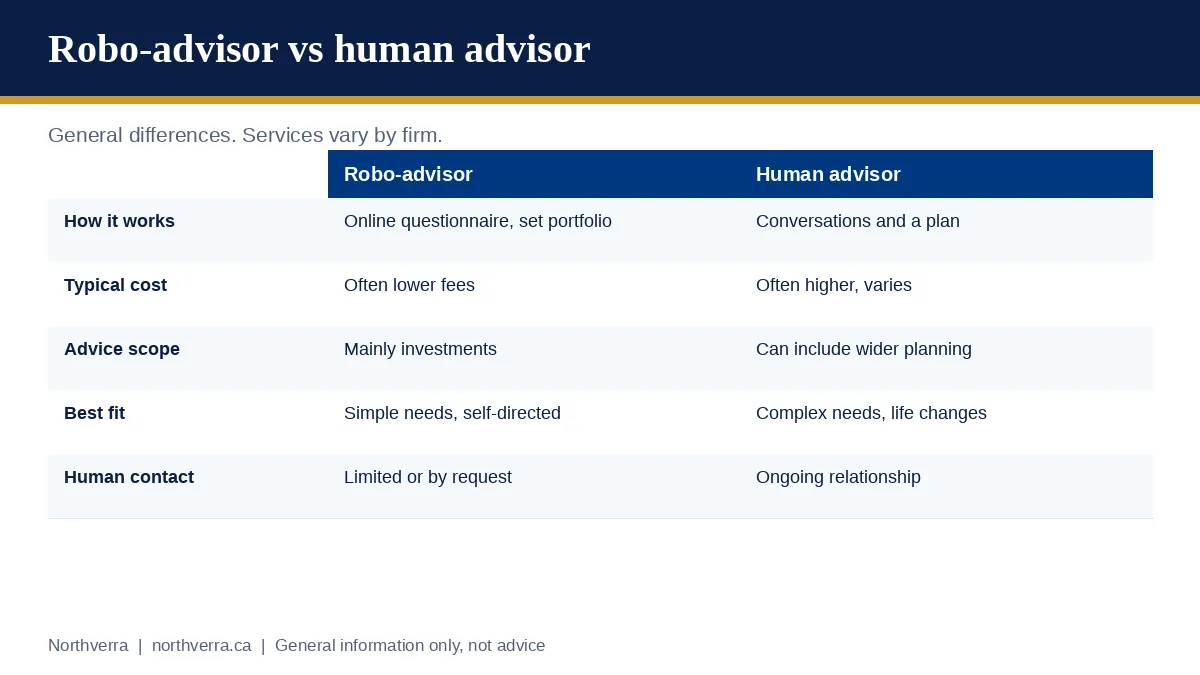
Short answer: A robo-advisor is an online service that builds and manages a diversified portfolio for you, usually from ETFs, based on a questionnaire, typically at lower cost. A human financial advisor can offer broader planning, such as retirement income, insurance, tax coordination and estate questions, and personal guidance through life changes, usually at higher cost. The better fit depends on how complex your situation is and how much support you want.
In this guide: How a robo-advisor works · How a human financial advisor works · Comparing costs · What each does well · Behaviour may be the biggest factor · Hybrid options · How to check who you are dealing with · Questions to ask either option · Common mistakes · Moving between the two over time · FAQ

The question of robo-advisor vs financial advisor has become common as online investing has grown in Canada. Both can be useful. Some people use one, some the other and some move between them as their lives change. This guide explains what each offers, what it may cost and how to decide.
How a robo-advisor works
You answer online questions about your goals, timeline, income and comfort with risk. The service recommends a model portfolio, often made of low-cost ETFs, invests your money, rebalances it automatically and reports online. Many offer TFSAs, RRSPs, FHSAs, RESPs and non-registered accounts. Robo-advisors in Canada are registered portfolio managers, and some provide access to human advisors by phone or video for questions.
How a human financial advisor works
“Financial advisor” is a broad term. It can include investment advisors at dealers, mutual fund representatives, financial planners and insurance advisors, each with different licences and permitted products. A human advisor meets with you, learns about your situation and helps build a plan. Depending on their registration, they may recommend investments, insurance, or both, and coordinate with your accountant or lawyer.
Comparing costs
Robo-advisors usually charge an annual management fee on the account balance, plus the fees inside the ETFs. Human advisors may be paid through fees on assets, commissions built into products, flat or hourly planning fees, or a combination. The total cost of advice can vary widely, so ask for every fee in writing, in dollars as well as percentages. Lower cost is an advantage, but value depends on what you receive. See mutual funds vs ETFs for how fund fees work.
What each does well
A robo-advisor may suit you if
- Your needs are mainly investing for a few clear goals.
- You are comfortable managing your account online.
- You want low costs and automatic rebalancing.
- You are disciplined enough to stay invested through market drops without someone to talk to.
A human advisor may suit you if
- You have several goals competing for money, or a complex situation.
- You own a business, have a pension decision to make or are approaching retirement.
- You want help with insurance, retirement income, tax coordination or estate planning.
- You value having someone to talk to when markets fall or life changes.
Example (hypothetical): Kim, 29, has a TFSA and an FHSA and a straightforward goal of buying a condo in four years. A robo-advisor may meet her needs well. Her parents, 61, are deciding when to start CPP, how to handle their RRSP to RRIF conversion and whether to keep their life insurance. They may benefit more from a planning relationship with a human advisor. These are illustrations, not recommendations.
Behaviour may be the biggest factor
A well-built portfolio only works if you stick with it. Some people find it easy to ignore market noise, while others are tempted to sell after a sharp drop. Having a trusted person to talk to at those moments can help prevent costly decisions. Our guide on what to do when the stock market drops covers this in more detail.
Hybrid options
Many firms now blend the two: online portfolios with access to human planners, or advisors who use low-cost ETFs. You can also pay for a one-time financial plan from a planner and implement it yourself through a robo-advisor or brokerage.
How to check who you are dealing with
- Search the Canadian Securities Administrators’ National Registration Search to confirm that a firm or individual is registered to sell securities or provide advice.
- For insurance advice and products in Alberta, check licensing with the Alberta Insurance Council.
- Ask about professional designations, and check them with the issuing organization.
- Ask how the person or firm is paid.
Questions to ask either option
- What exactly will you do for me, and how often will we review my plan?
- What will this cost me each year, in dollars?
- How is my risk profile determined, and how often is it updated?
- What happens if I want to leave or transfer my account?
- Who do I contact when I have a question?
Common mistakes
- Choosing on fees alone without considering the help you need.
- Paying for comprehensive advice but only receiving product sales.
- Answering a robo questionnaire optimistically and taking more risk than you can live with.
- Not checking registration.
- Never revisiting the choice as life becomes more complex.
Moving between the two over time
Your needs change. Someone who starts with a robo-advisor in their 20s may find, by their 40s, that they have a mortgage, children, a business or a pension decision that calls for broader advice. Others start with an advisor, learn the basics and later prefer a simpler, lower-cost setup. Transfers between institutions are usually done directly between firms, which keeps registered accounts intact, though transfer fees or sales charges may apply. Before moving, ask the receiving firm whether it will cover transfer fees and whether any of your current investments must be sold, which in a non-registered account could create a taxable capital gain.
Next step
Not sure what level of help you need? We are happy to talk through your situation and explain how we work.
More questions people ask
Are robo-advisors safe?
They invest in regular market securities, so your portfolio can rise and fall. Accounts at member firms may be protected by the Canadian Investor Protection Fund (CIPF) if the firm fails, within limits; CIPF does not protect against investment losses.
Can a robo-advisor help with retirement income?
Some offer basic tools, but complex questions about CPP timing, pensions and RRIFs often benefit from personal planning.
Do I need a lot of money to use a human advisor?
Not always. Some advisors serve clients at all asset levels, and some planners charge flat fees.
Can I use both?
Yes. Some people keep a robo account for simple goals and work with an advisor on broader planning.
Related guides
Have a question? Start a conversation
Tell us a little about your situation. We will reply within one business day.
By submitting this form you agree that Northverra may contact you about your enquiry. Please do not include account numbers, health details or other sensitive information. See our Privacy Policy.
Important information. Investing involves risk, including the possible loss of the amount invested. The value of investments can go down as well as up, and past performance does not guarantee future results. Nothing on this page is a recommendation or a promise of any return. Diversification and asset allocation do not ensure a profit or protect against loss. See our Disclosures.