
INVESTMENT QUESTIONS
What is an FHSA (First Home Savings Account) and how does it work?
Short answer: The FHSA (First Home Savings Account) is a registered account for eligible first-time home buyers in Canada. Contributions are generally tax-deductible, growth is tax-sheltered, and a qualifying withdrawal to buy a first home is tax-free. The CRA sets an annual participation room of $8,000 and a lifetime limit of $40,000, and the account can stay open for a limited period.
In this guide: Who can open an FHSA · How contribution room works · Tax treatment · How long the account can stay open · What can you hold inside an FHSA? · FHSA and the RRSP Home Buyers’ Plan · Checklist before you open one · Common mistakes · How the FHSA fits with your down payment plan · FAQ

The FHSA first home savings account was introduced in 2023 to help Canadians save for their first home. It combines two features that people like in other accounts: a tax deduction when you contribute, similar to an RRSP, and tax-free withdrawals for a qualifying home purchase, similar to a TFSA. Because the rules are specific, it is worth understanding them before you open one. Always confirm current details with the Canada Revenue Agency (CRA).
Who can open an FHSA
In general, to open an FHSA you must be:
- A resident of Canada.
- At least 18 years old, and not past the year in which you turn 71.
- A first-time home buyer, which under the CRA definition generally means you did not live in a home that you or your spouse or common-law partner owned at any time in the current calendar year or the previous four calendar years.
Each person opens their own FHSA, so a couple who both qualify can each have one.
How contribution room works
According to the CRA, you get $8,000 of FHSA participation room in the year you open the account and in each following year, up to a lifetime limit of $40,000. Unused room can be carried forward, but only up to $8,000, so the most you could contribute in a single year is $16,000. Room does not start building until you open an account, which is why some people open one early even if they cannot contribute much yet. Over-contributing can lead to a penalty tax, so check your room in CRA My Account.
Tax treatment
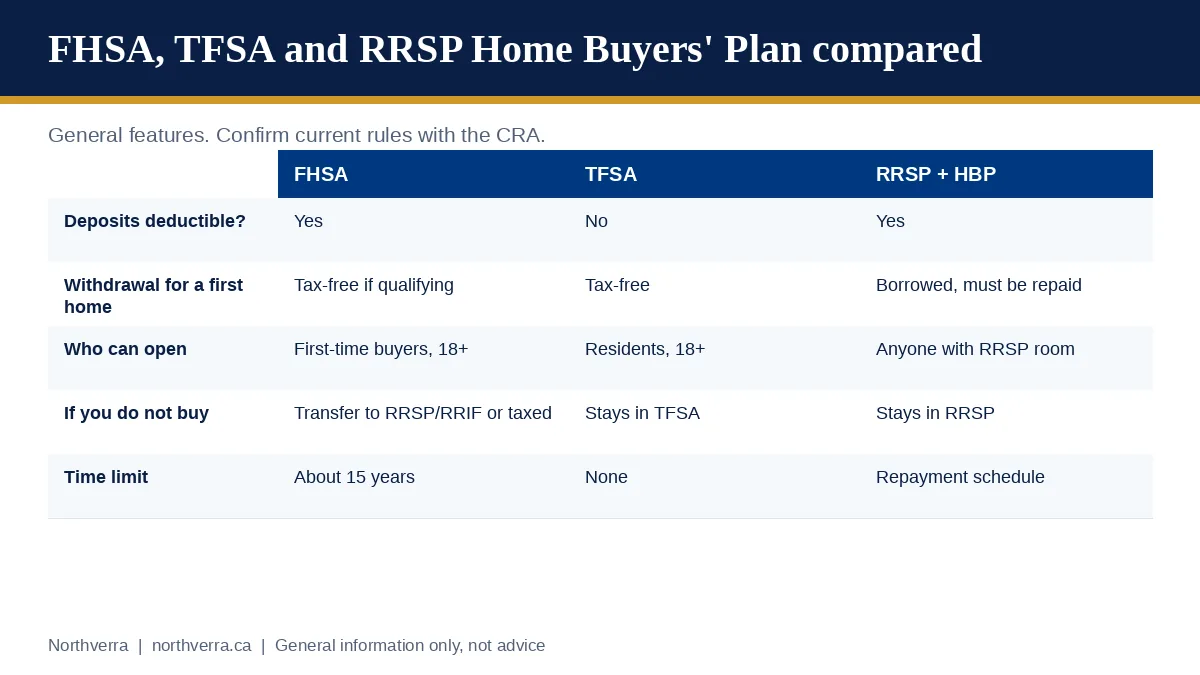
- Contributions: generally deductible from your income, and you can carry the deduction forward to a later year when your income may be higher.
- Growth: interest, dividends and gains inside the account are not taxed while they stay there.
- Qualifying withdrawal: tax-free when used to buy a qualifying first home and the conditions are met.
- Non-qualifying withdrawal: added to your income and taxed.
How long the account can stay open
The CRA’s maximum participation period generally ends after 15 years from when you first open an FHSA, or at the end of the year you turn 71, or the year after your first qualifying withdrawal, whichever comes first. If you have not used the money for a home by then, you can usually transfer it to your RRSP or RRIF tax-free, without using your RRSP room, or withdraw it as taxable income.
What can you hold inside an FHSA?
Like a TFSA or RRSP, an FHSA is a container. It can hold savings deposits, GICs, bonds, mutual funds, ETFs and stocks, depending on the financial institution. Because a home purchase usually has a fairly short timeline, many people keep FHSA money in lower-risk options as the purchase date approaches. A large drop in value just before you need the down payment could delay your plans. Our article on risk and time horizon explains why.
FHSA and the RRSP Home Buyers’ Plan
You can generally use both the FHSA and the RRSP Home Buyers’ Plan (HBP) for the same home, if you qualify for each. The key difference is that HBP withdrawals are a loan from your RRSP that must be repaid over time, while qualifying FHSA withdrawals do not have to be repaid. Our first-time home buyer checklist for Alberta covers the other steps, and our mortgage financing page explains how financing fits.
Example (hypothetical): Jordan, 26, opens an FHSA and contributes $5,000 in the first year, leaving $3,000 unused. The next year Jordan’s room is $8,000 plus the $3,000 carried forward, so $11,000. This is an illustration only; your room depends on your own history.
Checklist before you open one
- Confirm you meet the first-time home buyer definition.
- Decide on a timeline for buying, which shapes the investments you choose.
- Check how your FHSA, TFSA and RRSP fit together for this goal.
- Ask the financial institution about fees and investment options.
- Track your contributions to avoid exceeding your room.
- Keep receipts and records for the home purchase.
Common mistakes
- Assuming room builds before the account is opened.
- Investing short-term home money too aggressively.
- Contributing more than the carry-forward allows in one year.
- Missing the conditions for a qualifying withdrawal, which can make it taxable.
- Forgetting that a non-qualifying withdrawal is taxable income.
How the FHSA fits with your down payment plan
An FHSA is one tool in a wider plan, not the whole plan. Before you buy, you will also want to understand how much you can borrow, what your monthly payments could look like and how your credit history affects the mortgage you are offered. Our guides on how mortgage interest rates work and understanding your credit score cover those pieces. It also helps to budget for closing costs, such as legal fees, a home inspection and moving expenses, which are separate from your down payment. Keeping some savings outside the FHSA for these costs can stop you from withdrawing money in a way that does not qualify.
Next step
Planning your first home? We can look at how an FHSA, your other savings and your mortgage options fit together.
More questions people ask
Can I have an FHSA and a TFSA at the same time?
Yes. They are separate accounts with separate rules and room. Many first-time buyers use both. See RRSP vs TFSA basics for how the other two compare.
Do I have to claim the deduction in the year I contribute?
No. You can generally carry the deduction forward to a future year, which some people do if they expect higher income later. A tax professional can help you decide.
What if I never buy a home?
You can usually transfer the funds to an RRSP or RRIF tax-free without affecting your RRSP room, or withdraw them as taxable income.
Can my spouse contribute to my FHSA?
Only the account holder can claim the deduction. Rules on gifts and attribution can be technical, so ask the CRA or a tax professional about your situation.
Related guides
Have a question? Start a conversation
Tell us a little about your situation. We will reply within one business day.
By submitting this form you agree that Northverra may contact you about your enquiry. Please do not include account numbers, health details or other sensitive information. See our Privacy Policy.
Important information. Investing involves risk, including the possible loss of the amount invested. The value of investments can go down as well as up, and past performance does not guarantee future results. Nothing on this page is a recommendation or a promise of any return. Diversification and asset allocation do not ensure a profit or protect against loss. See our Disclosures.