
MORTGAGE QUESTIONS
What is the minimum down payment in Canada?
Short answer: The minimum down payment in Canada is 5% of the first $500,000 of the purchase price and 10% of the portion between $500,000 and $1.5 million. For homes priced at $1.5 million or more, the minimum is 20%. With less than 20% down, the mortgage must be insured against default, which adds a premium. Lenders may ask for more for some properties or borrowers.
In this guide: The minimum down payment rules · Worked examples · Why 20% is an important line · Where your down payment can come from · Proving your down payment · Plan for closing costs as well · Common mistakes to avoid · How your down payment affects the rest of your mortgage · Building a down payment plan · FAQ
The minimum down payment in Canada is set by federal rules, and it is the same in Alberta as anywhere else in the country. Knowing the exact number for your price range tells you how much you need to save, whether your mortgage will need default insurance and how much cash you should keep aside for everything else that comes with buying a home.
The minimum down payment rules
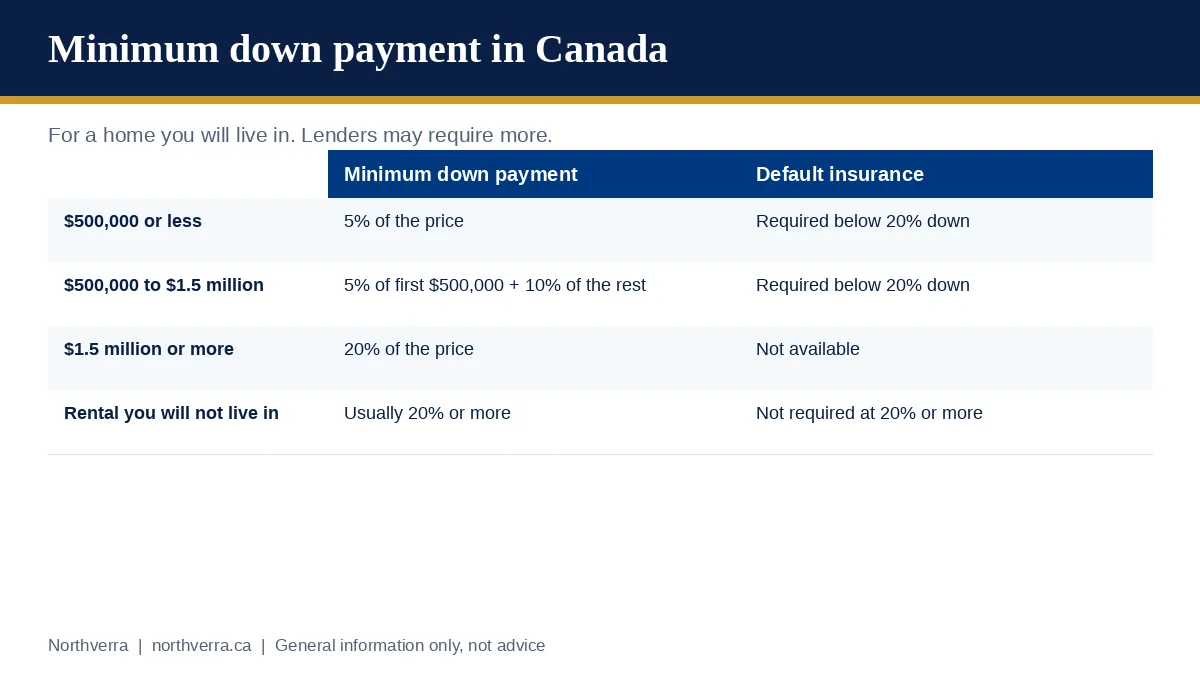
The rules depend on the purchase price of a home you will live in:
- $500,000 or less: at least 5% of the purchase price.
- Above $500,000 and below $1.5 million: 5% of the first $500,000, plus 10% of the portion above $500,000.
- $1.5 million or more: at least 20% of the purchase price. Mortgage default insurance is not available at this price.
These are minimums. A lender can ask for more, for example for some self-employed borrowers, for borrowers with limited credit history or for certain property types. Rental properties that you will not live in usually need at least 20% down; see our guide to rental property mortgages.
Worked examples
Example (hypothetical): For a $450,000 condo, the minimum is 5%, or $22,500. For a $600,000 house, it is 5% of $500,000 ($25,000) plus 10% of the remaining $100,000 ($10,000), for a total of $35,000. For a $1,600,000 home, the minimum is 20%, or $320,000. These are hypothetical prices used only to show the calculation.
Why 20% is an important line
With less than 20% down, your mortgage is “high-ratio” and must be insured against default through CMHC or a private insurer. The premium is a percentage of the loan and is usually added to your mortgage balance. The smaller your down payment, the higher the percentage. Our guide to CMHC mortgage insurance explains the premium tiers and how they are charged.
Putting 20% or more down avoids the premium, but it is not automatically the best choice. Waiting years to save 20% while prices and rents change may cost more than the premium, and draining all of your savings to reach 20% can leave you without a cushion. The right balance depends on your situation.
Where your down payment can come from
Lenders want to know that the down payment is genuinely yours and not a hidden loan. Common sources include:
- Personal savings in chequing, savings, GICs or investments.
- A First Home Savings Account (FHSA), which lets eligible first-time buyers save with tax advantages. See how the FHSA works.
- The RRSP Home Buyers’ Plan, which lets eligible buyers withdraw from RRSPs and repay over time. See how the Home Buyers’ Plan works.
- Proceeds from selling a property you already own.
- A gift from an immediate family member, usually confirmed with a signed gift letter stating it does not have to be repaid.
Some insured programs allow certain borrowed down payments for strong applicants, but rules are strict and lenders vary.
Proving your down payment
Expect your lender to ask for about 90 days of statements showing the money, so they can see where it came from. Large, unexplained deposits will raise questions. If a gift is coming, it often helps to have the funds deposited well before you apply, together with the gift letter. If you are moving money between accounts, keep a paper trail.
Plan for closing costs as well
The down payment is not the only cash you need. You will also pay legal fees, title insurance, land titles registration, adjustments and moving costs. CMHC suggests budgeting roughly 1.5% to 4% of the purchase price for closing costs. Lenders often want to see that you have these funds too. Our guide to closing costs in Alberta lists what to expect.
Common mistakes to avoid
- Using every dollar for the down payment and leaving nothing for closing costs or emergencies.
- Moving large sums around shortly before applying without keeping records.
- Assuming a gift can be repaid later; it should be a true gift.
- Forgetting that a price just over $500,000 raises the minimum on the portion above that line.
- Overlooking FHSA and Home Buyers’ Plan eligibility rules and timelines.
How your down payment affects the rest of your mortgage
The size of your down payment shapes more than the purchase. It changes the amount you borrow, the insurance premium, your monthly payment and, in some cases, your options. With an insured mortgage, eligible first-time buyers and buyers of newly built homes can choose up to a 30-year amortization, while other insured borrowers are generally limited to 25 years. With 20% or more down, the mortgage is conventional, and lenders often offer amortizations of up to 30 years, although rate pricing can differ between insured and uninsured loans. A larger down payment also gives you more equity from day one, which can matter if prices soften and you need to sell or refinance within a few years.
Building a down payment plan
A realistic plan starts with a target price range and works backward. Write down the minimum down payment for that range, add an estimate for closing costs and a small moving and furnishing budget, and then decide how much emergency savings you want left after closing. Divide the gap by the number of months until you hope to buy to get a monthly savings goal. Automating that amount on payday, and directing it into an FHSA first if you are eligible, keeps the plan on track. Review it every few months, because prices, rates and your own income will change along the way.
Next step
If you are working out a savings target, we can help you see what down payment fits your price range, what it would mean for mortgage insurance and how to keep a cushion for closing.
More questions people ask
Can I buy a home with 5% down in Alberta?
Yes, if the price is $500,000 or less and you qualify for an insured mortgage. Above $500,000, the portion over that amount needs 10%.
Does the minimum down payment change for first-time buyers?
No, the minimums are the same. First-time buyers may have access to the FHSA, the Home Buyers’ Plan and, for insured mortgages, a longer amortization.
Can my parents give me my down payment?
A gift from an immediate family member is generally accepted with a signed gift letter confirming it is not a loan. Each lender sets its own documentation rules.
Is it better to put 20% down?
It avoids mortgage insurance, but it is not always the better choice. Compare the premium with the cost of waiting and the value of keeping savings available.
Related guides
Have a question? Start a conversation
Tell us a little about your situation. We will reply within one business day.
By submitting this form you agree that Northverra may contact you about your enquiry. Please do not include account numbers, health details or other sensitive information. See our Privacy Policy.
Important information. Mortgage approval, interest rates, terms and eligibility depend on the lender, your financial profile, the property and current market conditions, and are not guaranteed. Mortgage products and rates change. Nothing on this page is a commitment to lend or a quote of any rate. See our Disclosures.