
MORTGAGE QUESTIONS
How does the RRSP Home Buyers’ Plan work?
Short answer: The Home Buyers’ Plan (HBP) lets eligible first-time home buyers withdraw up to $60,000 from their RRSPs to buy or build a qualifying home, without paying tax on the withdrawal as long as it is repaid. Repayments are generally spread over 15 years, and any amount you do not repay in a year is added to your taxable income. Rules are set by the Canada Revenue Agency and can change.
In this guide: How the Home Buyers’ Plan works · Who qualifies · Repaying the HBP · Using the HBP with an FHSA · Things to watch · Is the Home Buyers’ Plan right for you? · Common mistakes to avoid · Keeping records and checking your HBP balance · FAQ

The Home Buyers’ Plan has helped Canadians use their retirement savings toward a first home for decades. It is not free money: it is closer to an interest-free loan from yourself, with a strict repayment schedule. Used well, especially alongside a First Home Savings Account, it can make a meaningful difference to your down payment.
How the Home Buyers’ Plan works
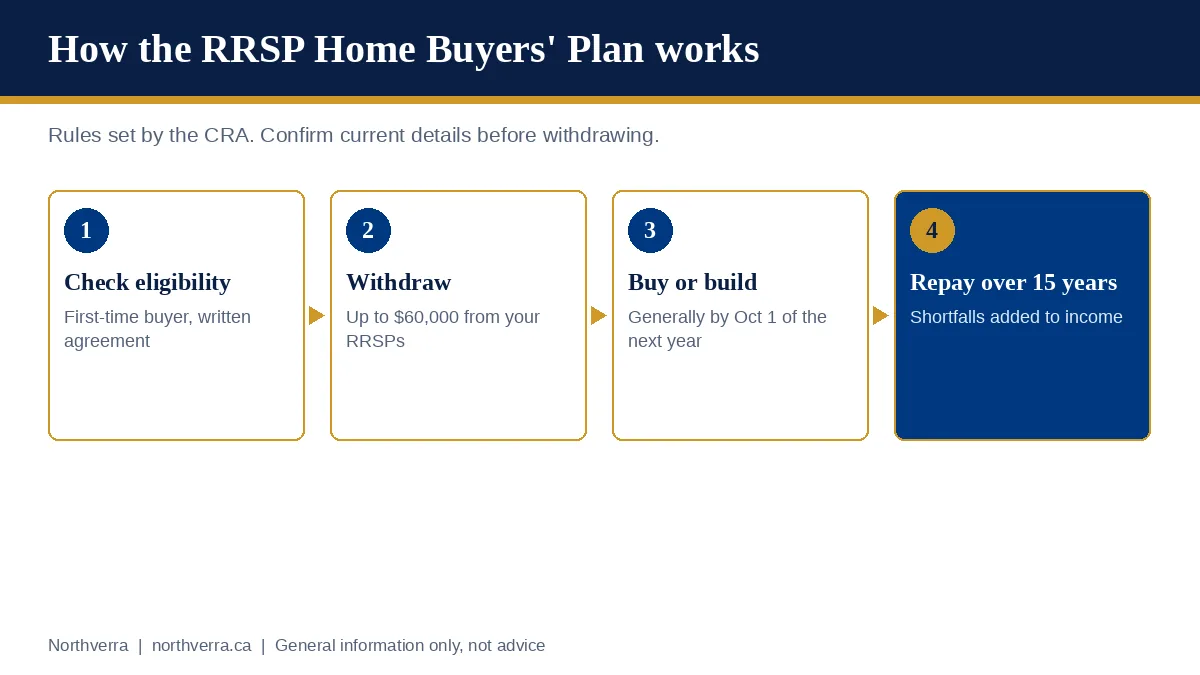
Under the HBP, you withdraw funds from your RRSPs to buy or build a qualifying home. As long as you meet the conditions, the RRSP issuer does not withhold tax on the withdrawal and it is not included in your income. You then repay the amount to your RRSPs over a set period. The main points, according to the Canada Revenue Agency:
- The maximum you can withdraw is $60,000 per person.
- If you buy with a spouse or common-law partner who also qualifies, each of you may be able to withdraw up to your own limit.
- You can generally make more than one withdrawal, but only in the calendar year of your first withdrawal and in January of the following year.
- Repayments are generally made over 15 years.
Who qualifies
In general you must be considered a first-time home buyer, which the CRA defines as not having lived in a home that you or your current spouse or common-law partner owned in a set period before the withdrawal. You must also have a written agreement to buy or build a qualifying home, intend to live in it as your principal place of residence, and be a resident of Canada. There are special rules for people with disabilities and for those whose marriage or common-law partnership has broken down. Always confirm your eligibility on the CRA website before withdrawing.
Repaying the HBP
Each year you must repay at least the scheduled amount, which is generally one-fifteenth of the total withdrawn. Repayments are made by contributing to your RRSP and designating them as HBP repayments on your tax return. If you repay less than required, the shortfall is added to your income for that year and taxed.
The start date depends on when you made your first withdrawal. Normally repayments begin in the second year after the year of withdrawal. The CRA has announced temporary relief: for first withdrawals made between January 1, 2026 and December 31, 2028, the repayment period starts in the fifth year after the year of withdrawal.
Example (hypothetical): Jordan makes a first HBP withdrawal of $40,000 in 2026. Under the temporary relief, his repayment period starts in 2031. His scheduled repayment is about $2,667 a year ($40,000 divided by 15). If he contributes only $1,500 as an HBP repayment one year, about $1,167 is added to his taxable income for that year. This is a hypothetical example; check the CRA’s current rules and your own statement of account.
Using the HBP with an FHSA
Eligible buyers can use both a First Home Savings Account and the HBP for the same home. The FHSA offers tax-deductible contributions and, for a qualifying withdrawal, no repayment requirement, while the HBP draws on RRSP savings and must be repaid. Many buyers use the FHSA first and the HBP as an extra source. Our guide to how the FHSA works explains the FHSA rules, and our article on RRSP vs TFSA basics covers RRSPs in general.
Things to watch
- The 90-day rule: RRSP contributions generally need to stay in the plan for at least 90 days before they can be withdrawn under the HBP, or they may not be deductible.
- Locked-in and group plans: money in locked-in accounts usually cannot be used, and some workplace plans have their own withdrawal rules.
- Closing dates: you generally have to buy or build the home by October 1 of the year after the withdrawal.
- Retirement impact: money withdrawn loses its tax-sheltered growth until it is repaid.
Is the Home Buyers’ Plan right for you?
It may suit you if you have RRSP savings, a solid plan to repay and a need for a larger down payment, for example to reach 20% or to reduce CMHC mortgage insurance. It may be less suitable if your budget is already tight, because the repayments are an added yearly commitment on top of your new mortgage. Our guide to how much down payment you need can help you set a target.
Common mistakes to avoid
- Withdrawing without confirming first-time buyer status.
- Contributing and withdrawing within 90 days.
- Forgetting to designate repayments on your tax return, so the CRA treats them as regular contributions.
- Missing repayments and being surprised by extra tax.
- Using the HBP without accounting for the impact on retirement savings.
Keeping records and checking your HBP balance
Each year after you participate, the CRA tracks your HBP balance and the minimum repayment due. You can generally see these details on your Notice of Assessment and in your CRA online account. Keep copies of the withdrawal forms, your purchase agreement and your RRSP statements in one place. When you file your return, report HBP repayments in the right section so they reduce your balance rather than counting as regular deductible contributions. If you change RRSP providers, move to a new province or have a change in your relationship, check how it affects your repayments. A tax professional can help if your situation is complicated.
Next step
If you are deciding how to combine your FHSA, RRSP and other savings for a down payment, we can help you map out the options and the repayment commitment.
More questions people ask
Do I pay tax on a Home Buyers’ Plan withdrawal?
Not if it is a qualifying withdrawal and you repay it on schedule. Amounts not repaid when due are added to your income for that year.
Can I repay the HBP faster?
Yes. You can repay more than the minimum in any year, which reduces your future required repayments.
Can my spouse and I both use the HBP?
If you both qualify, each of you may be able to withdraw up to the limit from your own RRSPs for the same home.
What happens if I do not buy a home?
Special rules apply, including cancelling your participation and returning the funds within a set time. Check the CRA’s guidance.
Related guides
Have a question? Start a conversation
Tell us a little about your situation. We will reply within one business day.
By submitting this form you agree that Northverra may contact you about your enquiry. Please do not include account numbers, health details or other sensitive information. See our Privacy Policy.
Important information. Mortgage approval, interest rates, terms and eligibility depend on the lender, your financial profile, the property and current market conditions, and are not guaranteed. Mortgage products and rates change. Nothing on this page is a commitment to lend or a quote of any rate. See our Disclosures.
Important information. The information on this page is general in nature, is provided for educational purposes only, and is not personalized financial, insurance, legal, tax or mortgage advice. Your circumstances are unique. Please speak with a properly licensed professional before making decisions. See our Disclosures.