
MORTGAGE QUESTIONS
What is CMHC mortgage insurance and when do I need it?
Short answer: CMHC mortgage insurance, also called mortgage default insurance, is required in Canada when you buy a home with less than 20% down. It protects the lender, not you, if a borrower defaults. The premium is a percentage of the mortgage, currently 2.80% to 4.00% depending on your down payment, and it is usually added to your mortgage balance rather than paid up front.
In this guide: What mortgage default insurance is · When CMHC mortgage insurance is required · How much the premium costs · How the premium is paid · Ways to reduce or avoid the premium · What insurance means for your options later · Common mistakes to avoid · Questions to ask your lender about insurance · FAQ

CMHC mortgage insurance is the reason most Canadians can buy a home with less than 20% down. It is provided by the Canada Mortgage and Housing Corporation and by private insurers that follow similar federal rules. Because the cost is folded into your mortgage, many buyers barely notice it, yet it can add thousands of dollars to what you borrow. Understanding how it works helps you decide how much to put down.
What mortgage default insurance is
When your down payment is under 20%, your mortgage is called “high-ratio”. Federal rules require lenders to insure these mortgages against default. If a borrower stops paying and the home is sold for less than what is owed, the insurer covers the lender’s loss. In exchange, lenders can offer high-ratio mortgages, often at competitive rates, to people who have not yet saved 20%.
It is important to be clear about who is protected. Mortgage default insurance protects the lender. It does not pay your mortgage if you lose your job, become ill or pass away. That is the role of other coverage, such as life or disability insurance; our page on whether you need life insurance if you have a mortgage explains the difference.
When CMHC mortgage insurance is required
- Your down payment is less than 20% of the purchase price.
- The purchase price is below $1.5 million, the maximum for an insured homeowner mortgage.
- The property is in Canada and meets the insurer’s requirements, generally a home you or a family member will live in, with up to four units.
CMHC also requires that at least one borrower or guarantor has a minimum credit score of 600, and its debt service guidelines are 39% for gross debt service and 44% for total debt service. Some lenders insure lower-ratio mortgages in bulk behind the scenes, but that cost is not usually charged directly to you.
How much the premium costs
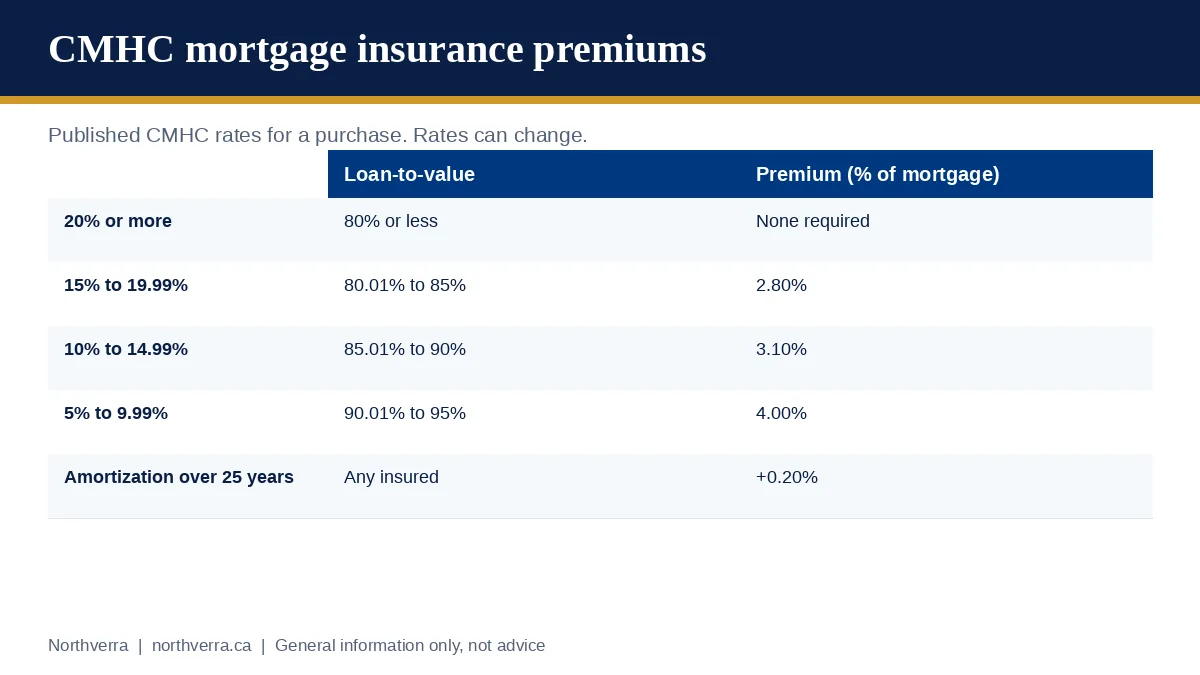
CMHC publishes premium rates based on the loan-to-value ratio, which is the mortgage amount as a percentage of the home’s value. Current published rates for a standard purchase are:
- 15% to 19.99% down (loan-to-value 80.01% to 85%): 2.80% of the mortgage.
- 10% to 14.99% down (loan-to-value 85.01% to 90%): 3.10% of the mortgage.
- 5% to 9.99% down (loan-to-value 90.01% to 95%): 4.00% of the mortgage.
CMHC adds a surcharge of 0.20% to the premium when the amortization is longer than 25 years. Rates can change, so confirm the current table with the insurer or your lender.
Example (hypothetical): A first-time buyer purchases a $500,000 home with 10% down ($50,000). The mortgage before insurance is $450,000. At 3.10%, the premium is $13,950, and the insured mortgage becomes $463,950. If the buyer chooses a 30-year amortization, the premium rate becomes 3.30%, or $14,850. These are hypothetical figures based on CMHC’s published rates.
How the premium is paid
Most borrowers add the premium to the mortgage, so it is paid off over the amortization along with interest. You can also pay it in cash at closing. Some provinces charge provincial sales tax on the premium, which must be paid at closing and cannot be added to the mortgage. Alberta does not have a provincial sales tax, so this does not apply to Alberta purchases, but your lawyer will confirm all closing amounts. See our guide to closing costs in Alberta.
Ways to reduce or avoid the premium
- Save a larger down payment. Crossing a tier, for example from 9% to 10%, lowers the rate on the whole mortgage.
- Put 20% or more down to avoid default insurance altogether.
- Use an FHSA or the RRSP Home Buyers’ Plan to boost your down payment. See how much down payment you need.
- Choose a 25-year amortization if the extra 0.20% for a longer amortization outweighs the benefit of lower payments for you.
Avoiding the premium is not always the best financial decision. If saving 20% would take many years, the premium may be a reasonable cost of buying sooner. It is worth comparing both paths.
What insurance means for your options later
An insured mortgage generally has a maximum amortization of 25 years, or up to 30 years for eligible first-time buyers and buyers of new builds. If you later refinance, the new loan cannot be insured in the same way, so refinancing usually requires at least 20% equity. Insured mortgages can be portable to a new home in many cases, and in some cases the insurance can be carried over, which may reduce a new premium. Ask your lender how it would work for you.
Common mistakes to avoid
- Thinking mortgage default insurance protects you or your family.
- Forgetting that the premium increases the mortgage, so you pay interest on it too.
- Missing a lower premium tier by a small amount of down payment.
- Overlooking the 0.20% surcharge when choosing a longer amortization.
Questions to ask your lender about insurance
Before you commit, ask your lender which insurer will be used, the exact premium rate and dollar amount, whether it will be added to the mortgage and how it affects your payment. If you are close to a lower premium tier, ask how much extra down payment would move you into it. If you may move within a few years, ask whether the mortgage is portable and how the insurance would be treated on a new purchase.
Next step
If you are deciding between a smaller down payment now and saving longer, we can compare the premium, the payments and your savings cushion side by side.
More questions people ask
Is CMHC insurance the same as mortgage life insurance?
No. Default insurance protects the lender if you stop paying. Mortgage life insurance and personal life insurance are separate products that protect you and your family.
Can I get a refund of the premium?
The premium is generally not refundable if you pay off the mortgage early. Ask about portability if you plan to move.
Do private insurers charge the same?
Private mortgage insurers in Canada follow similar federal rules and their premium tables are often similar. Your lender chooses the insurer.
Do I need CMHC insurance on a rental property?
Owner-occupied homes with up to four units can be insured. Rental properties you will not live in usually need 20% down. See our rental property mortgage guide.
Related guides
Have a question? Start a conversation
Tell us a little about your situation. We will reply within one business day.
By submitting this form you agree that Northverra may contact you about your enquiry. Please do not include account numbers, health details or other sensitive information. See our Privacy Policy.
Important information. Mortgage approval, interest rates, terms and eligibility depend on the lender, your financial profile, the property and current market conditions, and are not guaranteed. Mortgage products and rates change. Nothing on this page is a commitment to lend or a quote of any rate. See our Disclosures.