
MORTGAGE QUESTIONS
How much mortgage can I afford in Canada?
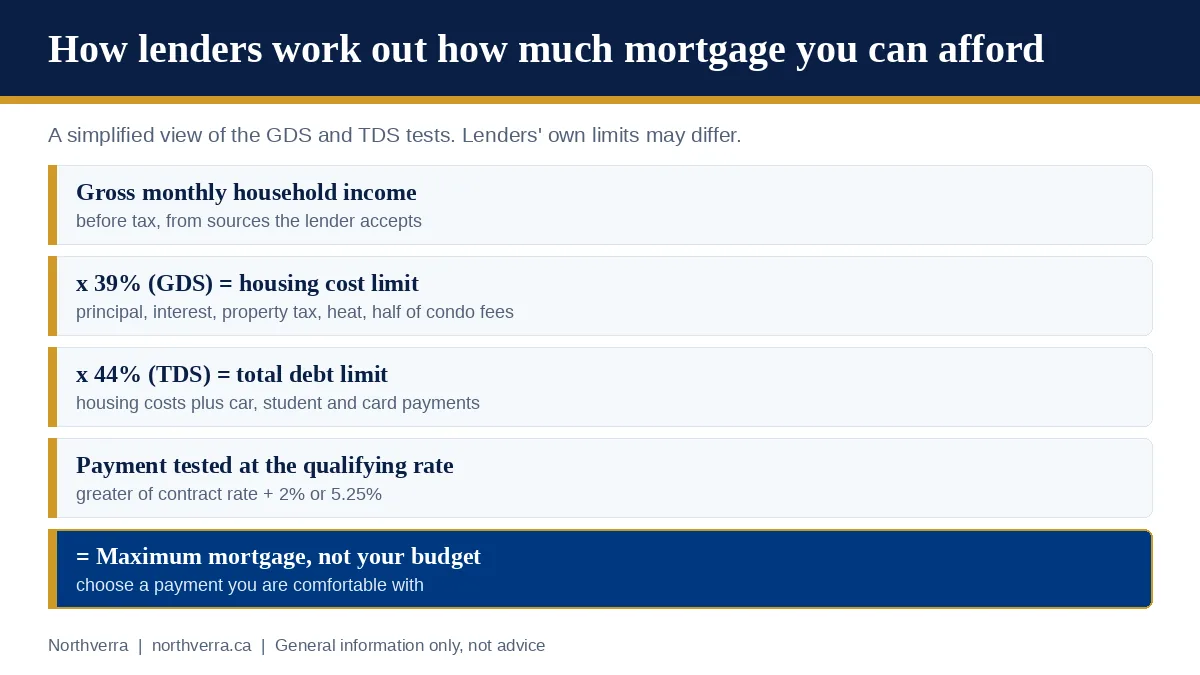
Short answer: How much mortgage you can afford depends on your gross income, your other debts, your down payment, the property’s costs and the qualifying rate lenders must use. Lenders work this out with two debt service ratios. The amount a lender approves is a ceiling, not a target: the right number is the payment you can carry comfortably while still saving and living your life.
In this guide: How lenders work out what you can afford · The two debt service ratios: GDS and TDS · A worked example · Your own number: what feels affordable · Ways to improve how much you can afford · Common mistakes to avoid · FAQ

“How much mortgage can I afford?” is usually the first question people ask when they start thinking about buying a home in Calgary or anywhere else in Alberta. There are really two answers. The first is the lender’s answer: the largest mortgage you can qualify for under Canadian lending rules. The second is your own answer: the payment that fits your budget, your plans and your peace of mind. This guide explains both, so you can walk into a pre-approval meeting knowing your numbers.
How lenders work out what you can afford
Canadian lenders look at affordability through a few key inputs. Each one can raise or lower the amount you qualify for.
- Gross household income: your income before tax, from employment, self-employment, pensions or other stable sources the lender accepts.
- Existing debts: car loans, student loans, credit card minimums, lines of credit and support payments.
- Housing costs: the mortgage payment, property taxes, heating and, for condos, part of the condo fees.
- The qualifying rate: lenders must test your payment at a rate higher than the one you will actually pay. Our guide to the mortgage stress test explains how it works.
- Your down payment: a larger down payment means a smaller loan, and below 20% the mortgage must be insured. See how much down payment you need.
- Credit history: lenders review how you have handled credit in the past. Our article on understanding your credit score covers the basics.
The two debt service ratios: GDS and TDS
Most affordability decisions in Canada come down to two percentages.
Gross debt service (GDS) ratio
GDS compares your monthly housing costs with your gross monthly income. Housing costs usually mean principal, interest, property taxes and heating, plus half of any condo fees. For insured mortgages, CMHC’s guideline is that this generally should not be more than 39% of gross household income.
Total debt service (TDS) ratio
TDS adds your other debt payments to the housing costs. For insured mortgages, CMHC’s guideline is that total debt payments generally should not be more than 44% of gross household income. Lenders can set their own, sometimes stricter, limits, and limits for uninsured mortgages vary by lender.
A worked example
Example (hypothetical): A Calgary couple earns a combined $120,000 a year, or $10,000 a month before tax. They expect property taxes of about $300 a month and heating of about $120 a month, and they have a $450 monthly car payment. At a 39% GDS limit, their housing costs can be up to $3,900 a month, which leaves about $3,480 for principal and interest. If the lender must qualify them at 6.5% over a 25-year amortization, that payment supports a mortgage of roughly $519,000. Their TDS check also passes: $3,900 plus $450 is $4,350, under the 44% limit of $4,400. At an actual contract rate of 4.5%, the real payment on that mortgage would be about $2,876 a month. All figures are hypothetical and rounded.
Notice two things in this example. First, the qualifying rate, not the contract rate, sets the limit. Second, the car payment matters: paying it off before applying would increase the amount the couple could qualify for. You can try your own numbers with the mortgage calculator on our Mortgage Financing page.
Your own number: what feels affordable
A lender’s maximum is built on gross income and a formula. It does not see your daycare costs, your travel plans, your retirement savings or how secure your job feels. Many buyers choose to borrow less than the maximum so they have room to breathe. When you set your own budget, think about:
- Take-home pay after tax, pension contributions and benefits, not gross pay.
- Ongoing ownership costs: maintenance, repairs, home insurance, utilities and, for condos, the full condo fee.
- Savings goals that should continue after you buy, such as an emergency fund and retirement.
- Life changes on the horizon: a parental leave, a career change, children or caring for a parent.
- What happens at renewal if rates are higher than they are today.
A useful test is to “practise” the payment. For a few months before you buy, set aside the difference between your current rent and your expected total housing cost. If it feels manageable, that is a good sign. If it feels tight, it may be worth adjusting your price range. Our guide to building an emergency fund explains why a cash cushion matters once you own.
Ways to improve how much you can afford
If the number is lower than you hoped, there are practical levers:
- Pay down or pay off consumer debt, especially high-interest balances and car loans.
- Grow your down payment, for example through a First Home Savings Account or the RRSP Home Buyers’ Plan.
- Check your credit report for errors and keep card balances well below their limits.
- Consider a longer amortization if you are eligible, keeping in mind it increases total interest.
- Look at homes with lower property taxes or condo fees, which affect GDS directly.
- Apply with a co-borrower whose income can be counted, understanding that they share full responsibility for the debt.
Common mistakes to avoid
- Treating the maximum approval as the budget.
- Forgetting closing costs, moving costs and the first year of furniture and repairs.
- Taking on a new car loan or credit card balance just before applying or before closing.
- Relying on overtime, bonuses or new self-employment income that a lender may not count in full.
- Comparing homes on price alone without looking at taxes, fees and running costs.
Next step
If you would like to see how lenders might view your income and debts, and what a comfortable price range could look like for you, we can walk through it together with no obligation.
More questions people ask
Is there a simple rule of thumb for affordability?
Some people use a multiple of income, but it ignores debts, taxes, fees and rates. The GDS and TDS ratios, tested at the qualifying rate, give a much more realistic picture.
Do lenders use gross or net income?
Lenders generally use gross income, before tax. Your own budget should use take-home pay, which is why a lender’s maximum can feel higher than what is comfortable.
Does a bigger down payment increase how much I can afford?
It increases the price you can pay for the same mortgage, and below 20% it can also reduce the cost of mortgage insurance. It does not change the income test on the mortgage itself.
Should I get pre-approved before I start looking?
Usually, yes. A mortgage pre-approval gives you an estimate of what a lender may lend and can hold a rate for a period, though it is not a final approval.
Related guides
Have a question? Start a conversation
Tell us a little about your situation. We will reply within one business day.
By submitting this form you agree that Northverra may contact you about your enquiry. Please do not include account numbers, health details or other sensitive information. See our Privacy Policy.
Important information. Mortgage approval, interest rates, terms and eligibility depend on the lender, your financial profile, the property and current market conditions, and are not guaranteed. Mortgage products and rates change. Nothing on this page is a commitment to lend or a quote of any rate. See our Disclosures.