
MORTGAGE QUESTIONS
How does a mortgage pre-approval work?
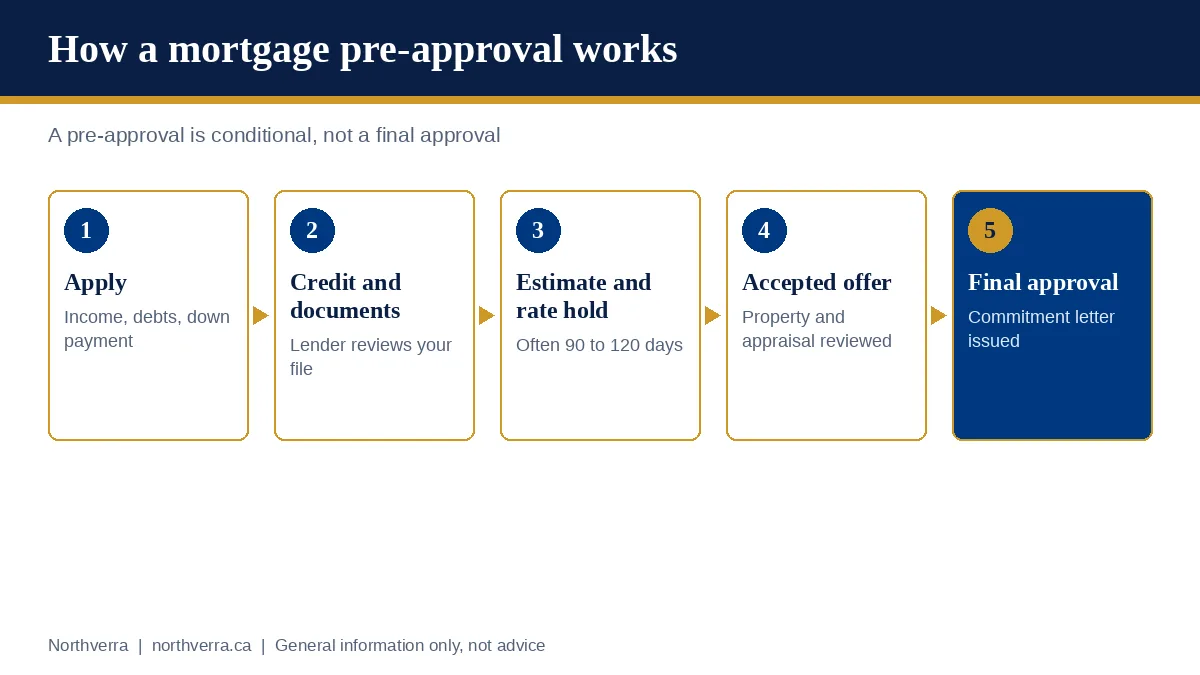
Short answer: A mortgage pre-approval is a lender’s conditional review of your income, debts, credit and down payment that estimates how much you may borrow and often holds an interest rate for a set period. It helps you shop with a realistic budget and move quickly on an offer, but it is not a final approval: the lender still has to approve the specific property and confirm your details.
In this guide: What a mortgage pre-approval is · What lenders check · Documents to gather · How long a pre-approval lasts · Why a pre-approval is not a guarantee · Does a pre-approval affect my credit score? · Common mistakes to avoid · Pre-approval and the rate hold: making the most of it · What happens after your offer is accepted · FAQ

A mortgage pre-approval is one of the most useful steps before you start viewing homes. It turns a vague budget into a working number, shows you what a lender will need from you and can protect you from rising rates while you search. It also has limits that are important to understand, because a pre-approval is not a promise to lend.
What a mortgage pre-approval is
When you apply for a pre-approval, a lender or mortgage professional reviews your financial picture and estimates the maximum mortgage you may qualify for. Many lenders also offer a rate hold, which guarantees a rate for a period, often in the range of 90 to 120 days depending on the lender. If rates rise while you shop, you keep the held rate. If rates fall, many lenders will give you the lower rate when you finalize.
It helps to know the difference between three terms that are often used loosely:
- Pre-qualification: a quick estimate based on what you tell the lender, usually without documents or a credit check.
- Pre-approval: a fuller review with a credit check and, ideally, documents, leading to a conditional estimate and often a rate hold.
- Final approval: given once you have an accepted offer and the lender has verified your documents and approved the property.
What lenders check
A pre-approval covers the same areas as a full application:
- Your income and how stable it is, including employment type and length.
- Your debts and monthly payments, used to calculate your debt service ratios.
- Your credit report and score. Our article on understanding your credit score explains what affects it.
- Your down payment amount and where it comes from.
- The qualifying rate under the mortgage stress test.
Documents to gather
Having documents ready makes the pre-approval more reliable and speeds up the final approval later. Lenders commonly ask for:
- Photo identification.
- A recent pay stub and an employment letter showing your position, salary and start date.
- Notices of Assessment and T4 slips from the Canada Revenue Agency, often for the last two years.
- For self-employed borrowers, two years of tax returns and financial statements. See our guide to self-employed mortgages.
- About 90 days of statements for your down payment accounts, plus any gift letter.
- Details of existing debts and any property you own.
How long a pre-approval lasts
The rate hold has an expiry date, and the lender’s review of your file is based on your situation at that moment. If you have not bought by the expiry, you can usually apply for a new pre-approval, though the rate may change. If your income, debts or credit change in the meantime, the estimate may no longer be valid.
Example (hypothetical): Maya is pre-approved for up to $480,000 with a 120-day rate hold. Two months later she finds a townhouse and makes an offer conditional on financing. The lender then reviews the townhouse, including its appraised value and condo documents, and confirms her income again. Because the appraisal comes in slightly below the price, she needs to add a little more to her down payment before the lender gives final approval. This is a hypothetical example.
Why a pre-approval is not a guarantee
Final approval can still be declined or changed if:
- The property does not meet the lender’s requirements, for example its condition, type or appraised value.
- Your employment, income or debts change before closing.
- Information in your application cannot be verified.
- Condo documents reveal issues such as low reserve funds or special assessments.
This is why most buyers make offers with a financing condition and keep their finances stable until closing day. Avoid new credit, large purchases or job changes until the purchase is complete if you can.
Does a pre-approval affect my credit score?
A pre-approval usually involves a credit check, which can have a small, temporary effect on your score. Multiple mortgage inquiries within a short shopping period are often treated less harshly than many unrelated credit applications, but scoring models differ. Shopping in a focused window is sensible.
Common mistakes to avoid
- Treating the pre-approved maximum as your budget. Our guide to how much mortgage you can afford explains why.
- Getting pre-approved without supplying documents, which makes the estimate less dependable.
- Letting the rate hold expire without noticing.
- Buying a car or financing furniture before closing.
- Making an offer without a financing condition unless you fully understand the risk.
Pre-approval and the rate hold: making the most of it
A rate hold is most valuable when rates are rising, but it only helps if you use it. Note the expiry date in your calendar and ask your lender or broker what happens if you are close to the deadline when you find a home. Some lenders allow a short extension, and others require a fresh application. It is also worth asking whether the held rate applies to every term and product, or only to the one you chose. If you think you may want a different term, a variable rate or a longer amortization, raise it early so the pre-approval reflects the mortgage you are likely to take. Finally, remember that the rate is only one part of the offer. Prepayment privileges, penalty calculations and portability can matter as much over a five-year term, and our guide to open vs closed mortgages explains why flexibility has a price.
What happens after your offer is accepted
Once you have an accepted offer, send the purchase agreement and any listing details to your lender quickly. The lender will usually order an appraisal, review condo documents if applicable, verify your documents and issue a commitment letter with the final terms. Read the conditions carefully, provide anything outstanding before the deadline and only remove your financing condition when you are satisfied the conditions are met.
Next step
If you are planning to start house hunting, we can help you prepare your documents, understand the pre-approval estimate and set a budget that fits.
More questions people ask
Does a pre-approval cost anything?
Pre-approvals are commonly offered without charge by lenders and mortgage professionals. Ask up front if any fee applies.
Can I get pre-approved by more than one lender?
Yes. Comparing offers can be worthwhile, but keep the applications within a short period to limit the effect on your credit file.
Is the rate in a pre-approval guaranteed?
It is guaranteed only if it comes with a rate hold, and only until the hold expires and subject to final approval.
How is a pre-approval different from a mortgage commitment?
A commitment is issued once the lender has reviewed the actual property and your verified documents. It sets out the final terms and conditions.
Related guides
Have a question? Start a conversation
Tell us a little about your situation. We will reply within one business day.
By submitting this form you agree that Northverra may contact you about your enquiry. Please do not include account numbers, health details or other sensitive information. See our Privacy Policy.
Important information. Mortgage approval, interest rates, terms and eligibility depend on the lender, your financial profile, the property and current market conditions, and are not guaranteed. Mortgage products and rates change. Nothing on this page is a commitment to lend or a quote of any rate. See our Disclosures.