
MORTGAGE QUESTIONS
Open vs closed mortgage: what is the difference?
Short answer: An open mortgage lets you pay off part or all of the balance at any time without a prepayment penalty, but it usually has a higher interest rate and shorter terms. A closed mortgage has a lower rate and limits how much extra you can pay each year; paying more than those limits, or breaking it early, triggers a penalty. Most Canadians choose closed mortgages, while open terms suit short-term or transitional needs.
In this guide: How an open mortgage works · How a closed mortgage works · When an open mortgage can make sense · Comparing the cost of flexibility · Other ways to keep flexibility · Converting between open and closed · Common mistakes to avoid · Reading the fine print on a closed mortgage · FAQ
The open vs closed mortgage choice is really a choice between flexibility and cost. Both are common products in Canada, and both can be fixed or variable. Knowing how each one handles extra payments and early payoff will help you avoid paying for flexibility you never use, or getting caught by a penalty you did not expect.
How an open mortgage works
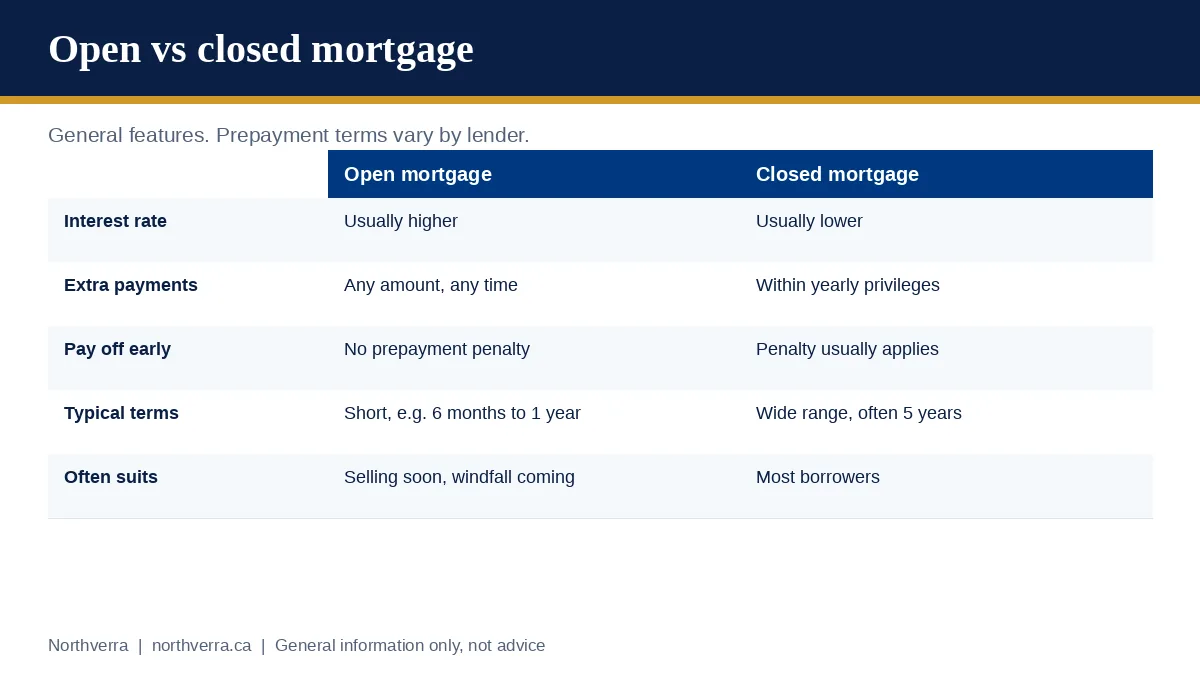
With an open mortgage, you can repay any amount, including the whole balance, at any time without a prepayment charge. Open terms are often short, such as six months or one year, and are available as fixed or variable rates depending on the lender. The flexibility comes at a price: open rates are usually noticeably higher than closed rates for a similar term, so you pay more interest on the balance you keep.
How a closed mortgage works
A closed mortgage gives you a lower rate in exchange for limits on prepayment. Most closed mortgages still include prepayment privileges, which commonly allow:
- an annual lump-sum payment up to a set percentage of the original principal, and
- an increase to your regular payment up to a set percentage.
The percentages vary by lender and product. Paying more than these privileges allow, paying off the mortgage early or breaking it to refinance or switch lenders before maturity usually triggers a prepayment penalty. Our guide to mortgage prepayment penalties explains how the penalty is calculated.
When an open mortgage can make sense
- You are selling your home soon and do not want a penalty when the sale closes.
- You expect a large sum, such as an inheritance, a bonus or the sale of a business or investment, and plan to pay off a big part of the mortgage.
- You are between plans, for example waiting for rates or a refinance, and need a short bridge.
- You want to pay the mortgage off completely within a short time.
In many other situations, a closed mortgage with generous prepayment privileges offers enough flexibility at a lower rate.
Example (hypothetical): Nadia expects to sell her condo in about eight months and move in with her partner. She is renewing now. A 1-year open term costs more in interest than a closed term would, but she will avoid a penalty when the sale closes. Her advisor compares the extra interest over eight months with the estimated penalty on a closed term, and the open term comes out ahead for her situation. These are hypothetical facts used only to show the comparison.
Comparing the cost of flexibility
A simple way to decide is to estimate both paths:
- Calculate the extra interest you would pay on an open rate over the time you expect to keep the mortgage.
- Estimate the penalty you would face on a closed mortgage if your plan happens, and the chance it happens.
- Check whether the closed mortgage’s prepayment privileges or portability would cover your plan without a penalty.
- Compare the totals, and include the value you place on certainty.
You can test the payment at different rates in our mortgage calculator.
Other ways to keep flexibility
- Portability: many closed mortgages can move with you to a new home, avoiding a penalty if you buy and sell at the same time.
- Variable closed mortgages: penalties are usually three months’ interest, which is often smaller than fixed-rate penalties. See fixed vs variable mortgages.
- A HELOC or readvanceable mortgage: part of your borrowing can be open while the rest is closed. See what a HELOC is.
- A shorter closed term that ends near the date you expect a change. Our guide to choosing a mortgage term explains the options.
Converting between open and closed
Many lenders allow you to convert an open mortgage to a closed term at any time, often at the lender’s current closed rate. Moving from closed to open in the middle of a term is less common and may involve a penalty. If you start with an open term while you wait for a decision, ask how the conversion works and how the rate would be set.
Common mistakes to avoid
- Paying a higher open rate for years without using the flexibility.
- Assuming a closed mortgage allows no extra payments; most allow some each year.
- Forgetting to check how prepayment privileges reset each year, often on the anniversary or calendar year.
- Breaking a closed mortgage without first asking about portability or blending.
Reading the fine print on a closed mortgage
Two closed mortgages with the same rate can behave very differently. Before signing, read the prepayment section of the commitment letter and mortgage terms. Look for the annual lump-sum limit, the payment-increase limit, whether privileges apply from the first day or only after a waiting period, and whether using them affects anything else, such as your ability to skip a payment. Look also at the penalty clause: whether it refers to posted rates, discounted rates or a specific formula, and whether there are separate administration or reinvestment fees. If the language is unclear, ask the lender to explain it in writing. Our article on what to review at mortgage renewal lists similar questions to ask when your term ends.
Next step
If you expect a sale, a windfall or a change in plans, we can compare open and closed options with you and estimate the cost of each path.
More questions people ask
Are open mortgages always variable?
No. Open mortgages can be fixed or variable, depending on what the lender offers. They tend to have shorter terms.
Can I make extra payments on a closed mortgage?
Usually yes, within the prepayment privileges in your contract. Amounts beyond those limits may trigger a penalty.
Is there a penalty to pay off an open mortgage?
No prepayment penalty applies to an open mortgage, although there may be administrative or discharge fees when you pay it off.
Do most people choose closed mortgages?
Yes. Closed mortgages are more common because of their lower rates, and their prepayment privileges meet many people’s needs.
Related guides
Have a question? Start a conversation
Tell us a little about your situation. We will reply within one business day.
By submitting this form you agree that Northverra may contact you about your enquiry. Please do not include account numbers, health details or other sensitive information. See our Privacy Policy.
Important information. Mortgage approval, interest rates, terms and eligibility depend on the lender, your financial profile, the property and current market conditions, and are not guaranteed. Mortgage products and rates change. Nothing on this page is a commitment to lend or a quote of any rate. See our Disclosures.