
MORTGAGE QUESTIONS
How do I choose a mortgage term?
Short answer: To choose a mortgage term, match the length of your contract to how long you expect to keep the mortgage unchanged and how much payment certainty you need. Short terms offer flexibility and earlier renewal; long terms offer certainty but can carry higher rates and larger penalties if you break them. The 5-year term is common, but it is not automatically the right choice.
In this guide: What a mortgage term is · Short, medium and long terms · Questions to ask yourself · Features to compare along with the term · Planning for renewal · Common mistakes to avoid · How rates for different terms compare · Matching the term to life events · FAQ

When you choose a mortgage term, you are deciding how long your rate and conditions are set before you renew. Terms in Canada typically run from six months to ten years. The term you pick affects your rate, your risk at renewal and how much it may cost to change course if life changes. This guide focuses on the term, while our guide to mortgage amortization covers the full repayment timeline.
What a mortgage term is
The term is the length of your current mortgage contract. During the term, you have an agreed rate type (fixed or variable), payment, prepayment privileges and penalty rules. When the term ends, you can renew with your lender, switch to another lender or pay off the balance. Most Canadians go through several terms before the mortgage is paid off.
Short, medium and long terms
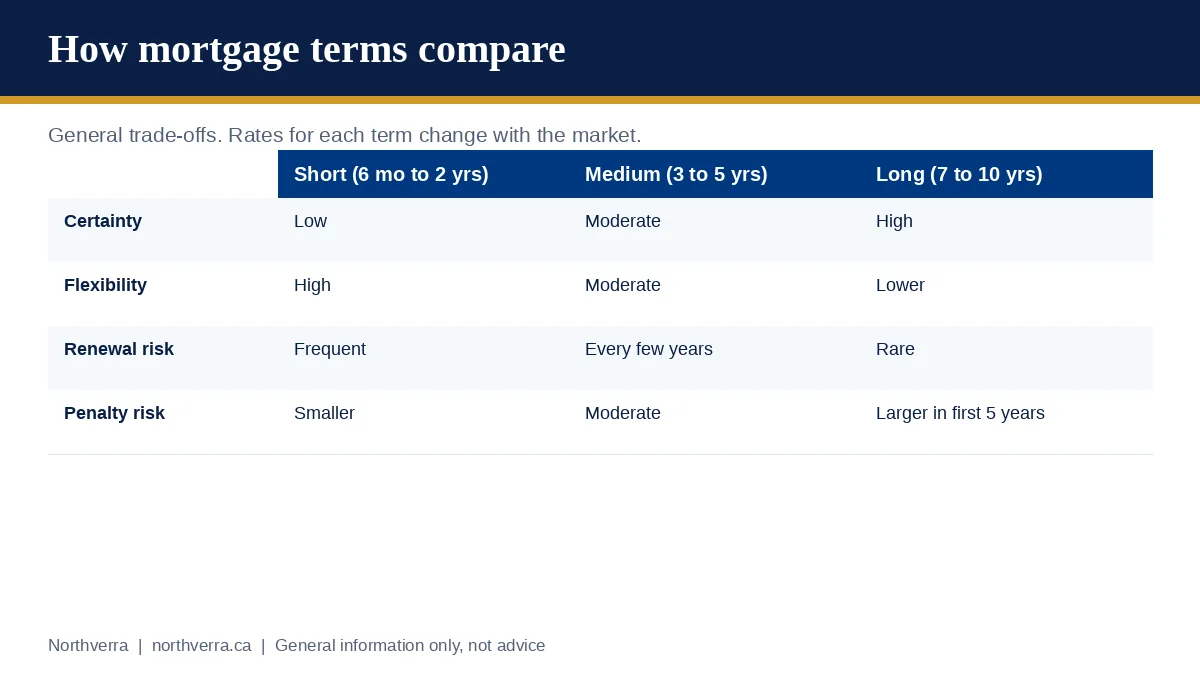
Short terms (six months to two years)
Short terms let you renew sooner, which can help if you expect to sell, receive a large sum or want to reassess rates soon. They can carry lower or higher rates than longer terms depending on the market. The trade-off is that you face renewal, and potentially higher rates, more often.
Medium terms (three to five years)
The 5-year term is the most common in Canada, partly out of habit and partly because it balances certainty and flexibility. A 3- or 4-year term can be a useful middle ground if you expect changes within five years.
Long terms (seven to ten years)
Long terms lock in certainty for a long period, which some households value highly. Rates are often higher, and if you break the mortgage early the penalty can be large. Under the federal Interest Act, for terms longer than five years, individuals can generally repay after the fifth year with a maximum of three months’ interest as the penalty. See how prepayment penalties are calculated.
Questions to ask yourself
- How likely is it that you will sell, move, refinance or pay off the mortgage before the term ends?
- How would your budget cope if the rate at your next renewal were higher?
- Are you expecting a change in income, such as a leave, retirement or a new business?
- Do you want the option to combine debts or access equity in the next few years?
- How much does payment certainty matter to you compared with flexibility?
If your answers point to change, a shorter term or a variable rate with a lower penalty may fit. If they point to stability and a tight budget, a longer fixed term may give peace of mind. Our comparison of fixed vs variable mortgages covers the rate-type decision that usually goes with the term.
Example (hypothetical): Aisha expects to relocate for work in about three years. A 5-year fixed term might leave her paying a penalty when she sells, unless the mortgage is portable to her next home. She compares a 3-year fixed term with a 5-year term that has good portability terms and decides based on the rate difference and the moving date. This is a hypothetical scenario.
Features to compare along with the term
- Prepayment privileges: how much extra you can pay each year without a penalty.
- Penalty calculation: especially how the lender calculates an interest rate differential.
- Portability: whether you can take the mortgage to a new home.
- Assumability: whether a qualified buyer could take over the mortgage.
- Open or closed: an open term allows full repayment without penalty but usually at a higher rate; see open vs closed mortgages.
Planning for renewal
Whatever term you choose, the end of it is a decision point. Lenders generally send a renewal statement before maturity, and federally regulated lenders must provide it at least 21 days before. Start comparing well before that, because you may be able to switch lenders or change your term. Our article on what to review at mortgage renewal has a checklist.
Common mistakes to avoid
- Picking a 5-year term automatically without considering your plans.
- Comparing rates without comparing penalties and portability.
- Choosing a long term to “beat” rates you expect to rise, without allowing for the chance you will need to break it.
- Letting a mortgage auto-renew without reviewing your options.
How rates for different terms compare
Lenders set separate rates for each term, and the relationship between short and long terms changes with market conditions. Sometimes longer terms cost more than shorter ones, and sometimes the reverse is true. Fixed rates are influenced by bond yields for similar periods, while variable rates follow prime. Rather than trying to predict rates, compare the total cost and risk of each option for your plans: the payment, the expected balance at maturity, the penalty if you break early and what you would do at renewal. You can test different rates in the mortgage calculator.
Matching the term to life events
A good rule of thumb is to look at the next five years of your life and write down anything that could change your mortgage: a move, a growing family, a separation, an inheritance, retirement or a business sale. If several are possible, flexibility has value, and a shorter term, an open option or a mortgage with generous portability may be worth a slightly higher rate.
Next step
If you are choosing a term for a purchase or a renewal, we can compare options with you, including penalties and portability, so the term fits your plans.
More questions people ask
What is the most common mortgage term in Canada?
The 5-year term is the most common, but shorter and longer terms are widely available and may suit some households better.
Can I change my term in the middle of it?
Sometimes, through an early renewal or a blend-and-extend offer from your lender. These may involve a penalty or a blended rate.
Is a longer term safer?
It offers more certainty about your rate, but it can cost more and carry larger penalties if you break it. Safety depends on how likely you are to keep the mortgage unchanged.
When should I start shopping before my term ends?
Many people start several months before maturity. Some lenders allow early renewal or a rate hold within a set window.
Related guides
Have a question? Start a conversation
Tell us a little about your situation. We will reply within one business day.
By submitting this form you agree that Northverra may contact you about your enquiry. Please do not include account numbers, health details or other sensitive information. See our Privacy Policy.
Important information. Mortgage approval, interest rates, terms and eligibility depend on the lender, your financial profile, the property and current market conditions, and are not guaranteed. Mortgage products and rates change. Nothing on this page is a commitment to lend or a quote of any rate. See our Disclosures.