
MORTGAGE QUESTIONS
How is a mortgage prepayment penalty calculated?
Short answer: A mortgage prepayment penalty is what a lender charges when you pay more than your contract allows or break a closed mortgage before its term ends. For variable mortgages it is usually three months’ interest. For fixed mortgages it is usually the greater of three months’ interest or an interest rate differential (IRD), which can be much larger. Your contract sets the exact method, so ask for a written estimate.
In this guide: When a prepayment penalty applies · Method 1: three months’ interest · Method 2: the interest rate differential (IRD) · A worked example · The five-year rule for longer terms · Ways to reduce or avoid a penalty · Questions to ask your lender · Common mistakes to avoid · Penalties when you sell and buy at the same time · Keep a record of what you agreed to · FAQ

A mortgage prepayment penalty can be the most expensive surprise in home ownership. People break mortgages for many reasons: selling, refinancing, separating, switching lenders or paying off a large amount. The penalty is designed to compensate the lender for the interest it expected to earn. Knowing how it is calculated helps you plan and, sometimes, reduce or avoid it.
When a prepayment penalty applies
- You pay off the entire closed mortgage before maturity, for example when you sell.
- You refinance before maturity to borrow more or change the terms.
- You switch to another lender mid-term.
- You make extra payments beyond your annual prepayment privileges.
Penalties do not usually apply to payments within your privileges, at maturity, or on an open mortgage. Our guide to open vs closed mortgages explains the difference.
Method 1: three months’ interest
This is the simpler calculation: roughly three months of interest on the amount you are prepaying, at your mortgage rate. It is the usual penalty on variable-rate mortgages and the minimum on most fixed-rate mortgages.
Method 2: the interest rate differential (IRD)
The IRD compares your mortgage rate with the rate the lender could charge today for a term close to the time left on your mortgage, then applies that difference to the amount you are prepaying for the remaining term. If current rates are lower than your rate, the IRD can be large. If current rates are higher, the IRD may be small or zero, and three months’ interest applies.
Lenders calculate the IRD differently. Some use posted rates and subtract any discount you received when you signed, which can make the penalty larger. This is one reason why penalties on similar mortgages can vary widely between lenders. The Financial Consumer Agency of Canada recommends asking your lender how the penalty is calculated and getting an estimate before you decide.
A worked example
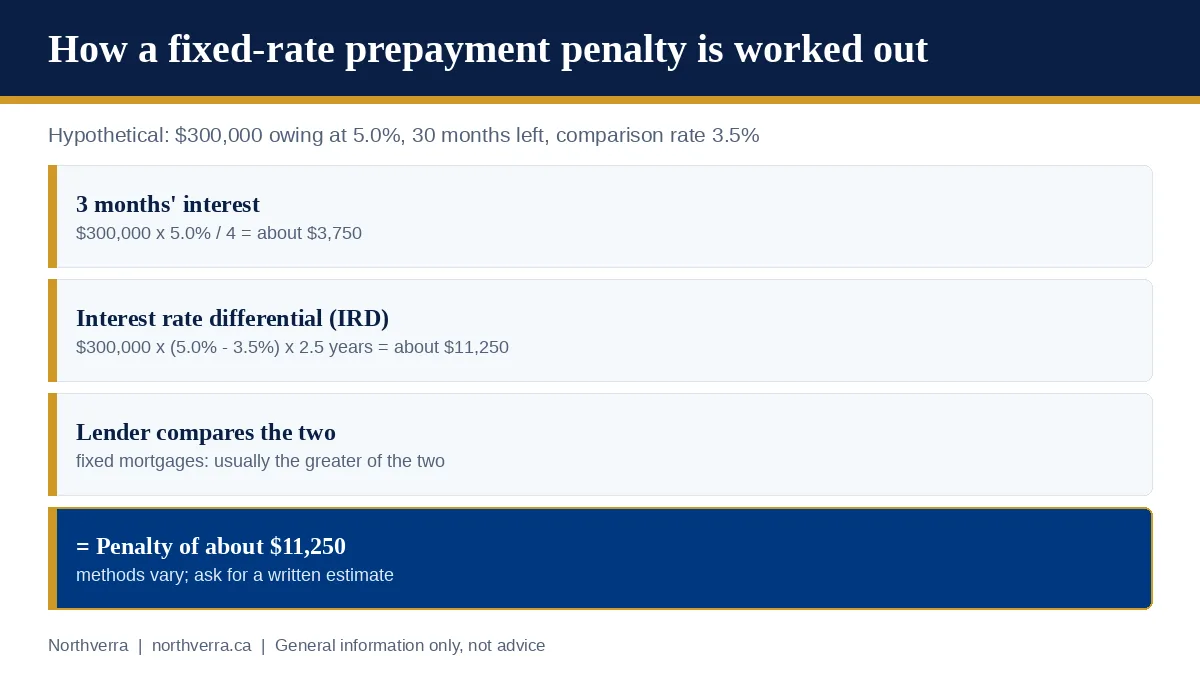
Example (hypothetical): Chris has a fixed-rate mortgage at 5.0% with $300,000 owing and 30 months left in his term. Three months’ interest is about $3,750 ($300,000 x 5.0% / 4). His lender’s comparison rate for a 2.5-year term is 3.5%, so a simple IRD is about $11,250 ($300,000 x 1.5% x 2.5 years). Because the IRD is larger, the penalty would be about $11,250. Using a posted-rate method could make it even higher. These are hypothetical, simplified figures; each lender’s formula differs.
The five-year rule for longer terms
Under section 10 of the federal Interest Act, if a mortgage term is longer than five years, an individual borrower can generally repay it after the fifth anniversary by paying no more than three months’ interest as a penalty. This is one reason to understand the rules before choosing a long term; see how to choose a mortgage term.
Ways to reduce or avoid a penalty
- Use your prepayment privileges first. Paying the maximum lump sum allowed before breaking can reduce the balance the penalty is based on, if your lender allows it.
- Port your mortgage. If you are buying a new home, a portable mortgage may move with you without a penalty.
- Blend and extend. Some lenders blend your current rate with a new rate if you borrow more or renew early, instead of charging a full penalty.
- Time it with maturity. If you can wait until the term ends, there is usually no penalty.
- Have the buyer assume the mortgage, if your mortgage is assumable and the buyer qualifies.
- Compare the savings. When refinancing to a lower rate, compare the total interest saved with the penalty and fees. See when refinancing makes sense.
Questions to ask your lender
- How exactly is my penalty calculated, and which comparison rate is used?
- Can I make my annual prepayment before paying out the mortgage?
- Is my mortgage portable or assumable, and on what conditions?
- What other fees apply, such as discharge or administration fees?
- Can you give me a written penalty estimate valid for a specific date?
Common mistakes to avoid
- Choosing a mortgage only on rate, without asking how penalties are calculated.
- Assuming three months’ interest applies to a fixed-rate mortgage.
- Breaking a mortgage to save a small amount of interest that the penalty wipes out.
- Forgetting to ask about porting or blending before selling or refinancing.
Penalties when you sell and buy at the same time
If you are moving, the penalty question usually comes up before you list your home. Ask your lender whether your mortgage is portable, how long you have between selling and buying to port it, and how any additional borrowing would be priced. A port with extra borrowing is often handled through a blended rate. If the timing does not work, or if the new home needs a much smaller mortgage, you may still pay a penalty on part or all of the balance. Getting this information early lets you factor it into your sale price, your purchase budget and your choice of possession dates. Our guide to closing costs in Alberta covers the other costs that come with a move.
Keep a record of what you agreed to
Your commitment letter and mortgage terms describe the penalty method that applies to you. Keep them with your home documents, along with any later amendments, so you can check the calculation if you ever need a payout statement.
Next step
If you are thinking of selling, refinancing or switching, we can help you read your penalty estimate and compare it with the alternatives before you decide.
More questions people ask
Can a lender charge any penalty it wants?
The penalty must follow your mortgage contract and applicable law. Federally regulated lenders must disclose how prepayment charges are calculated.
Is the penalty lower on a variable mortgage?
Usually. Variable mortgages commonly charge three months’ interest, while fixed mortgages often charge the greater of three months’ interest or the IRD.
Do I pay a penalty if I sell my home?
If you pay off a closed mortgage before maturity, usually yes, unless you port the mortgage to a new home or the buyer assumes it.
Is the penalty tax-deductible?
For a home you live in, generally not. Rules can differ for rental or business properties, so ask a tax professional.
Related guides
Have a question? Start a conversation
Tell us a little about your situation. We will reply within one business day.
By submitting this form you agree that Northverra may contact you about your enquiry. Please do not include account numbers, health details or other sensitive information. See our Privacy Policy.
Important information. Mortgage approval, interest rates, terms and eligibility depend on the lender, your financial profile, the property and current market conditions, and are not guaranteed. Mortgage products and rates change. Nothing on this page is a commitment to lend or a quote of any rate. See our Disclosures.