
INVESTMENT QUESTIONS
How do GICs work in Canada?
Short answer: A GIC (Guaranteed Investment Certificate) is a deposit you leave with a bank, credit union or trust company for a fixed term, usually from a few months to five years. In return you typically earn a set rate of interest, and your principal is returned at maturity. Eligible GICs may be covered by deposit insurance up to set limits, but many cannot be cashed early.
In this guide: The basics · Main types of GICs · How interest is paid · Deposit insurance · Using GICs inside registered accounts · GIC laddering · When GICs can make sense · The trade-offs · Questions to ask before you buy · Common mistakes · GICs and your tax return · FAQ

If you have ever asked “how do GICs work?”, you are not alone. Many Canadians first meet GICs at their bank, often as a “safe” place for money they do not want to risk. Understanding how GICs work helps you decide when that safety is worth the trade-offs, and when another option might fit better. This guide covers the main types, how interest is paid, deposit insurance, taxes and the questions to ask before you lock money away.
The basics
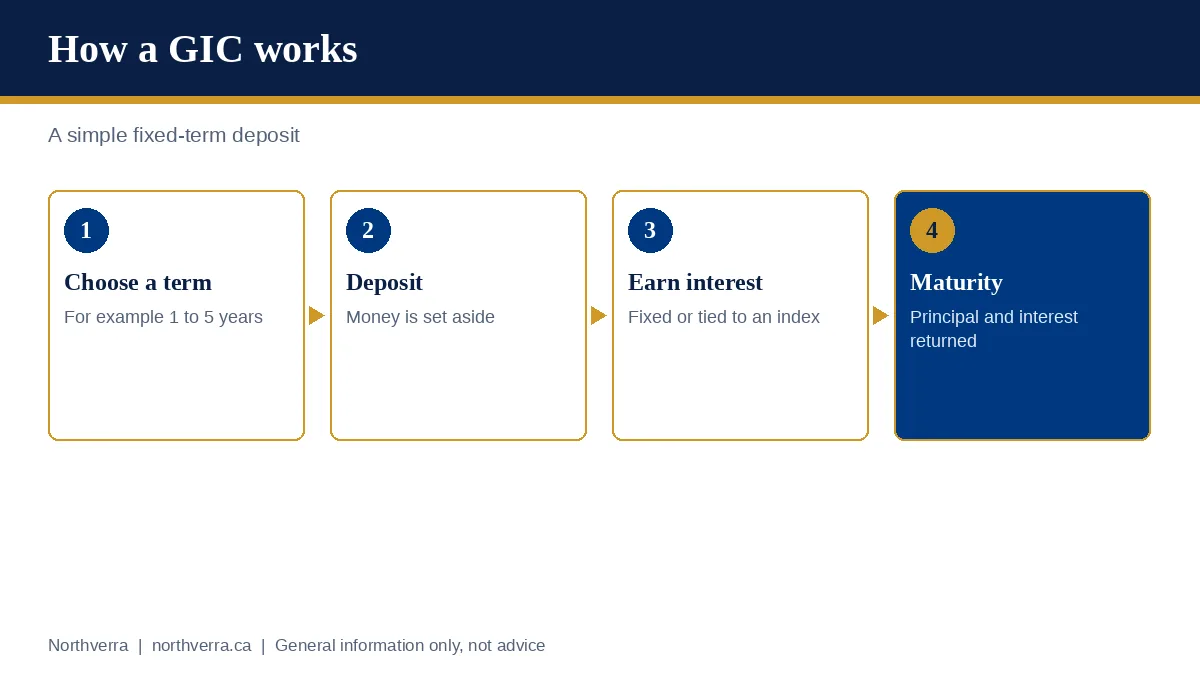
When you buy a GIC you agree to deposit a sum for a set term. The institution agrees to pay interest at a stated rate or according to a stated formula, and to return your deposit at the end. Longer terms often, but not always, offer higher rates. Rates change frequently with the interest rate environment, so compare current offers between institutions.
Main types of GICs
Non-redeemable (locked-in) GICs
You cannot withdraw the money before maturity, except in limited circumstances such as death. These often pay a higher rate than cashable versions in exchange for less flexibility.
Cashable or redeemable GICs
You can withdraw before maturity, sometimes after a short waiting period, usually at a lower rate or with reduced interest if you cash out early.
Market-linked GICs
Your principal is protected if held to maturity, but the interest depends on the performance of a stock market index or a basket of shares, often with a cap. You may earn little or no interest if markets perform poorly. Read the terms closely to understand how the return is calculated.
Escalating or step-up GICs
The rate rises each year of the term. Compare the average rate over the term with a regular fixed GIC.
How interest is paid
Some GICs pay interest monthly, semi-annually or annually, while others compound interest and pay it all at maturity. Compound GICs can earn interest on interest. Either way, outside a registered account, interest is generally taxable each year as it accrues, even if you do not receive it until the end.
Deposit insurance
The Canada Deposit Insurance Corporation (CDIC) insures eligible deposits, including GICs, at member institutions up to $100,000 per insured category, per member institution, including principal and interest. Categories include, for example, deposits held in your own name, joint deposits, TFSAs, RRSPs, RRIFs, FHSAs and RESPs. Credit unions in Alberta are covered by a separate provincial guarantee, the Credit Union Deposit Guarantee Corporation. Check that the institution and product are covered before you buy, and check the limits for your situation.
Using GICs inside registered accounts
GICs can be held inside a TFSA, RRSP, RRIF, FHSA or RESP. Holding them in a TFSA means interest is not taxed. Many people use GICs inside an FHSA as a home purchase approaches, or inside a RRIF for part of their near-term income needs.
GIC laddering
A ladder spreads money across several GICs with different maturity dates, for example one-, two-, three-, four- and five-year terms. Each year one matures, giving you access to part of the money and a chance to reinvest at current rates. Laddering can reduce the risk of locking everything in at a low rate, and it provides regular access to funds.
Example (hypothetical): Lena has $10,000 she wants to keep safe for future home repairs. She splits it into five $2,000 GICs maturing one to five years from now. Each year, one GIC matures; she either uses the money or reinvests it in a new five-year GIC. This is an illustration only, not a recommendation.
When GICs can make sense
- Money you will need on a known date within a few years.
- Part of an emergency reserve beyond what you keep fully liquid.
- The stable portion of a retirement portfolio.
- Situations where you want certainty and cannot afford a loss.
The trade-offs
- Inflation: after tax, a GIC’s interest may not keep pace with rising prices. See how inflation affects your savings.
- Liquidity: locked-in GICs tie up money for the full term.
- Opportunity cost: money in GICs does not participate in long-term stock market growth.
- Reinvestment risk: rates may be lower when your GIC matures.
Questions to ask before you buy
- Is this GIC cashable or locked-in, and what happens if I need the money early?
- How and when is interest paid?
- Is it covered by CDIC or a provincial deposit guarantee?
- Does it automatically renew at maturity, and at what rate?
- For market-linked GICs, how exactly is the return calculated and capped?
Common mistakes
- Letting a GIC renew automatically at a low posted rate without comparing.
- Putting money you might need into a non-redeemable term.
- Exceeding deposit insurance limits at one institution without realizing it.
- Treating market-linked GICs as if they pay a fixed rate.
GICs and your tax return
Outside a registered account, GIC interest is reported on a T5 slip and taxed at your full marginal rate. For multi-year compound GICs, interest generally has to be reported each year as it accrues, even though you receive nothing until maturity, so set aside money for the tax. Holding GICs inside a TFSA avoids this, and holding them in an RRSP or RRIF defers it until withdrawal. If you are in a high tax bracket, compare the after-tax return with other options, and remember that a rate which looks attractive before tax may be modest after tax and inflation.
Next step
Wondering how GICs might fit alongside your other savings? We can review your timeline and options with you.
More questions people ask
Can I lose money in a GIC?
If you hold a regular GIC to maturity at a sound institution, your principal is returned. Market-linked GICs may pay little or no interest. The main risk is that returns do not keep up with inflation.
Are GICs better than a high-interest savings account?
GICs may pay more in exchange for locking your money in. Savings accounts offer full access. Many people use both.
Do GIC rates change after I buy?
For a fixed-rate GIC, no. The rate is set for the term. New GICs you buy later will be at whatever rates are offered then.
Are GICs the same as bonds?
No. A GIC is a deposit with an institution, while a bond is a debt security that can be traded and can change in price. See stocks vs bonds.
Related guides
Have a question? Start a conversation
Tell us a little about your situation. We will reply within one business day.
By submitting this form you agree that Northverra may contact you about your enquiry. Please do not include account numbers, health details or other sensitive information. See our Privacy Policy.
Important information. Investing involves risk, including the possible loss of the amount invested. The value of investments can go down as well as up, and past performance does not guarantee future results. Nothing on this page is a recommendation or a promise of any return. Diversification and asset allocation do not ensure a profit or protect against loss. See our Disclosures.