
INVESTMENT QUESTIONS
RRSP to RRIF conversion: when should I convert?
Short answer: You must wind up your RRSP by December 31 of the year you turn 71. Most people convert it to a RRIF (Registered Retirement Income Fund), which keeps the money invested and tax-deferred but requires a minimum withdrawal each year starting the year after it is opened. You can convert earlier if you need income sooner. Other options include buying an annuity or withdrawing the money, which is fully taxable.
In this guide: The deadline and your options · How a RRIF works · Tax on RRIF withdrawals · When to convert earlier than 71 · Annuities as an alternative or a complement · Investing inside a RRIF · Beneficiaries and successor annuitants · Conversion checklist · Common mistakes · FAQ

An RRSP to RRIF conversion is one of the biggest transitions in a retirement plan. It changes your savings from something you build into something you draw from. This guide explains the deadline, how RRIF withdrawals work, the tax rules and the choices to consider. Rules can change, so confirm details with the CRA or your financial institution.
The deadline and your options
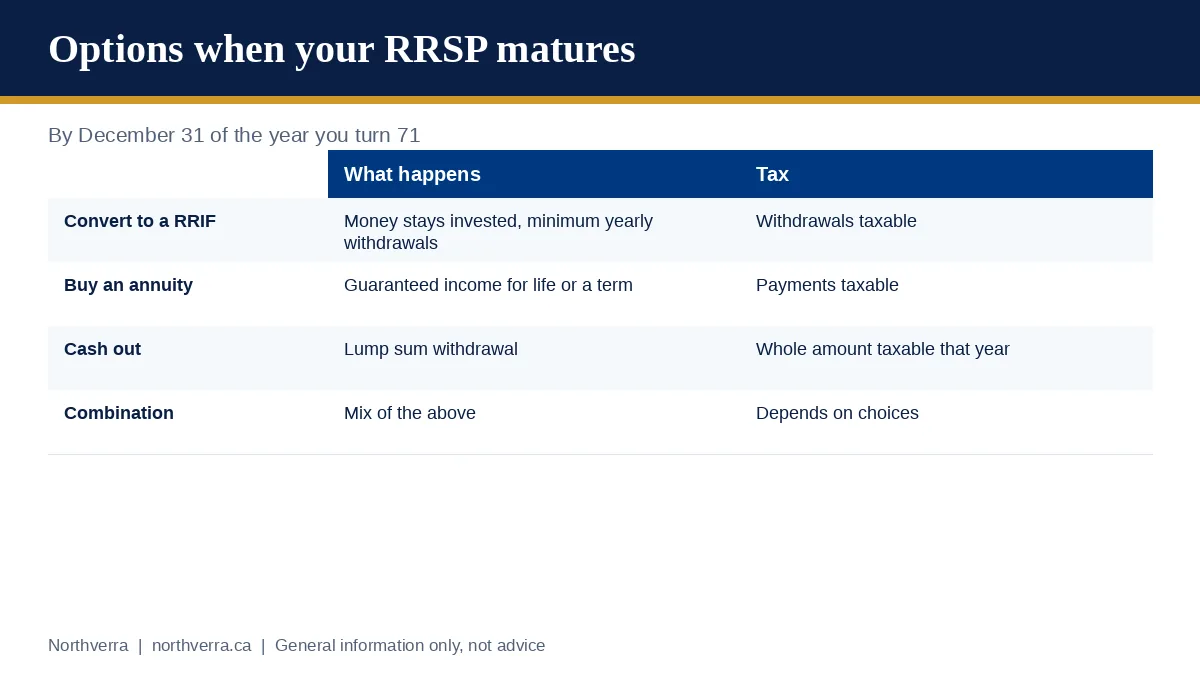
By the end of the year you turn 71, you can no longer hold an RRSP in your own name. Before then you need to choose one or a combination of:
- Convert to a RRIF: the most common choice. Investments can stay the same.
- Buy an annuity: exchange some or all of the money for guaranteed payments for life or for a set period.
- Withdraw the money: the full amount is added to your income that year, which usually creates a large tax bill.
If you do nothing, your financial institution may cash out the plan, so do not let the deadline pass. Our guide to retirement income sources in Canada shows how a RRIF fits alongside CPP, OAS and pensions.
How a RRIF works
A RRIF is like an RRSP in reverse. You cannot contribute to it, but your investments continue to grow tax-deferred. Each year, starting the year after the RRIF is set up, you must withdraw at least a minimum amount. The minimum is calculated from the RRIF’s value at the start of the year and a percentage set by the government that rises with age. You can take more than the minimum whenever you like.
Using a younger spouse’s age
You can choose to base the minimum on the age of your spouse or common-law partner when you open the RRIF. If they are younger, the minimum is lower, which can help keep more money tax-deferred. This choice is generally made when the RRIF is set up.
Tax on RRIF withdrawals
All RRIF withdrawals are taxable income. Your institution does not withhold tax on the minimum amount, but it must withhold tax on amounts above the minimum, at set lump-sum rates. Withholding is a prepayment, not the final tax; you may owe more or get a refund when you file. Many retirees ask for tax to be withheld on the minimum too, to avoid a bill in April.
At age 65 and older, RRIF income may qualify for the pension income amount and for pension income splitting with a spouse or common-law partner. These can reduce the household’s tax. A tax professional can help you use them.
When to convert earlier than 71
- You have retired and need income to bridge the years before other pensions start.
- You want to use the pension income amount from age 65.
- You want to draw down the RRSP gradually in lower-income years, rather than face larger forced withdrawals later.
- You want to manage the effect of future RRIF income on OAS, which is reduced at higher incomes.
Converting part of an RRSP early is possible; you do not have to convert everything at once.
Example (hypothetical): Maria retires at 63 with an RRSP and a small workplace pension. She plans to delay CPP and OAS to receive larger payments later, so she converts part of her RRSP to a RRIF at 64 to cover living costs until then. This is an illustration of a strategy some people consider, not a recommendation.
Annuities as an alternative or a complement
An annuity turns a lump sum into guaranteed payments, often for life. It removes market risk and the worry of outliving savings, but once purchased it usually cannot be changed, and payments depend on interest rates and your age at purchase. Some retirees use part of their RRSP for an annuity to cover essential expenses and keep the rest in a RRIF for flexibility.
Investing inside a RRIF
Because you will be drawing money every year, many people keep one or two years of withdrawals in cash or short-term GICs inside the RRIF, so they are not forced to sell investments during a market drop. The rest can be invested according to a mix that reflects a retirement that may last decades. See asset allocation by age and how GICs work.
Beneficiaries and successor annuitants
Naming your spouse or common-law partner as successor annuitant generally lets the RRIF continue in their name without immediate tax. Other beneficiaries may receive the funds, but the value is generally taxable on your final return unless a rollover applies. Review your designations and your will, and see what happens to life insurance when you retire for related estate questions.
Conversion checklist
- Decide when you need income and how much.
- Choose whether to use your age or a younger spouse’s.
- Decide how often to receive payments, such as monthly or annually.
- Set up voluntary tax withholding if needed.
- Name a successor annuitant or beneficiary.
- Set aside near-term withdrawals in stable investments.
- Coordinate with CPP, OAS and pension start dates.
Common mistakes
- Missing the deadline and having the RRSP collapsed.
- Forgetting that the first minimum is due the year after you open the RRIF.
- Not withholding enough tax and facing a large balance owing.
- Ignoring the effect of withdrawals on OAS.
- Holding all RRIF investments in assets that may fall just as withdrawals are needed.
Next step
Approaching 71, or retiring early? We can map out a RRIF withdrawal plan that works with your other income.
More questions people ask
Can I still contribute to an RRSP after 71?
Not to your own. If you have contribution room and a younger spouse or common-law partner, you may be able to contribute to a spousal RRSP until the end of the year they turn 71.
Can I convert a RRIF back to an RRSP?
Generally yes, if you are 71 or younger, but the minimum for the current year must still be paid out first.
Can I hold the same investments in a RRIF?
Usually. Many institutions let you transfer your RRSP holdings into the RRIF as they are.
Does a LIRA convert the same way?
Locked-in accounts have their own rules and usually convert to a LIF. See what a LIRA is.
Related guides
Have a question? Start a conversation
Tell us a little about your situation. We will reply within one business day.
By submitting this form you agree that Northverra may contact you about your enquiry. Please do not include account numbers, health details or other sensitive information. See our Privacy Policy.
Important information. Investing involves risk, including the possible loss of the amount invested. The value of investments can go down as well as up, and past performance does not guarantee future results. Nothing on this page is a recommendation or a promise of any return. Diversification and asset allocation do not ensure a profit or protect against loss. See our Disclosures.