
INVESTMENT QUESTIONS
What is a LIRA (locked-in retirement account) in Alberta?
Short answer: A LIRA (locked-in retirement account) holds pension money that you transfer out of an employer pension plan, usually when you leave the job. It works much like an RRSP for investing and tax deferral, but the money is “locked in” so it can only be used for retirement income, typically by converting it to a LIF (life income fund). Which rules apply depends on the legislation that governed the original pension plan.
In this guide: Where a LIRA comes from · How a LIRA works · Which rules apply to you · Turning a LIRA into income: the LIF · Unlocking in Alberta · LIRA vs RRSP at a glance · Spouse and beneficiary rights · Should you leave your pension with your former employer instead? · Questions to ask · Common mistakes · FAQ

If you have left a job that had a registered pension plan, you may have been offered the option to move the commuted value of your pension into a LIRA locked-in retirement account. Many people end up with one or more LIRAs without fully understanding how they differ from an RRSP. This guide explains the basics, with a focus on the Alberta rules. Pension legislation is detailed and changes from time to time, so confirm the current rules with your financial institution or the Alberta Superintendent of Pensions.
Where a LIRA comes from
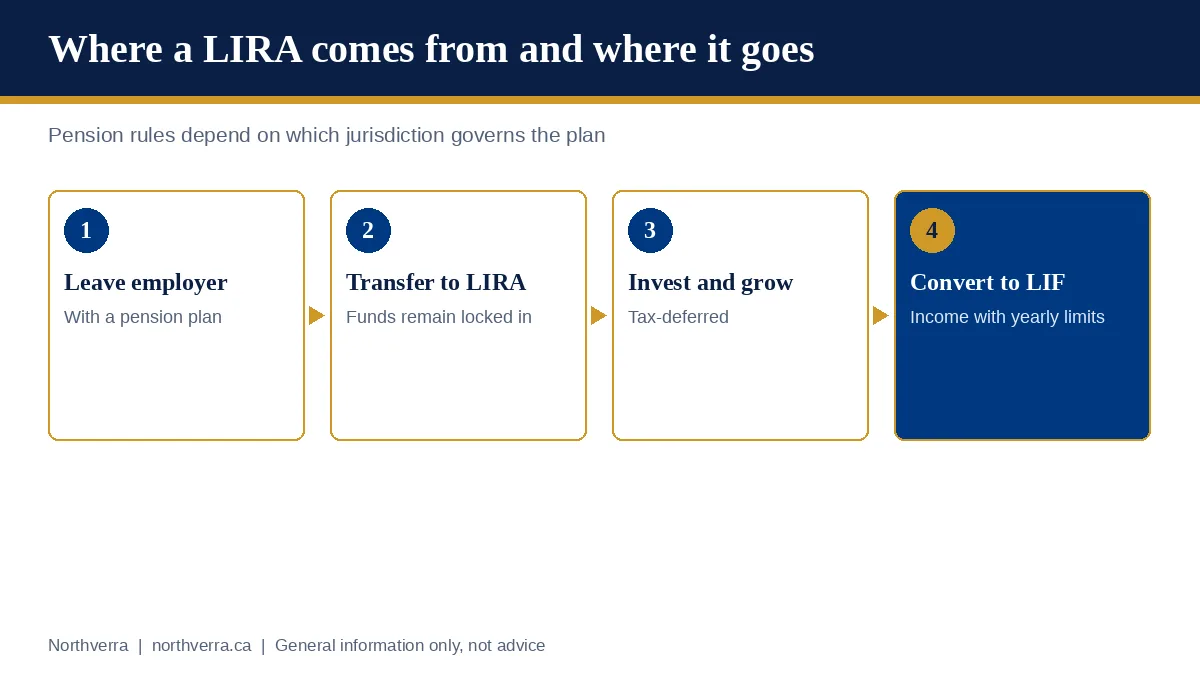
When you leave an employer with a defined benefit or defined contribution pension plan, you may be able to leave your pension with the plan or transfer its value out. If you transfer it out, pension law usually requires that the money stay “locked in” for retirement, so it goes into a LIRA (sometimes called a locked-in RRSP for federally regulated plans). The goal is to make sure pension money provides retirement income, not a cash payout. Part of a commuted value may exceed tax limits and be paid to you in cash, which is taxable.
How a LIRA works
- Investments: you can usually hold the same types of investments as in an RRSP, such as GICs, funds, ETFs and stocks.
- Tax: growth is tax-deferred. Money is taxed when it is eventually paid out as income.
- No new contributions: you cannot add money other than transfers from pension plans or other locked-in accounts.
- Restricted withdrawals: you generally cannot take money out of a LIRA except in limited situations allowed by the governing legislation.
Which rules apply to you
The rules that govern your LIRA are based on where the original pension plan was registered, not where you live today. An Alberta-registered plan is governed by Alberta’s Employment Pension Plans legislation. A plan for a federally regulated employer, such as a bank, airline or telecom company, follows federal rules. Plans registered in other provinces follow that province’s rules. Your LIRA contract or addendum will say which jurisdiction applies.
Turning a LIRA into income: the LIF
When you are ready for retirement income, you generally transfer the LIRA to a life income fund (LIF). A LIF works much like a RRIF, but it has both a minimum and a maximum annual withdrawal. The maximum is designed to make the money last. Alternatively, LIRA money can usually be used to buy a life annuity. Like an RRSP, a LIRA must generally be converted by the end of the year you turn 71. See RRSP to RRIF conversion for how the RRIF side works.
Unlocking in Alberta
The one-time 50% unlocking
Alberta rules allow a one-time option to unlock up to 50% of the money when you transfer it from a LIRA into a LIF. The unlocked portion can be taken as cash, which is taxable, or moved to an RRSP or RRIF to keep it tax-deferred. If you have a pension partner, a waiver is generally required. You only get one opportunity at the time of the transfer, so decide carefully. Eligibility conditions apply, so confirm them with your institution before you start.
Other limited circumstances
Pension legislation also allows unlocking in specific situations, which may include a small balance below a set threshold, shortened life expectancy or non-residency in Canada for a required period. The conditions and forms differ between Alberta, federal and other provincial rules.
Example (hypothetical): Dan, 56, left an Alberta employer years ago and has a LIRA. He plans to retire at 60. When he converts to a LIF, he considers unlocking 50% into his RRIF so he has more flexibility in the early years, while keeping the rest in the LIF with its annual maximum. He reviews the decision with his spouse, who must sign a waiver. This illustration is general, not advice.
LIRA vs RRSP at a glance
- Source of money: pension transfers vs your own contributions.
- Access: locked in vs withdraw any time, with tax.
- Income stage: LIF with a maximum or annuity vs RRIF with no maximum.
- Spousal rights: pension partner rights often apply vs beneficiary designation.
Spouse and beneficiary rights
Because the money began as a pension, a spouse or pension partner may have legal rights to survivor benefits from a LIRA or LIF, which can override a beneficiary designation unless a proper waiver has been signed. If your family situation has changed, review your documents with a lawyer.
Should you leave your pension with your former employer instead?
That choice comes before the LIRA. Leaving a defined benefit pension in the plan may give you a predictable lifetime income, sometimes with survivor or indexing benefits. Transferring to a LIRA gives you control over investments but moves the investment risk to you. The decision depends on the plan’s terms, your health, your other savings and your comfort with risk. Our guides to retirement income sources and planning for retirement in your 40s and 50s can help frame the question.
Questions to ask
- Which jurisdiction governs my LIRA?
- What unlocking options am I eligible for, and when?
- What are the minimum and maximum LIF withdrawals at my age?
- Does my pension partner need to sign a waiver?
- What fees do I pay inside the LIRA?
- Would consolidating several LIRAs simplify things, and is that allowed?
Common mistakes
- Treating a LIRA like an RRSP and expecting to withdraw freely.
- Missing the one-time unlocking choice at the time of transfer to a LIF.
- Forgetting the LIRA when planning retirement income.
- Leaving it invested without a plan because it feels out of reach.
- Not reviewing spousal rights after a separation or new relationship.
Next step
Have a LIRA from a past employer? We can help you understand your options and how it fits into your retirement income plan.
More questions people ask
Can I contribute to a LIRA?
No. Only transfers from pension plans or other locked-in accounts can go in.
Is a LIRA the same as a locked-in RRSP?
They are very similar. The name depends on the governing legislation; federally regulated plans often use the term locked-in RRSP.
Can I move my LIRA to another institution?
Usually yes, as a direct transfer to another locked-in account under the same rules.
Is LIRA money protected from creditors?
Locked-in pension money often has strong creditor protection under pension law, but the details depend on the jurisdiction. Ask a lawyer.
Related guides
Have a question? Start a conversation
Tell us a little about your situation. We will reply within one business day.
By submitting this form you agree that Northverra may contact you about your enquiry. Please do not include account numbers, health details or other sensitive information. See our Privacy Policy.
Important information. Investing involves risk, including the possible loss of the amount invested. The value of investments can go down as well as up, and past performance does not guarantee future results. Nothing on this page is a recommendation or a promise of any return. Diversification and asset allocation do not ensure a profit or protect against loss. See our Disclosures.