
MORTGAGE QUESTIONS
What is the mortgage stress test in Canada?
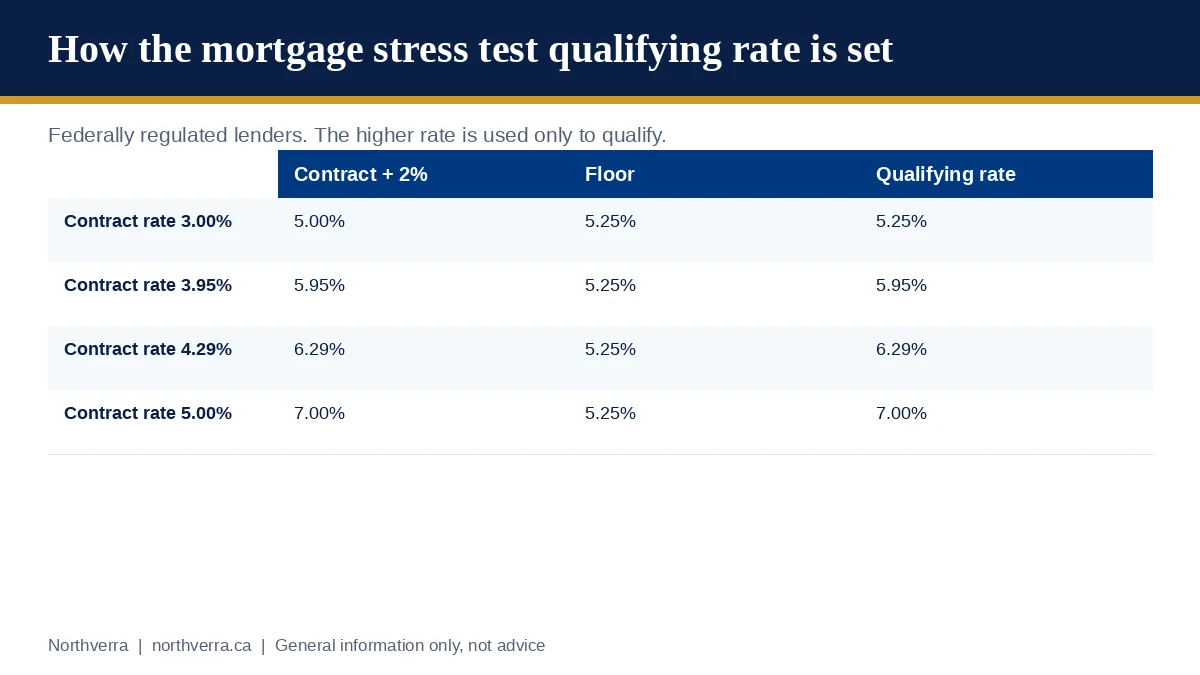
Short answer: The mortgage stress test requires lenders to check that you could still afford your payments at a higher rate than the one you will actually pay. For mortgages from federally regulated lenders, the qualifying rate is the greater of your contract rate plus 2% or 5.25%. Your approval is based on that higher payment, which reduces the maximum you can borrow but builds in a cushion.
In this guide: How the qualifying rate works · Why the stress test exists · Who the stress test applies to · How the stress test changes what you can borrow · Fixed and variable rates under the stress test · How to prepare if the stress test limits you · Common mistakes to avoid · Looking past qualifying: your own stress test · FAQ

The mortgage stress test is one of the most talked-about rules in Canadian housing. It does not change the rate you pay. It changes the rate you must qualify at, which in turn sets the largest mortgage a lender can approve. Understanding it helps you predict your approval and plan for future rate changes.
How the qualifying rate works
For uninsured mortgages at federally regulated lenders, such as banks, the minimum qualifying rate set by the Office of the Superintendent of Financial Institutions (OSFI) is the greater of:
- your mortgage contract rate plus 2%, or
- 5.25%.
Insured mortgages, where the down payment is under 20%, face a similar test under federal mortgage insurance rules. Lenders then use the payment at that qualifying rate when they calculate your gross and total debt service ratios.
Example (hypothetical): Suppose a lender offers a 5-year fixed rate of 4.29% on a $450,000 mortgage with a 25-year amortization. The qualifying rate is 6.29%, because 4.29% plus 2% is higher than 5.25%. The actual payment would be about $2,438 a month, but the lender must check whether you could carry about $2,957 a month. If the offered rate were 3.0%, the qualifying rate would be the 5.25% floor instead. All numbers are hypothetical and rounded.
Why the stress test exists
Mortgage terms in Canada are usually shorter than the amortization, so most borrowers renew several times. Rates at renewal may be higher than when they first borrowed. The stress test is designed to make sure borrowers have room in their budgets if rates rise, if income dips or if other costs go up. It also helps protect the wider financial system from too many borrowers being stretched at once.
Who the stress test applies to
- Buyers applying for a new mortgage with a federally regulated lender.
- Homeowners refinancing, since refinancing is a new loan amount. See when refinancing makes sense.
- Borrowers adding a HELOC or increasing borrowing against their home.
Some situations are treated differently. Since November 21, 2024, OSFI no longer expects federally regulated lenders to apply the minimum qualifying rate to uninsured “straight switches”, where you move your mortgage to another federally regulated lender at renewal without increasing the amount or the amortization. Lenders still must underwrite prudently, so some may still assess affordability. Renewing with your current lender also does not normally require requalifying. Our article on what to review at mortgage renewal covers the renewal choices.
Credit unions regulated by the province set their own rules, which may differ. Ask any lender which test they apply.
How the stress test changes what you can borrow
Because the payment is calculated at a higher rate, the maximum mortgage is lower than it would be at the contract rate. The difference can be significant, often tens of thousands of dollars. That is why two buyers with the same income can see very different approvals depending on their debts, their down payment and the rate offered. Our guide to how much mortgage you can afford walks through the full calculation, and you can try different rates in the mortgage calculator.
Fixed and variable rates under the stress test
The rule applies to both fixed and variable mortgages. For a variable rate, the contract rate is the current variable rate, which moves with the lender’s prime rate. For reference, the Bank of Canada reported a prime rate of 4.45% as of September 30, 2026. A lower contract rate leads to a lower qualifying rate, subject to the 5.25% floor. Our comparison of fixed vs variable mortgages explains the trade-offs beyond qualifying.
How to prepare if the stress test limits you
- Reduce monthly debt payments before applying, especially car loans and card balances.
- Increase your down payment to reduce the loan you need.
- Consider a co-borrower whose income can be counted.
- Look at homes with lower property taxes or condo fees.
- If eligible, ask how a longer amortization would affect qualifying and total interest.
- Give yourself time: income growth and debt repayment improve your ratios.
Common mistakes to avoid
- Assuming you qualify at the advertised rate.
- Expecting the stress test to apply in the same way at every type of lender.
- Using a non-federally regulated lender only to borrow more than you could comfortably carry.
- Forgetting that a refinance is a new test, even if you have paid on time for years.
Looking past qualifying: your own stress test
Passing the stress test tells you a lender is allowed to approve the mortgage. It does not tell you whether the payment would feel comfortable if rates rose at renewal. You can run your own version at home. Take your expected mortgage, calculate the payment at your offered rate, then calculate it again at a rate one or two percentage points higher. Ask yourself how you would handle that difference each month: would it come out of savings, travel, retirement contributions or something more essential? If the answer is uncomfortable, consider a smaller mortgage, a larger down payment or a longer fixed term for more certainty. This kind of planning is general information, not a forecast of where rates are going, which no one can predict reliably.
Next step
If the stress test is shaping your budget, we can walk through your numbers, the qualifying rate that would apply and practical ways to strengthen your application.
More questions people ask
Does the stress test mean I pay a higher rate?
No. You pay your contract rate. The higher qualifying rate is only used to check that you could afford higher payments.
Is the 5.25% floor fixed forever?
No. OSFI reviews the minimum qualifying rate and can change it. Always check the current rule when you apply.
Do I have to pass the stress test when I renew?
Not usually when you renew with your current lender. Uninsured straight switches between federally regulated lenders are also exempt from the prescribed test, though lenders still assess affordability.
Does the stress test apply to private lenders?
Private lenders are not federally regulated and set their own rules, but they usually charge higher rates and fees.
Related guides
Have a question? Start a conversation
Tell us a little about your situation. We will reply within one business day.
By submitting this form you agree that Northverra may contact you about your enquiry. Please do not include account numbers, health details or other sensitive information. See our Privacy Policy.
Important information. Mortgage approval, interest rates, terms and eligibility depend on the lender, your financial profile, the property and current market conditions, and are not guaranteed. Mortgage products and rates change. Nothing on this page is a commitment to lend or a quote of any rate. See our Disclosures.