
MORTGAGE QUESTIONS
How can I pay off my mortgage faster?
Short answer: You can pay off your mortgage faster by choosing accelerated bi-weekly or weekly payments, increasing your regular payment, making lump-sum prepayments within your privileges and keeping your payment the same, or higher, at renewal. Every extra dollar of principal reduces the interest charged for the rest of the mortgage. Before prepaying, make sure you have an emergency fund and no high-interest debt.
In this guide: Why extra payments matter so much · Five ways to pay off your mortgage faster · A worked example · Stay within your prepayment privileges · Prepay the mortgage or invest? · Do these first · Common mistakes to avoid · Make it automatic · FAQ

“How can I pay off my mortgage faster?” is one of the most common questions Canadian homeowners ask, and small changes can make a surprisingly large difference over decades. The key is to understand the tools your mortgage already includes, use them in a way that fits your budget and weigh prepaying against other goals such as retirement savings.
Why extra payments matter so much
Interest is charged on the balance you owe. When you pay down principal ahead of schedule, that amount stops generating interest for the rest of the amortization. Early in the mortgage, when the balance is largest, extra payments have the greatest long-term effect. Our guide to mortgage amortization explains how each payment is split.
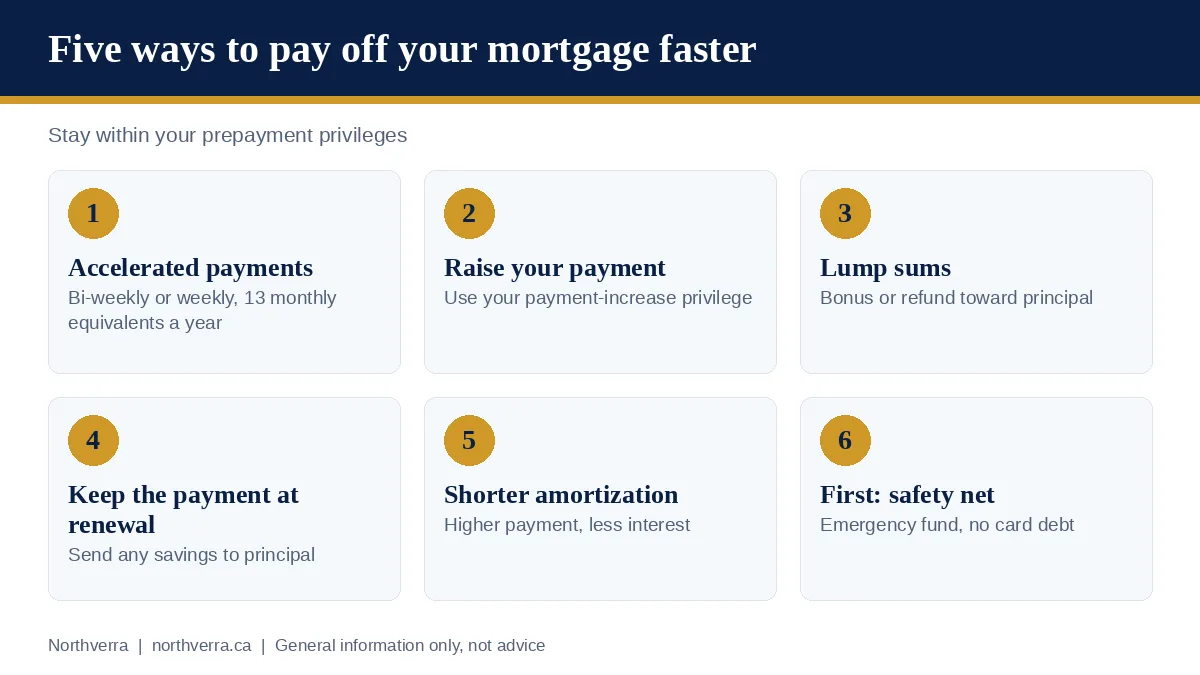
Five ways to pay off your mortgage faster
1. Accelerated bi-weekly or weekly payments
With accelerated bi-weekly payments, you pay half of your monthly payment every two weeks. Because there are 26 bi-weekly periods in a year, you make the equivalent of 13 monthly payments instead of 12. Accelerated weekly payments work the same way with a quarter of the monthly payment. Regular, non-accelerated bi-weekly payments simply spread 12 monthly payments over the year and do not speed things up much.
2. Increase your regular payment
Most closed mortgages let you increase your payment by a set percentage each year. Even a modest increase, especially after a raise, shortens the amortization.
3. Lump-sum prepayments
Most closed mortgages allow an annual lump sum up to a set percentage of the original principal. Bonuses, tax refunds or the proceeds of a sale can go here. Check when your privilege resets, often each calendar year or mortgage anniversary.
4. Keep your payment at renewal
If rates are lower at renewal, keeping your payment the same rather than taking the lower payment sends the difference to principal. If you have prepaid, ask the lender to keep your payment and shorten the remaining amortization.
5. Choose a shorter amortization at renewal or refinance
A shorter amortization raises the payment but cuts total interest. It only makes sense if the payment remains comfortable.
A worked example
Example (hypothetical): On a $400,000 mortgage at 5% with a 25-year amortization, the monthly payment is about $2,326. Switching to accelerated bi-weekly payments of about $1,163 would pay the mortgage off in roughly 21.5 years and save about $48,000 in interest, if the rate stayed the same. Adding $200 a month to the regular monthly payment gives a similar result. These are hypothetical, rounded figures; your results depend on your rate at each renewal and your lender’s rules. Try your own numbers in the mortgage calculator.
Stay within your prepayment privileges
Paying more than your contract allows can trigger a penalty. Read your mortgage documents or ask your lender for:
- the maximum annual lump sum and when it resets,
- the maximum payment increase,
- whether unused privileges carry forward (usually they do not), and
- whether you can reduce the payment again later if needed.
If you want unlimited flexibility, our comparison of open vs closed mortgages explains the trade-off.
Prepay the mortgage or invest?
Paying down a mortgage gives a guaranteed “return” equal to your mortgage rate, because it saves that interest. Investing may grow more over time, but it carries risk and is not guaranteed. Many households do some of both. Things to weigh:
- Your mortgage rate compared with the after-tax return you might reasonably expect, without assuming any particular result.
- Whether you have unused TFSA or RRSP room, and any employer matching on workplace plans.
- How much you value being mortgage-free sooner.
- Whether you would still have access to money in an emergency. Money paid into a mortgage is not easy to get back without borrowing.
Our article on debt repayment vs investing explores this trade-off in more depth.
Do these first
- Build an emergency fund. See how to build an emergency fund.
- Pay off high-interest debt, such as credit cards, which usually cost far more than a mortgage.
- Make sure your insurance and basic savings are in place.
Common mistakes to avoid
- Choosing regular bi-weekly payments and thinking they are accelerated.
- Prepaying beyond your privileges and paying a penalty.
- Sending every spare dollar to the mortgage and leaving no emergency savings.
- Taking a lower payment at renewal by default.
- Ignoring employer retirement matching in order to prepay.
Make it automatic
The strategies that work best are the ones that run without effort. Set up accelerated payments from the start of a new term, schedule a yearly reminder to make a lump-sum payment and plan to raise your payment whenever your income increases. Some households direct a fixed share of every raise or bonus to the mortgage, so their lifestyle and their payoff date both improve over time. If money becomes tight, find out ahead of time whether your lender lets you reduce the payment back to the original amount, so you are not locked into a higher commitment you cannot keep.
Next step
If you would like to compare prepayment strategies, or weigh prepaying against investing, we can model the options with your actual mortgage terms.
More questions people ask
Are bi-weekly payments the same as accelerated bi-weekly?
No. Accelerated bi-weekly payments are half of your monthly payment every two weeks, which adds the equivalent of one extra monthly payment a year. Regular bi-weekly payments do not.
Is there a penalty for paying my mortgage off early?
On a closed mortgage, paying more than your privileges allow or paying it off before maturity usually triggers a penalty. Open mortgages do not have prepayment penalties.
When is the best time to make a lump-sum payment?
Generally, the earlier in the year and the earlier in the mortgage, the more interest it saves, as long as you keep enough savings.
Should I prepay if my mortgage rate is low?
It depends on your goals, other debts, savings and comfort with risk. Some people prefer investing when rates are low, while others value being debt-free.
Related guides
Have a question? Start a conversation
Tell us a little about your situation. We will reply within one business day.
By submitting this form you agree that Northverra may contact you about your enquiry. Please do not include account numbers, health details or other sensitive information. See our Privacy Policy.
Important information. Mortgage approval, interest rates, terms and eligibility depend on the lender, your financial profile, the property and current market conditions, and are not guaranteed. Mortgage products and rates change. Nothing on this page is a commitment to lend or a quote of any rate. See our Disclosures.