
MORTGAGE QUESTIONS
When does it make sense to refinance a mortgage?
Short answer: It can make sense to refinance a mortgage when the benefit, such as a lower rate, access to equity for a planned purpose or consolidating high-interest debt, clearly outweighs the costs, which can include a prepayment penalty, legal and appraisal fees and a longer payoff. In Canada you can generally refinance up to 80% of your home’s value, and you must requalify under current lending rules.
In this guide: What refinancing means · How much you can borrow · Common reasons to refinance · The true cost of refinancing · Alternatives to a full refinance · Questions to ask before you refinance · Common mistakes to avoid · How the refinance process works · FAQ

When people ask whether to refinance a mortgage, they usually have a goal in mind: a lower rate, money for renovations, help with debts or a change in their finances. Refinancing replaces your existing mortgage with a new one, often for a larger amount. It can be a useful tool, but it is not free, and borrowing against your home has long-term consequences.
What refinancing means
A refinance creates a new mortgage on a home you already own. You can increase the amount you borrow, change the term, rate or amortization, or add someone to or remove someone from the mortgage. If you refinance before your current term ends, you will usually pay a prepayment penalty. At renewal, a refinance can often be done without a penalty, although you still need to qualify.
How much you can borrow
For most refinances, lenders in Canada allow total borrowing secured by your home of up to 80% of its appraised value. Refinanced mortgages generally cannot be insured in the way a high-ratio purchase can, so the 80% limit applies. You must also pass the mortgage stress test and the lender’s debt service ratios.
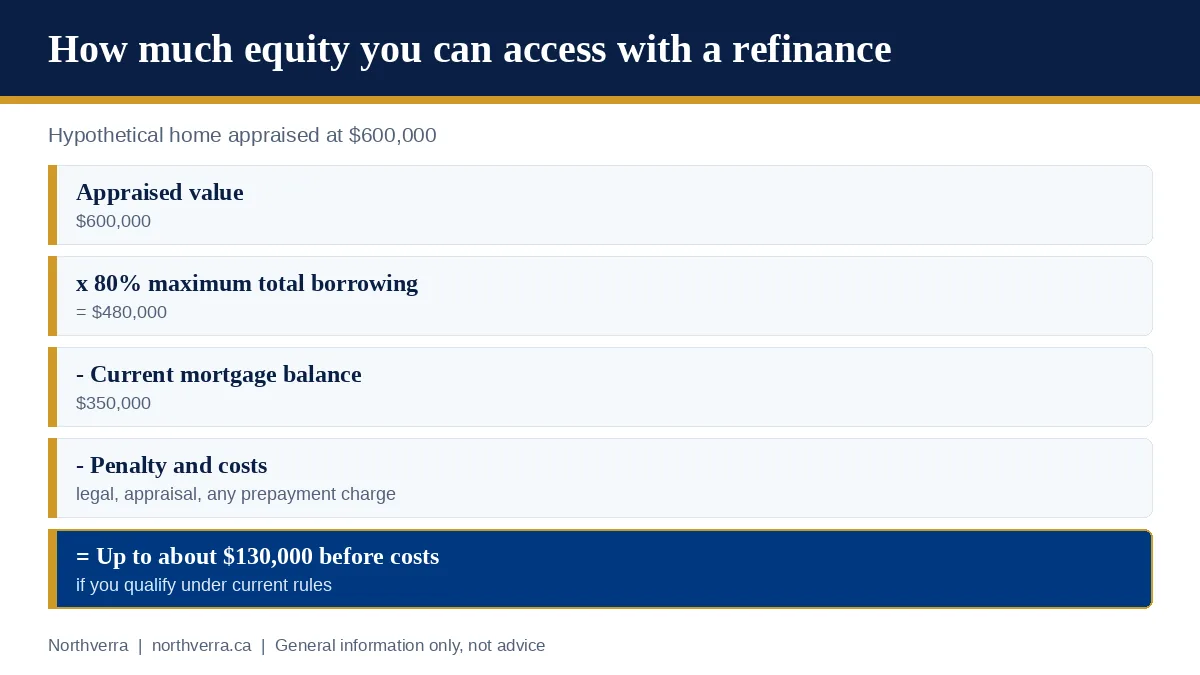
Example (hypothetical): Priya and Daniel’s home is appraised at $600,000, and they owe $350,000. At 80%, the maximum they could borrow in total is $480,000, so they could access up to about $130,000 before costs, if they qualify. They want $60,000 for a kitchen and a basement suite, so they request only that amount. These are hypothetical figures.
Common reasons to refinance
To get a lower rate
If rates have fallen, refinancing to a lower rate can reduce your payments or interest. Compare the interest saved over the remaining term with the penalty and fees. Our guide to mortgage prepayment penalties shows how the penalty is calculated, which is often the deciding factor.
To renovate
Using equity for improvements that add value or make the home work better for your family is a common reason. Get firm quotes and consider a contingency, because renovations often cost more than planned.
To consolidate high-interest debt
Rolling credit cards or loans into a mortgage can reduce the interest rate and monthly payments. The risk is that short-term debts become long-term debts secured by your home, and that the cards fill up again. A refinance works best with a plan to change the habits that created the debt; our article on budgeting basics can help.
For a major life change
Separation, buying out a co-owner or funding a family need can all lead to a refinance. These situations often involve legal advice as well.
The true cost of refinancing
Add up all of the costs before deciding:
- Prepayment penalty if you break your term early.
- Appraisal and legal fees, and possibly title insurance and discharge fees.
- More interest over time if you increase the balance or extend the amortization.
- The new rate, which may be higher than your current rate if rates have risen.
Example (hypothetical): Consolidating $30,000 of credit card debt into a mortgage at 4.5% over 25 years adds about $166 a month to the mortgage payment, far less than the minimums on the cards. But if that $30,000 is repaid over 25 years, the total interest is much larger than if it were paid off in three years. A shorter repayment plan for the consolidated portion, or a separate prepayment target, can help. Hypothetical figures, rounded.
Alternatives to a full refinance
- A HELOC to access equity as needed. See what a HELOC is.
- Blend and extend with your current lender, which may avoid a full penalty.
- Waiting until renewal to refinance without a penalty.
- A second mortgage, usually at a higher rate, if a full refinance is not possible. Use with caution.
Questions to ask before you refinance
- What exactly will the money be used for, and how much do I really need?
- What is the total cost, including the penalty and fees?
- How will my payment and amortization change?
- How will this affect my plans to be mortgage-free?
- Would I still have an emergency cushion afterward?
Common mistakes to avoid
- Refinancing to save a small amount of interest that a penalty wipes out.
- Borrowing the full 80% because it is available.
- Consolidating debt without a plan to stop it from returning.
- Extending the amortization without noticing the extra interest.
How the refinance process works
A refinance usually follows a similar path to a purchase. You apply with your current lender or a new one, provide income and debt documents and authorize a credit check. The lender orders an appraisal to confirm the home’s value. If approved, a lawyer registers the new mortgage, pays out the old one, including any penalty, and sends you or your creditors the remaining funds. The process can take a few weeks, so start early if you have a deadline such as a renovation start date. Staying with your current lender can sometimes reduce costs or allow a blended rate, while moving to a new lender may offer a better rate but involve a penalty and new legal fees. Compare both before deciding, and ask for all fees in writing.
Refinancing in Calgary and across Alberta: local points
- Home values vary by neighbourhood. Your available equity depends on an appraisal, so recent sales near you matter.
- Alberta closing steps. A refinance involves legal work to register the new mortgage at Alberta Land Titles and discharge the old one, with registration fees.
- More lender choice. Albertans can compare banks, credit unions, ATB Financial and lenders available through brokers.
- Timing with renewal. Refinancing at the end of your term usually avoids a prepayment penalty.
If you are weighing a line of credit instead, see HELOC vs. mortgage refinance, and for paying off other debts, see using home equity to consolidate debt.
A typical refinance timeline
- Review your goals, your current mortgage terms and any penalty.
- Get quotes and a pre-qualification from lenders or a broker.
- Submit income documents and arrange an appraisal.
- Receive the approval and review the conditions.
- Sign the mortgage documents with your lawyer, who registers the new mortgage and pays out the old one.
Next step
If you are considering a refinance, we can help you compare the costs, penalty and alternatives, and check whether it supports your longer-term plans.
More questions people ask
How often can I refinance my mortgage?
There is no fixed limit, but each refinance has costs and requires qualifying. Refinancing often can add significant expense.
Can I refinance with less than 20% equity?
Generally not with a standard lender, because refinances are typically limited to 80% of the home’s value.
Do I need an appraisal to refinance?
Usually, yes. The lender needs to confirm the current value of your home.
Is it better to refinance or get a HELOC?
It depends on how you will use the money. A lump-sum need often suits a refinance, while ongoing or uncertain needs may suit a HELOC.
How long does a refinance take?
It often takes a few weeks from application to closing, depending on the lender, the appraisal and how quickly you provide documents. Allow more time if your income is complex.
What does it cost to refinance in Alberta?
Common costs include legal fees, Alberta Land Titles registration and discharge fees, an appraisal, and any prepayment penalty if you refinance before the end of your term. Ask each lender which costs they cover.
Should I refinance now or wait until renewal?
If your penalty is large, waiting until renewal may save money. If the benefit of refinancing now, such as paying off high-interest debt, is larger than the penalty and costs, refinancing early can still make sense.
Can I refinance to buy out a former spouse?
Many lenders allow a refinance to buy out a co-owner, subject to qualifying on your own income. Legal agreements usually need to be in place first. Speak with your lawyer and lender about the requirements.
Last updated: October 11, 2026
Related guides
Have a question? Start a conversation
Tell us a little about your situation. We will reply within one business day.
By submitting this form you agree that Northverra may contact you about your enquiry. Please do not include account numbers, health details or other sensitive information. See our Privacy Policy.
Important information. Mortgage approval, interest rates, terms and eligibility depend on the lender, your financial profile, the property and current market conditions, and are not guaranteed. Mortgage products and rates change. Nothing on this page is a commitment to lend or a quote of any rate. See our Disclosures.