
MORTGAGE QUESTIONS
How does a rental property mortgage work?
Short answer: A rental property mortgage usually needs at least 20% down when you will not live in the property, and lenders count only part of the expected rent toward qualifying. If you live in one unit of a home with up to four units, you may qualify for an insured mortgage with a smaller down payment. Rates, rules and the way rental income is counted vary by lender.
In this guide: Two very different situations · How lenders count rental income · Plan for the full cost of a rental · Tax considerations · Financing a rental with home equity · Questions to ask before you buy · Common mistakes to avoid · Buying a home with a suite to help with the mortgage · FAQ
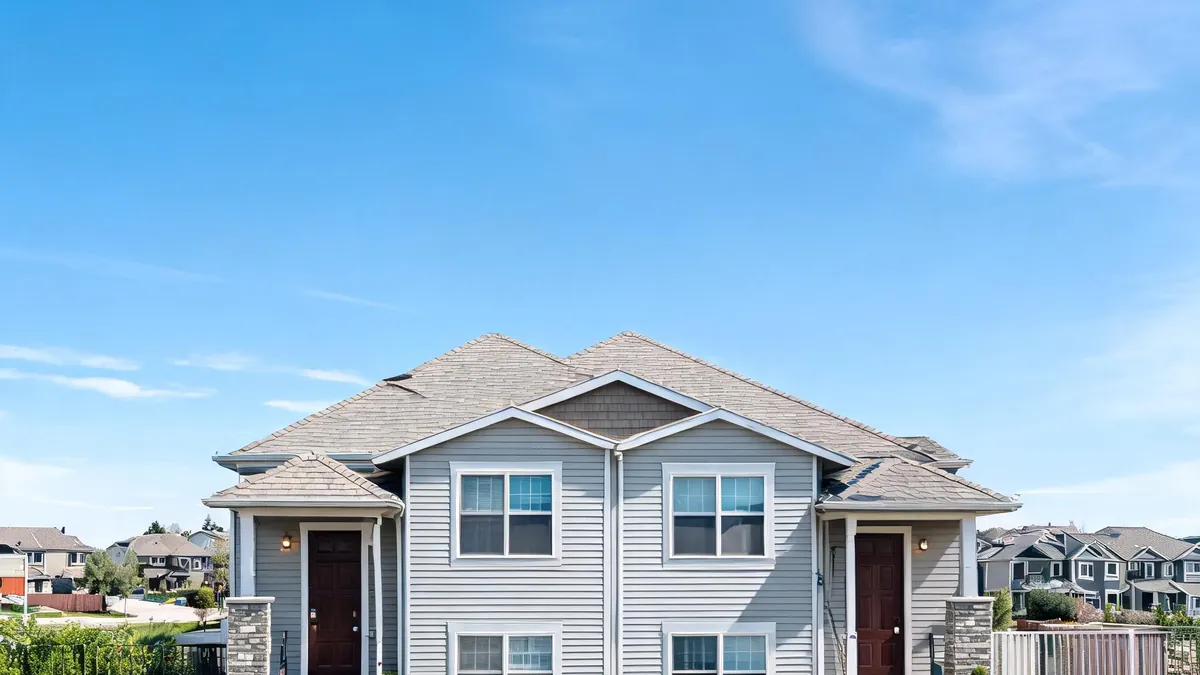
A rental property mortgage works much like a regular mortgage, but lenders look at it differently because the property is an investment rather than your home. The rules for down payment, qualifying income and rates depend on whether you will live in the property and how many units it has. Knowing them helps you judge whether a rental fits your finances before you make an offer.
Two very different situations
You will live in one of the units
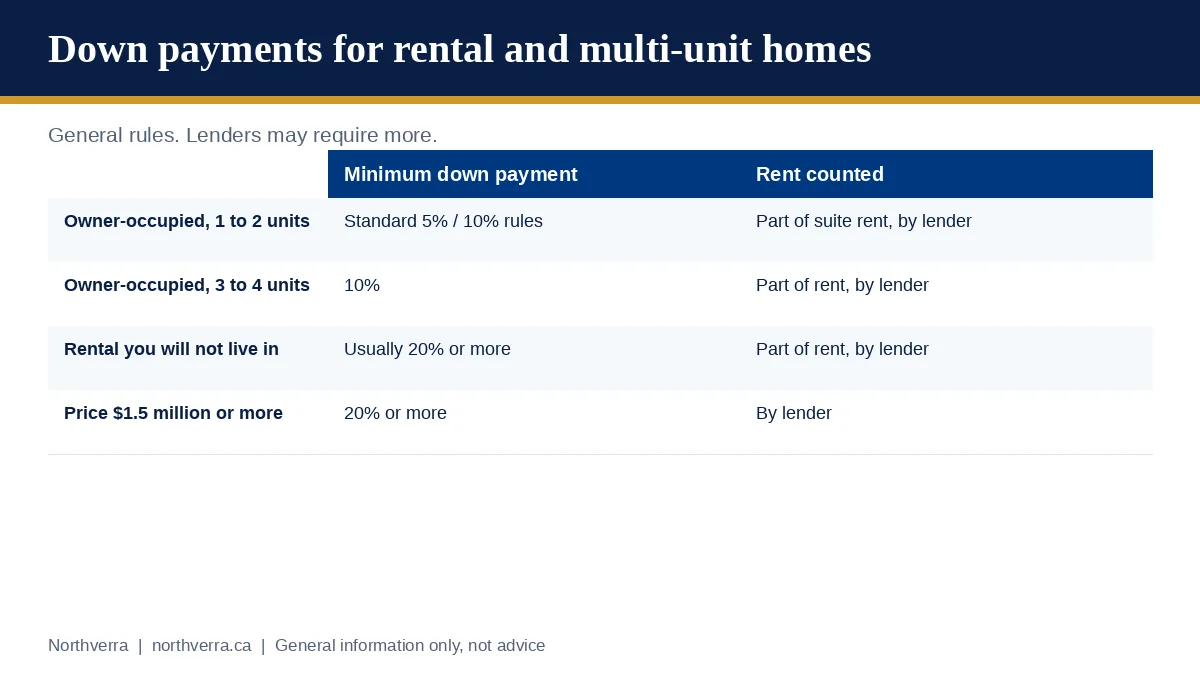
If you buy a home with up to four units and live in one of them, the mortgage can be treated as a homeowner mortgage. CMHC’s homeowner mortgage loan insurance is available for 1- to 4-unit properties where at least one unit is owner-occupied. According to CMHC, the minimum down payment is generally 5% to 10% for 1- to 2-unit homes, following the standard rules, and 10% for 3- to 4-unit homes. See the minimum down payment in Canada.
You will not live there
For a property you will only rent out, most lenders require at least 20% down. Rates can be higher than for owner-occupied homes. You also need enough income to qualify for both your home and the rental.
How lenders count rental income
Lenders do not count the full rent as income. Common approaches include:
- Adding a percentage of the rent to your income, such as 50% to 80%, depending on the lender and property.
- Offsetting a percentage of the rent against the property’s costs, so only the net figure affects your ratios.
For an existing rental, lenders usually want leases and tax returns showing rental income. For a new purchase, they may use an appraiser’s estimate of market rent. The method makes a big difference to how much you can borrow, which is one reason to compare lenders.
Example (hypothetical): Kai is buying a $600,000 side-by-side duplex in Calgary as a rental, with 20% down. The mortgage is $480,000; at a hypothetical 5% over 25 years, the payment is about $2,792 a month. Each side rents for $1,900, or $3,800 in total. His lender counts 50% of the rent, $1,900, toward his qualifying income, which means Kai’s other income must carry much of the debt. Kai also budgets for property taxes, insurance, maintenance, vacancies and a reserve. All figures are hypothetical.
Plan for the full cost of a rental
- Property taxes, insurance and utilities you pay.
- Maintenance and repairs, plus a reserve for larger items such as roofs and furnaces.
- Vacancy between tenants and the possibility of unpaid rent.
- Property management fees if you hire help.
- Condo fees, if applicable.
- Closing costs at purchase; see closing costs in Alberta.
A rental with negative cash flow, where costs exceed rent, can still be part of a plan, but you should know how much you will add each month and for how long. Our comparison of real estate vs stocks discusses leverage and concentration risk.
Tax considerations
Rental income is taxable, and certain expenses, including mortgage interest on a rental, may be deductible. When you sell, a rental property may be subject to capital gains tax, unlike a principal residence that qualifies for the exemption. See capital gains tax in Canada. Rules can be complex, so speak with a tax professional before you buy.
Financing a rental with home equity
Some owners use a HELOC or refinance on their own home to fund the down payment for a rental. This adds debt secured against your home, and the interest may have tax implications. Lenders will still need to see that you qualify for the total debt. Our guide to what a HELOC is explains the risks.
Questions to ask before you buy
- Will I live in the property, and how many units does it have?
- How will the lender count the rental income?
- Can I cover the payments if the unit is vacant for several months?
- Are there zoning, permit or safety requirements for a legal suite?
- What happens to my overall finances if rates rise at renewal?
Common mistakes to avoid
- Assuming lenders will count the full rent.
- Ignoring vacancy and maintenance in the numbers.
- Using all of your home equity to buy a rental with no cushion.
- Buying an illegal suite without understanding the insurance and safety implications.
- Forgetting the tax consequences when you sell.
Buying a home with a suite to help with the mortgage
Many first-time buyers in Calgary look at homes with a basement suite or a second unit so that rent can help with the payments. If you live in the home, the mortgage is a homeowner mortgage, and the rules for insured mortgages on 1- to 4-unit properties can apply. Lenders may count part of the suite’s rent, particularly if the suite is legal and has a separate entrance, kitchen and appropriate safety features. Check with the City of Calgary or your municipality about permit and safety requirements, and tell your home insurer about the rental. Being a landlord also brings responsibilities under Alberta’s residential tenancy rules, so learn them before you sign a lease with a tenant.
Next step
If you are considering a rental property or a home with a suite, we can help you understand how lenders may view it, what down payment applies and how the numbers could work.
More questions people ask
Can I buy a rental property with 5% down?
Generally not if you will not live there. If you live in one unit of a 1- to 2-unit home, standard insured minimums can apply.
Do lenders count rental income from a basement suite?
Many do, especially for a legal suite, but usually only a portion of the rent and according to their own policy.
Is mortgage interest deductible on a rental?
Interest on money borrowed to earn rental income may be deductible. Speak with a tax professional about your situation.
Are rental property mortgage rates higher?
Often slightly higher than for owner-occupied homes, depending on the lender, the property and your file.
Related guides
Have a question? Start a conversation
Tell us a little about your situation. We will reply within one business day.
By submitting this form you agree that Northverra may contact you about your enquiry. Please do not include account numbers, health details or other sensitive information. See our Privacy Policy.
Important information. Mortgage approval, interest rates, terms and eligibility depend on the lender, your financial profile, the property and current market conditions, and are not guaranteed. Mortgage products and rates change. Nothing on this page is a commitment to lend or a quote of any rate. See our Disclosures.
Important information. The information on this page is general in nature, is provided for educational purposes only, and is not personalized financial, insurance, legal, tax or mortgage advice. Your circumstances are unique. Please speak with a properly licensed professional before making decisions. See our Disclosures.