
MORTGAGE GUIDE
Using Home Equity to Consolidate Debt
Short answer: Using home equity to consolidate debt means borrowing against your home, usually through a refinance or a home equity line of credit (HELOC), to pay off higher-interest debts. It can lower your rate and simplify payments, but it turns unsecured debt into debt secured by your home and can cost more over time if repaid slowly.
Quick facts
- In Canada, you can generally borrow up to 80% of your home’s value in total through a refinance or combined mortgage and HELOC.
- The revolving HELOC portion is generally limited to 65% of your home’s value.
- You must qualify under current lending rules, including the stress test at federally regulated lenders.
- Breaking your current mortgage early to refinance can trigger a prepayment penalty.
- Debt secured by your home puts the home at risk if you cannot make the payments.
In this guide: How debt consolidation with home equity works · Your main options · Step 1: List your debts and their rates · Step 2: Check how much equity you can access · Step 3: Compare the full cost · Step 4: Make a repayment plan · Risks to weigh carefully · When to consider alternatives · FAQ

For many Canadian homeowners, the equity in their home is their largest asset. When high-interest debt builds up, borrowing against that equity at a lower rate can look like an easy fix. It can help, but it also changes the nature of your debt. This guide explains the main ways to use home equity for debt consolidation, the limits, the costs and the questions to answer before you go ahead.
How debt consolidation with home equity works
You borrow against the value of your home and use the money to pay off other debts, such as credit cards, lines of credit or car loans. Instead of several payments at different rates, you have one larger debt secured by your home, usually at a lower interest rate than unsecured credit.
Your main options
- Refinance: replace your mortgage with a larger one and use the difference to pay off debts.
- HELOC: a revolving line of credit secured by your home that you draw on as needed.
- Second mortgage: a separate loan that sits behind your first mortgage.
- Blend and extend: some lenders add funds to your mortgage by blending your current rate with a new rate.
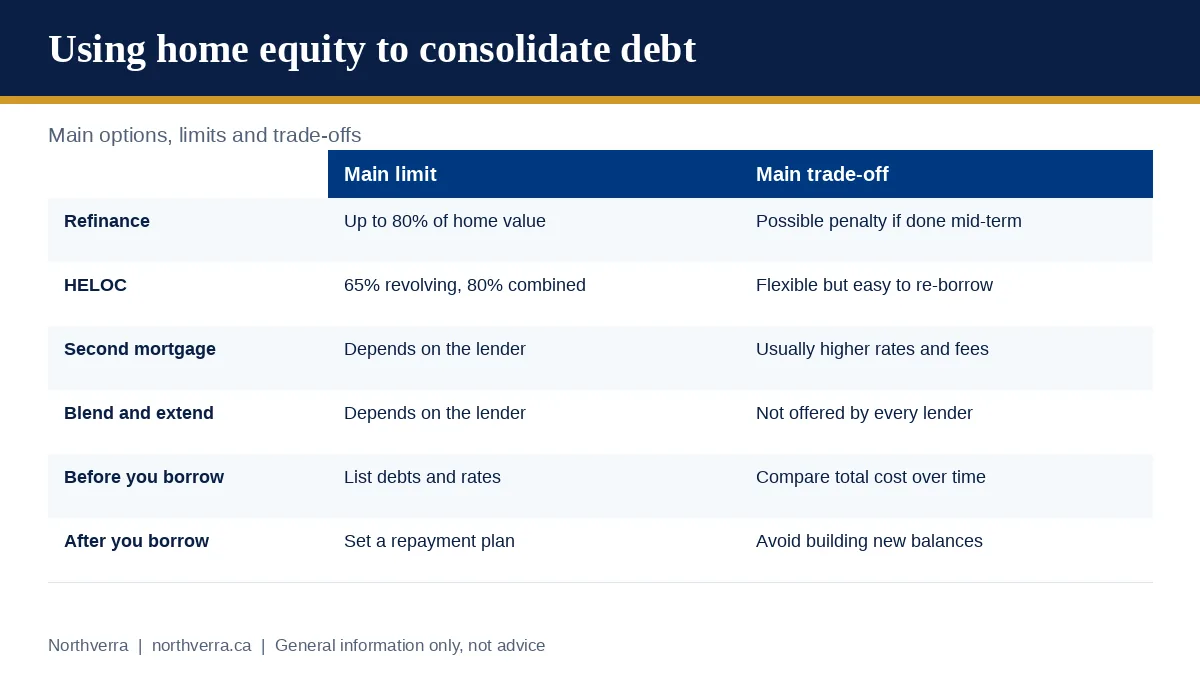
| Option | Main limit | Main trade-off |
|---|---|---|
| Refinance | Up to 80% of home value | May trigger a prepayment penalty if done mid-term |
| HELOC | 65% of home value for the revolving part, 80% combined | Flexible, but easy to keep borrowing |
| Second mortgage | Depends on the lender | Usually higher rates and fees |
| Blend and extend | Depends on the lender | Not offered by every lender |
Step 1: List your debts and their rates
Write down every debt, its balance, interest rate and monthly payment. This shows how much you would need to borrow and how much interest you could save.
Step 2: Check how much equity you can access
Estimate your home’s value and subtract your mortgage balance. Lenders will usually let your total borrowing reach up to 80% of the value, subject to qualifying. For example, on a home worth $500,000 with a $300,000 mortgage, total borrowing could be up to $400,000, leaving up to $100,000 available before costs, if you qualify. These figures are hypothetical.
Step 3: Compare the full cost
- Prepayment penalty if you break your mortgage before the end of the term. See how penalties are calculated.
- Legal, appraisal and discharge fees.
- Interest over time: a lower rate spread over 20 or more years can still cost more in total than a higher rate paid off in three years.
Step 4: Make a repayment plan
The biggest risk is treating the consolidation as the end of the problem. Decide how quickly you will repay the amount you moved into your mortgage, and consider making extra payments. See paying off your mortgage faster.
Example (hypothetical): Ravi has $35,000 in credit card and line of credit balances at high rates. At his mortgage renewal, he refinances to pay them off, so he avoids a prepayment penalty. He then sets up an extra monthly payment equal to what he used to pay on the cards, and closes two of the cards he no longer needs.
Risks to weigh carefully
- Your home becomes security for debts that used to be unsecured.
- If you repay slowly, you may pay more interest in total.
- Variable-rate borrowing can become more expensive if rates rise.
- A HELOC can be borrowed again, which can lead to new balances.
- If home values fall, you may have less equity than expected.
When to consider alternatives
If you are struggling to make minimum payments, or debt keeps returning after consolidation, it may help to address the underlying budget first. A non-profit credit counselling service can help you explore options. Our guide to budgeting basics is a good starting point.
Key takeaways
- Consolidating can lower your interest cost, but only if you stop adding new debt.
- Compare the total cost, including penalties, legal and appraisal fees.
- Stretching debts over a long amortization can increase the total interest you pay.
- A HELOC requires discipline because it can be borrowed again.
- Alternatives such as a consolidation loan or credit counselling may suit some situations better.
Who this guide is for
- Homeowners carrying high-interest credit card or loan balances.
- People whose monthly debt payments are straining their budget.
- Homeowners approaching renewal who are reviewing their options.
- Anyone comparing a refinance with a HELOC for debt repayment.
Questions to ask a mortgage professional
- How much equity can I access, and what would my new payment be?
- What penalty and fees would I pay to refinance now?
- Would a HELOC or a refinance cost me less overall?
- How long would it take to pay off the consolidated debt?
- What happens if interest rates rise?
Frequently asked questions
Is it smart to use home equity to pay off credit cards?
It can be, if it lowers your interest rate meaningfully, you have a plan to repay the consolidated amount, and you stop using the cards for new debt. Without those, many people end up with both a larger mortgage and new credit card balances.
How much home equity can I borrow?
Federally regulated lenders generally allow total borrowing secured by your home of up to 80% of its value. The revolving HELOC portion is generally limited to 65%. You also need enough income to qualify for the new payment.
Will consolidating debt into my mortgage hurt my credit score?
Applying for new credit can cause a small, temporary dip. Paying off high card balances can improve your credit utilization over time. Missing payments on the new loan would hurt your credit.
Should I refinance or use a HELOC to consolidate debt?
A refinance gives you a lump sum with a set payment schedule, which can help you pay the debt down steadily. A HELOC offers flexibility and usually interest-only minimum payments, which requires discipline. See HELOC vs. refinance.
Can I consolidate debt at mortgage renewal?
Renewal is often a good time to review this, because you may be able to refinance without a prepayment penalty. You will still need to qualify and may pay legal and appraisal costs.
What is a second mortgage?
A second mortgage is a separate loan secured by your home, behind your first mortgage. It may avoid breaking your current mortgage, but rates and fees are usually higher.
What are the alternatives to using home equity?
Options include an unsecured consolidation loan, a balance transfer card, a budget and repayment plan, negotiating with creditors, or help from a non-profit credit counselling service. See budgeting basics.
What are the risks of consolidating debt with home equity?
Your home becomes security for the debt, total interest can rise if you stretch repayment out, variable rates can increase, and the freed-up credit can be used again. A clear repayment plan reduces these risks.
Last updated: October 11, 2026
Related guides
- When does it make sense to refinance a mortgage?
- What is a HELOC and how does it work?
- HELOC vs. Mortgage Refinance
- Debt repayment vs. investing
- How is a mortgage prepayment penalty calculated?
- All mortgage questions, answered
Talk it through with us
Every situation is different. If you would like to talk about how this applies to you, we are happy to walk through your questions with no obligation.
Have a question? Start a conversation
Tell us a little about your situation. We will reply within one business day.
By submitting this form you agree that Northverra may contact you about your enquiry. Please do not include account numbers, health details or other sensitive information. See our Privacy Policy.
Important information. Mortgage approval, interest rates, terms and eligibility depend on the lender, your financial profile, the property and current market conditions, and are not guaranteed. Mortgage products and rates change. Nothing on this page is a commitment to lend or a quote of any rate. See our Disclosures.
Important information. The information on this page is general in nature, is provided for educational purposes only, and is not personalized financial, insurance, legal, tax or mortgage advice. Your circumstances are unique. Please speak with a properly licensed professional before making decisions. See our Disclosures.