
MORTGAGE GUIDE
HELOC vs. Mortgage Refinance
Short answer: A HELOC is a revolving line of credit secured by your home that you can borrow, repay and reuse, usually at a variable rate. A mortgage refinance replaces your mortgage with a larger one and pays you a lump sum on a set schedule. A HELOC suits ongoing costs; a refinance suits one large amount repaid steadily.
Quick facts
- A HELOC’s revolving portion is generally limited to 65% of your home’s value, and total borrowing against the home to 80%.
- A refinance can generally go up to 80% of your home’s value.
- HELOC rates are usually variable and tied to the lender’s prime rate.
- Refinancing mid-term can trigger a prepayment penalty on your current mortgage.
- Both require you to qualify under current lending rules.
In this guide: HELOC vs. refinance at a glance · How a HELOC works · How a refinance works · How to choose · Costs to compare · Risks with both options · A combined approach · FAQ

A HELOC and a mortgage refinance both let you borrow against the equity in your home, and both can be useful for renovations, debt consolidation or other large expenses. The difference is in how you receive the money, how you repay it and what it costs. This guide puts them side by side so you can see which one fits your needs.
HELOC vs. refinance at a glance
| Feature | HELOC | Mortgage refinance |
|---|---|---|
| How you get the money | Borrow as needed, up to your limit | One lump sum at closing |
| Borrowing limit | Revolving part up to 65% of home value; up to 80% combined with your mortgage | Up to 80% of home value |
| Interest rate | Usually variable, tied to prime | Fixed or variable, like any mortgage |
| Payments | Often interest-only minimums on what you use | Principal and interest over an amortization |
| Can you borrow again? | Yes, as you repay | No, unless you refinance again or have a readvanceable feature |
| Upfront costs | Usually legal and appraisal fees | Possible prepayment penalty plus legal and appraisal fees |
| Often suits | Ongoing or uncertain costs | One large amount with a steady payoff |
How a HELOC works
A home equity line of credit is a revolving line of credit secured by your home. You can draw money when you need it, repay it, and borrow again, up to your credit limit. You pay interest only on the amount you use. Our guide on what a HELOC is covers the details.
How a refinance works
A refinance replaces your existing mortgage with a new, larger mortgage. The extra money is paid to you or used to pay off debts at closing. Your new mortgage has a rate, a term and an amortization like any other. See when refinancing makes sense.
How to choose
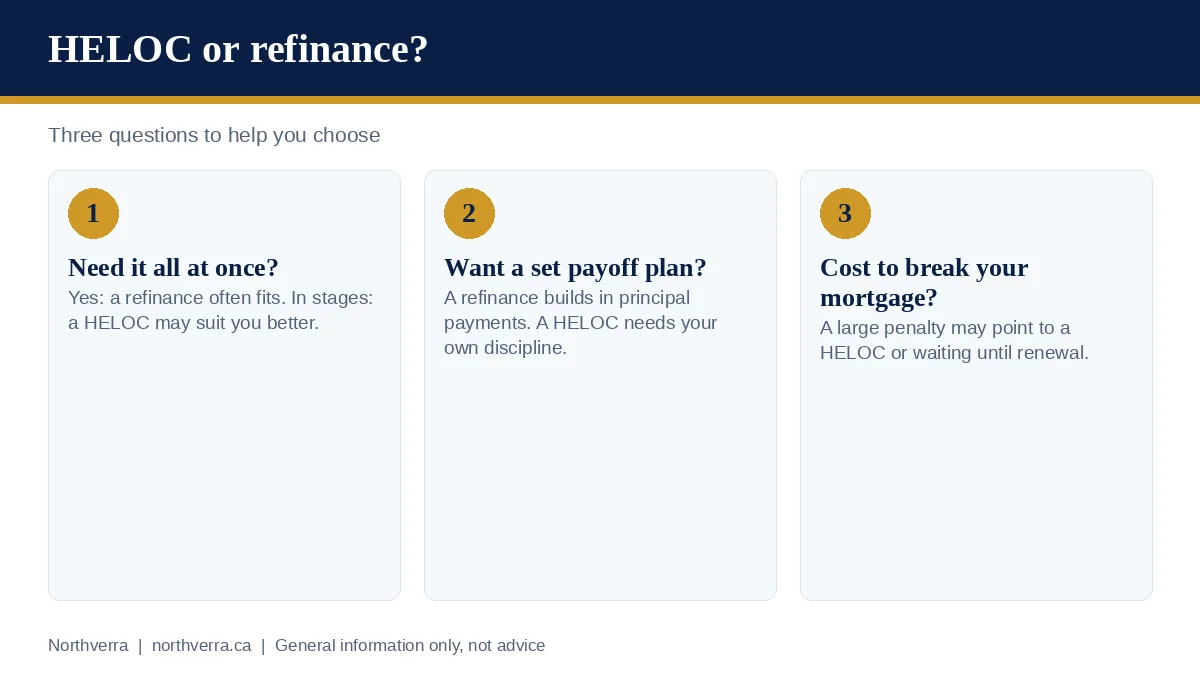
Ask yourself three questions:
- Do you need all the money at once? If yes, a refinance often fits. If you need money in stages, a HELOC may suit you better.
- Do you want a set repayment plan? A refinance builds in principal payments. With a HELOC, you have to choose to pay down the balance.
- What would it cost to break your current mortgage? If the penalty is large, a HELOC or waiting until renewal may make more sense. See prepayment penalties.
Costs to compare
- The interest rate on each option and how it could change.
- Any prepayment penalty on your current mortgage.
- Legal, appraisal and title fees.
- Total interest over the time you expect to carry the debt.
Use the mortgage calculator to compare payments for different amounts and rates.
Example (hypothetical): Jen and Omar plan a kitchen renovation that will be paid in three stages over six months, and they are not sure of the final cost. Their mortgage has two years left in the term with a sizable penalty to break it. They choose a HELOC so they can draw money as each stage is billed, and plan to pay the balance down within a few years.
Risks with both options
- Your home secures the debt, so missed payments put it at risk.
- Stretching repayment over many years increases the total interest you pay.
- Rising rates can increase payments on a HELOC or variable refinance.
- Home values can change, which affects the equity available later.
A combined approach
Some lenders offer a mortgage with a HELOC attached, often called a readvanceable mortgage. It can combine the structure of a mortgage with the flexibility of a line of credit. It suits borrowers who are disciplined about repayment.
Key takeaways
- Choose a HELOC for flexible, ongoing borrowing; choose a refinance for a set amount you want to repay on a schedule.
- Compare total cost, including penalties, fees and interest over time.
- HELOC minimum payments can be interest-only, which means the balance does not shrink unless you pay more.
- A refinance can lock in a fixed rate for the borrowed amount.
- Timing a refinance at renewal can avoid a penalty.
Who this guide is for
- Homeowners planning a renovation.
- Homeowners consolidating debt.
- People who want access to emergency funds or investment money secured by their home.
- Anyone comparing quotes for a HELOC and a refinance.
Questions to ask a mortgage professional
- What would it cost me to break my current mortgage now?
- What rate and payment would each option have?
- Can I set up a combined mortgage and HELOC?
- How would rising rates affect my HELOC payments?
- What fees apply to set up each option?
Frequently asked questions
Is a HELOC cheaper than refinancing?
Not always. A HELOC may avoid a prepayment penalty and have lower setup costs, but its rate is usually variable and often higher than mortgage rates. A refinance may cost more upfront but can offer a lower rate and a steady payoff. Compare the total cost for your situation.
Can I have a HELOC and a mortgage at the same time?
Yes. Many lenders offer a combined product, sometimes called a readvanceable mortgage, where a HELOC sits alongside your mortgage. As you pay down the mortgage, more credit can become available on the HELOC, within the 80% total limit.
What is better for a renovation, a HELOC or a refinance?
A HELOC often suits renovations that are paid in stages or where the total cost is uncertain, because you only pay interest on what you use. A refinance may suit a large project with a known cost if you want a fixed payment schedule.
Do I need to pass the stress test for a HELOC?
At federally regulated lenders, yes. You generally qualify using the higher of your contract rate plus 2% or 5.25%, so your income needs to support the payments under that test. See the stress test.
What happens to my HELOC if interest rates rise?
Because HELOC rates are usually tied to prime, your interest cost rises when prime goes up. If you only make minimum interest payments, a rising rate increases your payment without reducing the balance.
When is a good time to refinance?
Often at renewal, when you can avoid a prepayment penalty. Refinancing mid-term can still make sense if the savings or benefits outweigh the penalty and costs.
Can a lender reduce or freeze my HELOC?
HELOC agreements usually allow the lender to review and change the credit limit in certain situations, such as a significant drop in home value or changes in your finances. Read your agreement carefully.
Which option is better for debt consolidation?
A refinance can help if you want a set plan to repay debt. A HELOC can work if you are disciplined about paying down the balance and not borrowing again. See using home equity to consolidate debt.
Last updated: October 11, 2026
Related guides
- What is a HELOC and how does it work?
- When does it make sense to refinance a mortgage?
- Using Home Equity to Consolidate Debt
- How is a mortgage prepayment penalty calculated?
- Mortgage calculator
- All mortgage questions, answered
Talk it through with us
Every situation is different. If you would like to talk about how this applies to you, we are happy to walk through your questions with no obligation.
Have a question? Start a conversation
Tell us a little about your situation. We will reply within one business day.
By submitting this form you agree that Northverra may contact you about your enquiry. Please do not include account numbers, health details or other sensitive information. See our Privacy Policy.
Important information. Mortgage approval, interest rates, terms and eligibility depend on the lender, your financial profile, the property and current market conditions, and are not guaranteed. Mortgage products and rates change. Nothing on this page is a commitment to lend or a quote of any rate. See our Disclosures.
Important information. The information on this page is general in nature, is provided for educational purposes only, and is not personalized financial, insurance, legal, tax or mortgage advice. Your circumstances are unique. Please speak with a properly licensed professional before making decisions. See our Disclosures.