
LIFE INSURANCE QUESTIONS
Can I get life insurance after age 50?
Short answer: Yes. People can buy life insurance in their 50s, 60s and beyond. Premiums are higher than at younger ages, but term and permanent coverage are both available, and guaranteed issue plans exist for people who cannot qualify for fully underwritten policies.
In this guide: Your options · What affects the cost · Is term still an option? · Why people buy after 50 · Tips · Three ways insurers decide on applicants over 50 · Scenarios: what people over 50 commonly do · Common mistakes to avoid · A quick checklist before you apply · FAQ
Your options
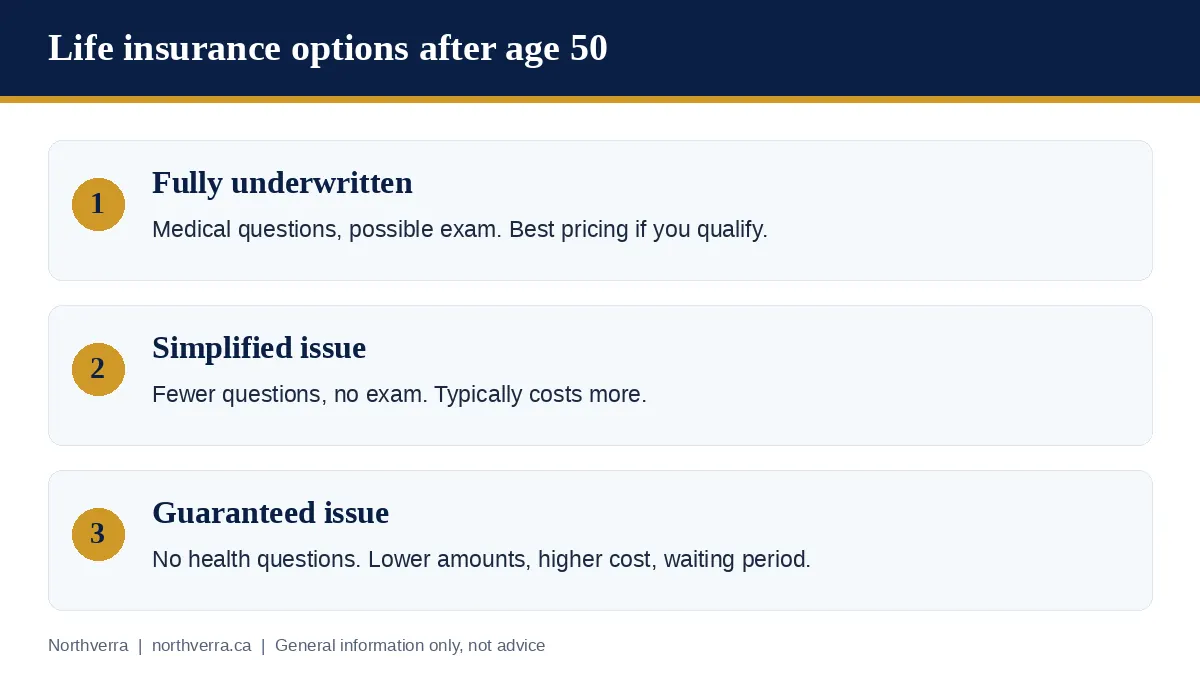
- Fully underwritten term or permanent: usually the best pricing if your health qualifies
- Simplified issue: fewer questions and no exam, higher cost
- Guaranteed issue: no health questions, smaller coverage amounts, higher cost and a waiting period
- Final expense or burial coverage: small permanent policies designed to cover end-of-life costs
What affects the cost
Age and health are the biggest factors. Premiums rise with each year of age, so buying earlier usually costs less. Tobacco use, the coverage amount and the type of policy also matter. Our guide on life insurance costs in Alberta explains the main factors.
Is term insurance still an option?
Yes. Many insurers offer term policies into a person’s 60s or 70s, often in shorter terms such as 10 or 15 years. Check the maximum age for renewal and whether the policy can be converted to permanent coverage.
Why people buy after 50
- To protect a spouse or partner who relies on their income or pension
- To cover a mortgage or business debt that has not yet been paid off
- To leave an inheritance or fund a legacy gift
- To provide for final expenses and estate taxes
- To support a child or relative with ongoing needs
Tips
- Apply while your health is stable
- Ask a broker to compare several insurers
- Check whether existing group coverage can be converted when you retire, as explained in what happens to life insurance when you retire
Next step
It’s rarely too late to look at your options. We can help you compare.
Three ways insurers decide on applicants over 50
Once you are past 50, the way your application is assessed matters as much as the type of policy. Most Canadian insurers use one of three approaches.
Fully underwritten coverage
You answer a detailed health questionnaire, and the insurer may ask for a paramedical exam, blood and urine tests, or reports from your doctor. It takes longer, often several weeks. In return, healthy applicants usually get the widest choice of coverage amounts and the lowest prices available for their age.
Simplified issue coverage
You answer a shorter list of health questions, usually with no medical exam. Approval is faster, but coverage limits are lower and premiums are often higher than for a fully underwritten policy, because the insurer knows less about your health.
Guaranteed issue coverage
There are no health questions within the eligible age range. Coverage amounts are small and the cost per dollar of coverage is the highest of the three. Many of these policies limit the benefit for deaths from natural causes during the first two years, often to a refund of premiums. Read that clause carefully before you buy.
Scenarios: what people over 50 commonly do
- Age 52, mortgage with 15 years left: a 15- or 20-year term policy sized to the mortgage and the income a spouse would lose is often the simplest fit.
- Age 58, children grown, wants to leave something behind: a permanent policy with a modest death benefit can create a guaranteed inheritance while other savings are spent in retirement.
- Age 63, owns a cabin or investments with large gains: some people use permanent coverage, sometimes a joint last-to-die policy with a spouse, to help pay the tax owing on the second death.
- Age 67, health conditions, mainly wants final expenses covered: a simplified or guaranteed issue policy may be the realistic option, accepting the higher cost.
Common mistakes to avoid
- Waiting another year. Prices rise with each birthday, and a new diagnosis can narrow your options quickly.
- Choosing guaranteed issue first. If you could qualify for underwritten coverage, you may pay much more for less.
- Cancelling an old policy too early. Keep existing coverage in force until any new policy is approved and in effect.
- Forgetting group coverage ends. Workplace life insurance often stops or shrinks at retirement. Check the conversion option before you leave.
- Guessing on health questions. Incomplete or inaccurate answers can lead to a claim being reduced or denied.
A quick checklist before you apply
- List what the coverage is for: a debt, income for a spouse, final costs, an estate tax bill or a gift.
- Decide how long the need lasts. A need that ends in 15 years points to term; a lifelong need points to permanent coverage.
- Gather your medication list, doctors’ names and dates of any treatment.
- Check what you already have through work, a former employer or an association.
- Compare more than one insurer, because each assesses age and health differently.
- Set a monthly budget you can keep paying when your income changes in retirement.
More questions people ask
Is there a maximum age to buy life insurance in Canada?
Many insurers offer some form of coverage into the 70s and sometimes beyond, but the choices narrow with age. Term policies often have a maximum issue age, and the longest terms may not be available at older ages.
Can my spouse and I share one policy?
Yes. Joint policies can pay on the first death or on the second death. Joint last-to-die coverage is often used for estate planning, because it pays when the second spouse dies, which is often when taxes come due.
Do I need a medical exam?
Not always. It depends on your age, the amount of coverage and the type of policy. Larger amounts and fully underwritten policies are more likely to require tests.
Will smoking or vaping affect my price?
Yes. Insurers usually charge smokers and many nicotine users much higher rates. Some will move you to non-smoker rates after a period without nicotine, often 12 months.
Related guides
Have a question? Start a conversation
Tell us a little about your situation. We will reply within one business day.
By submitting this form you agree that Northverra may contact you about your enquiry. Please do not include account numbers, health details or other sensitive information. See our Privacy Policy.
Important information. Life insurance products are subject to underwriting, eligibility, exclusions, limitations and the terms of the policy contract. Coverage, premiums and availability depend on your age, health, lifestyle and other factors. Nothing on this page is an offer of insurance or a guarantee of coverage or price. See our Disclosures.