
LIFE INSURANCE QUESTIONS
Can life insurance help with estate planning?
Short answer: Yes. Life insurance can provide cash at death to cover taxes, debts and final expenses, equalize inheritances and leave a gift to charity. When a named beneficiary is designated, proceeds are generally paid outside the estate, which can avoid probate fees and speed access to funds.
In this guide: Providing cash when it is needed · Equalizing an inheritance · Probate and beneficiaries · Charitable giving · Steps to take · Taxes that can come due at death in Canada · Probate and beneficiaries in Alberta · Scenarios · Joint last-to-die policies · Common mistakes · Organizing your estate documents · Reviewing beneficiaries regularly · FAQ
Providing cash when it is needed
An estate may include assets that are hard to sell quickly, such as a home, a cottage or a business, and it may owe taxes on death. Life insurance provides immediate funds so the estate does not have to sell assets in a hurry.
Equalizing an inheritance
If one child will inherit the family business or cottage, insurance can provide equal value to the other children.
Probate and beneficiaries
When you name an individual as beneficiary, the insurer generally pays them directly, outside the estate. This can avoid probate fees and delays and may protect the proceeds from the estate’s creditors. If you name your estate as beneficiary, the proceeds go through probate.
Charitable giving
You can name a charity as beneficiary or donate a policy. Tax treatment depends on how it is done, so check with a tax professional.
Steps to take
- Review beneficiary designations after major life events
- Work with a lawyer on your will and powers of attorney
- Coordinate with an accountant on taxes
- Read what happens when you retire if your coverage is changing
Estate rules differ by province and situation. Our investments page also covers estate and legacy planning.
How life insurance fits into an estate plan, step by step
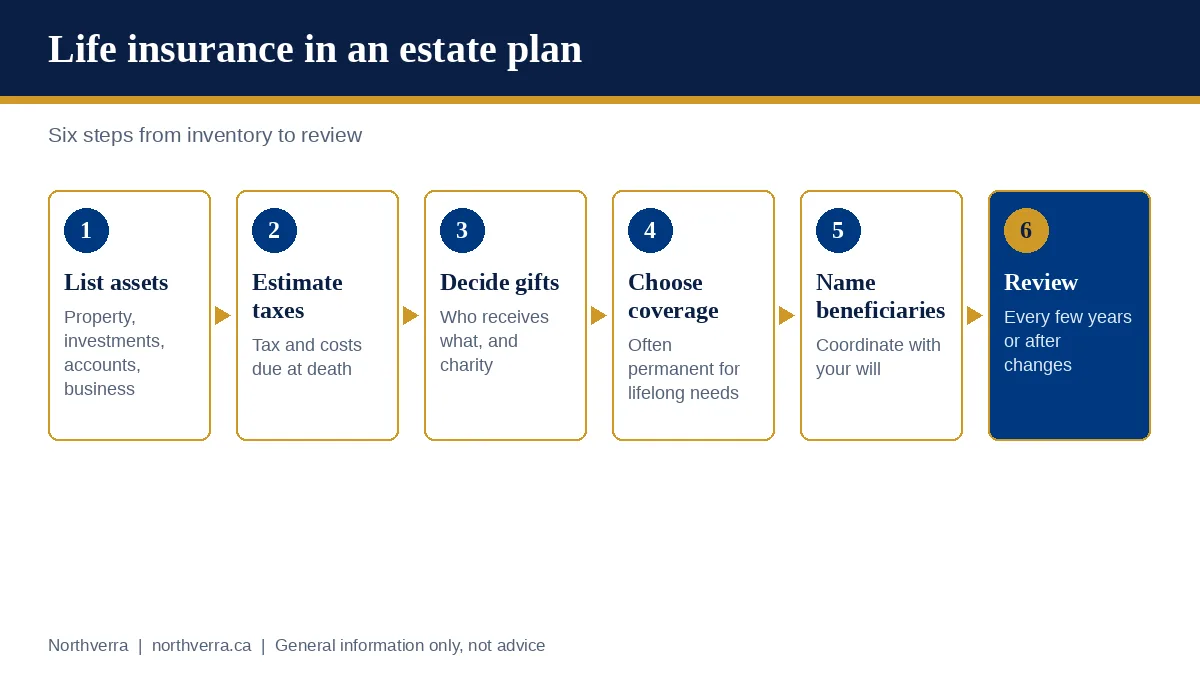
- List your assets and debts, including property, investments, registered accounts and business interests.
- Estimate taxes and costs at death, such as tax on capital gains, registered accounts and estate administration costs.
- Decide what you want to leave and to whom, including any equal treatment of children or gifts to charity.
- Choose the coverage that would supply cash when it is needed. Permanent insurance is often used because estate needs last for life.
- Name beneficiaries carefully and coordinate them with your will.
- Review every few years or after major life changes.
Naming beneficiaries: common choices
| Beneficiary choice | How it works | Points to consider |
|---|---|---|
| Spouse or partner | Money is paid directly to them | Simple; consider a backup (contingent) beneficiary |
| Adult children | Paid directly, often in equal shares | Consider how this fits with the rest of your will |
| Minor children | Children cannot receive the money directly | Name a trustee or use a trust to manage the funds |
| A trust | Money is managed by a trustee under set terms | Useful for minors or dependants with special needs |
| Your estate | Money becomes part of your estate | May be exposed to probate fees and creditors |
| A charity | Supports a cause you care about | May create a tax receipt for your estate |
Next step
We can coordinate the insurance side with your lawyer and accountant.
Taxes that can come due at death in Canada
Canada has no inheritance tax, but the final tax return can still be large. When a person dies, they are generally treated as having sold their capital property at fair market value, which can trigger capital gains tax on a cabin, rental property, shares or a business. The full value of RRSPs and RRIFs is also generally taxable on the final return, unless it can roll over to a surviving spouse or a qualifying dependant. A life insurance death benefit, usually paid tax-free to a named beneficiary, can help pay these bills so assets do not have to be sold quickly.
Probate and beneficiaries in Alberta
In Alberta, surrogate court filing fees for probate are relatively low compared with some other provinces. The bigger advantages of naming a beneficiary directly on a policy are usually speed and privacy. The money is paid to the beneficiary without waiting for the estate to be settled, and it does not become part of the public probate record. If the estate is named as the beneficiary, the money becomes part of the estate and may be exposed to the estate’s creditors.
Minor children as beneficiaries
Insurers generally cannot pay a large benefit directly to a minor. If no trustee is named, the funds may end up being managed by the province until the child reaches the age of majority, which is 18 in Alberta. Naming a trustee, or setting up a trust through your will or an insurance declaration, gives you more control over how and when the money is used.
Scenarios
- Family cabin: parents want to leave a cabin to their children. A policy can pay the capital gains tax so the family does not have to sell it.
- Business owner with one child in the business: the business goes to that child, and insurance gives an equal value to the others.
- Blended family: a policy can provide for children from a first relationship while other assets go to a current spouse.
- Charitable gift: naming a charity as beneficiary, or donating a policy, can create a larger gift and may produce a tax credit.
Joint last-to-die policies
Many couples leave everything to each other, so the largest tax bill usually comes when the second spouse dies. A joint last-to-die policy insures both spouses and pays on the second death. Because the insurer pays only once, and usually later, it can cost less than two separate policies for the same amount.
Common mistakes
- Leaving old beneficiaries in place after a divorce, remarriage or death.
- Naming a minor child without naming a trustee.
- Naming the estate when a direct beneficiary would serve the goal better.
- Not telling the executor that a policy exists.
- Forgetting to coordinate the will, beneficiary designations and joint ownership of assets.
Organizing your estate documents
Insurance works best as part of a complete plan. Keep these documents current and tell your executor where they are.
- Your will, naming an executor and any trusts
- Enduring power of attorney and personal directive, which Alberta uses for financial and health decisions if you lose capacity
- A list of every policy, the insurer, the policy number and the beneficiary
- Account and property lists, including pensions, RRSPs, RRIFs and TFSAs, with their beneficiary designations
Reviewing beneficiaries regularly
A beneficiary designation on a policy generally overrides your will for that policy. Review it whenever you marry, separate, divorce, have a child or lose a loved one, and confirm it with the insurer in writing.
More questions people ask
Is a life insurance payout taxable in Canada?
The death benefit is generally received tax-free by the beneficiary. Income earned after it is paid, such as interest, is taxable.
Can I change my beneficiary?
Usually yes, unless you named an irrevocable beneficiary, whose consent is required.
Should I use a trust?
A trust can help manage money for minors, a person with a disability or someone who needs help managing money. A lawyer can help you choose the right structure.
How do I estimate my estate tax?
An accountant can estimate the tax on your final return based on your assets. That figure can guide how much coverage you need.
Can life insurance pay the tax on a cottage or rental property?
Yes. When you die, tax can be due on the growth in value of property such as a cottage or rental. A life insurance payout can provide the cash to pay that tax, so heirs do not have to sell the property.
What happens if my beneficiary is a minor?
A minor cannot receive the payout directly. Without a named trustee or trust, the money may be managed under court supervision until the child reaches the age of majority. Naming a trustee or setting up a trust gives you more control.
Does life insurance avoid probate in Alberta?
When a named beneficiary receives the payout directly, the money generally does not form part of your estate, so it is not subject to probate. Alberta’s probate fees are lower than in some provinces, but direct payment can still mean faster access for your family.
Do I need permanent insurance for estate planning?
Estate needs such as taxes at death usually last for life, so permanent insurance is commonly used. Some people use term insurance while children are young and add a smaller permanent policy for estate goals.
Last updated: October 11, 2026
Related guides
Have a question? Start a conversation
Tell us a little about your situation. We will reply within one business day.
By submitting this form you agree that Northverra may contact you about your enquiry. Please do not include account numbers, health details or other sensitive information. See our Privacy Policy.
Important information. Life insurance products are subject to underwriting, eligibility, exclusions, limitations and the terms of the policy contract. Coverage, premiums and availability depend on your age, health, lifestyle and other factors. Nothing on this page is an offer of insurance or a guarantee of coverage or price. See our Disclosures.