
LIFE INSURANCE QUESTIONS
How can business owners use life insurance?
Short answer: Business owners use life insurance to protect the company and the people behind it. Common uses are key person coverage, funding a buy-sell agreement, repaying business loans and creating liquidity for succession and estate planning.
In this guide: Key person coverage · Buy-sell funding · Business loans · Succession and estate planning · Who owns the policy? · Key person coverage in more detail · Scenarios · Personal versus corporate ownership · Common mistakes · Getting started · Term or permanent for business needs? · Questions to discuss with your advisors · FAQ
Key person coverage
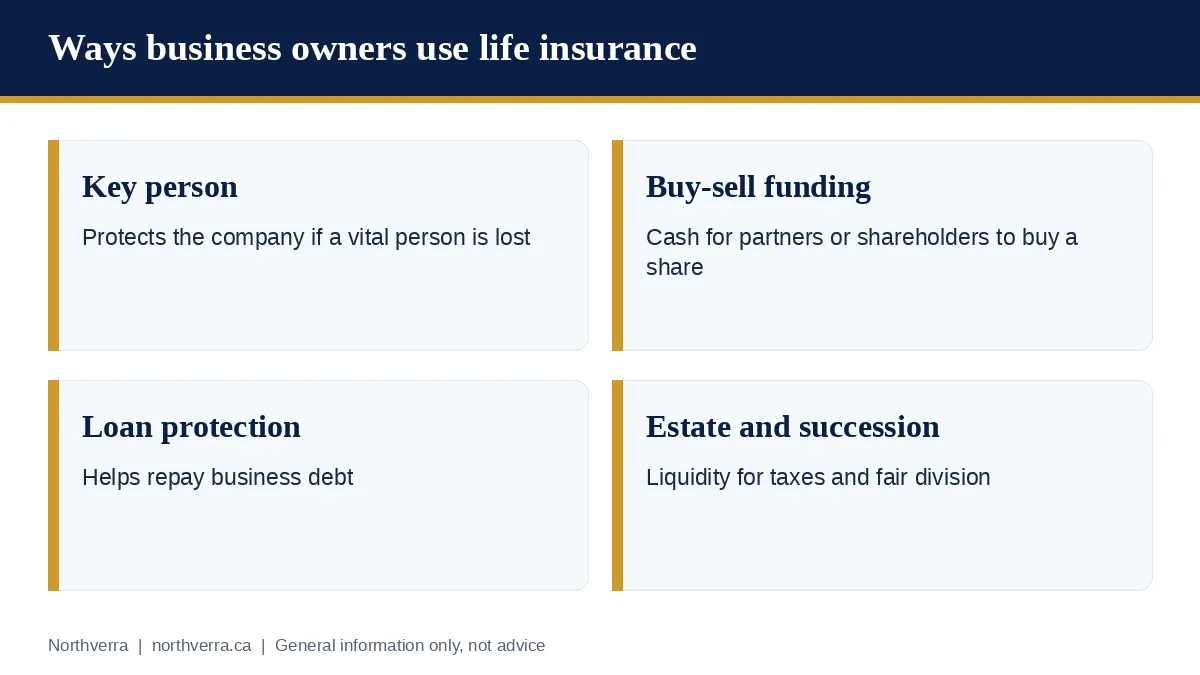
If a founder, top salesperson or key technical expert died, the business could lose revenue or struggle to find a replacement. Coverage on that person provides funds to steady the business.
Buy-sell funding
A buy-sell agreement sets out how a partner’s share will be bought if they die. Insurance provides the cash. Read more in our guide on buy-sell agreements.
Business loans
Lenders may require life insurance on owners. The policy can be assigned as collateral, see using life insurance as collateral.
Succession and estate planning
Owners often hold much of their wealth in the business. Insurance provides cash for taxes and for family members who are not part of the business. See estate planning and life insurance.
Who owns the policy?
A policy can be owned personally or by the corporation, and the choice affects premiums, taxes and who receives the benefit. See incorporated business owners.
Choosing coverage for common business needs
| Business need | What the coverage does | Type often used |
|---|---|---|
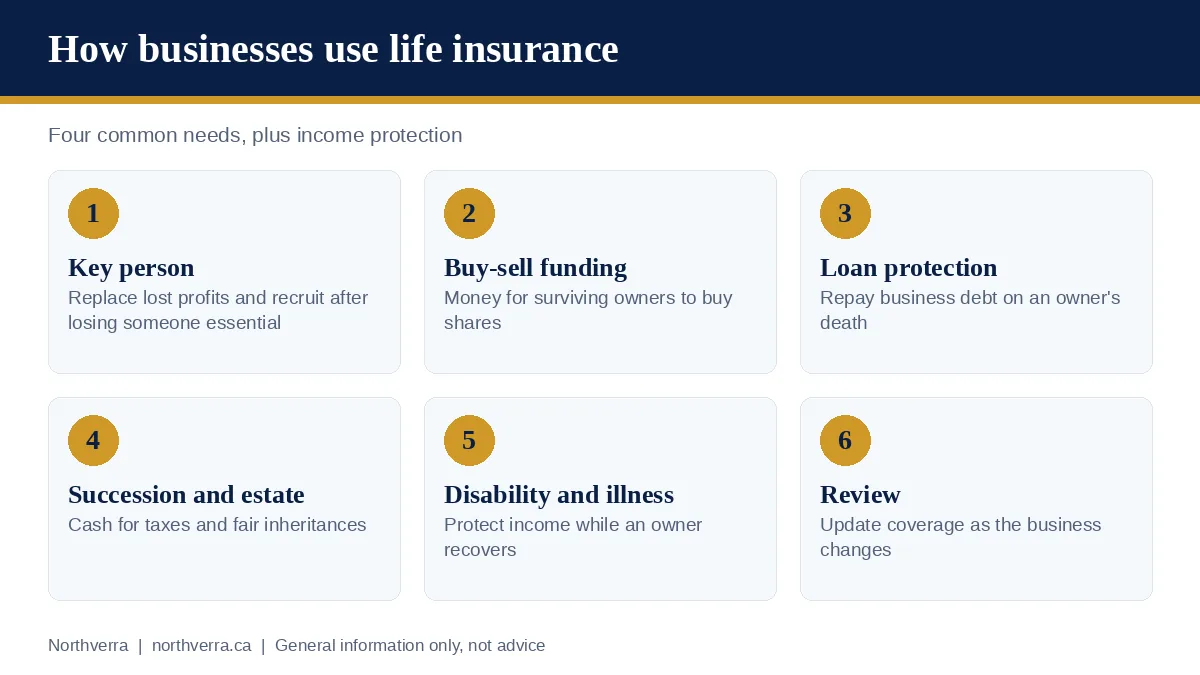
| Key person | Helps the business replace lost profits and recruit after the loss of someone essential | Term or permanent, owned by the business |
| Buy-sell funding | Gives surviving owners money to buy the deceased owner’s shares | Term or permanent, owned according to the agreement |
| Loan protection | Repays business debt so it does not fall on the business or the family | Term matched to the loan |
| Succession and estate | Provides cash for taxes and to equalize an estate among heirs | Usually permanent |
Protecting more than the death benefit
Life insurance covers one risk. Many business owners are more likely to face a period of illness or disability during their working years. Disability insurance, critical illness insurance and business overhead expense coverage can protect income and keep the doors open while an owner recovers. Our guide to financial planning for business owners shows how these pieces fit together with pay, retirement and succession planning.
Next step
We work with your accountant and lawyer to design coverage that fits.
Key person coverage in more detail
A key person is someone whose death would hurt the business’s revenue, customer relationships or ability to borrow. The business usually owns and pays for the policy and is the beneficiary. The money can help cover lost profits, the cost of hiring and training a replacement, and reassurance to lenders and suppliers.
How to estimate the amount
- A multiple of the person’s salary or share of profits
- The cost to recruit and train a replacement, plus the time it would take
- Loans or lines of credit the person personally guarantees
- Contracts or projects that depend on them
Scenarios
- Two-partner trades company in Calgary: each partner owns half. A funded buy-sell agreement lets the survivor buy the deceased partner’s shares from the family at an agreed price.
- Sole owner with a business loan: the bank requires coverage assigned to it. Insurance repays the loan so the business or estate is not forced to sell assets.
- Family business: one child will take over. Insurance provides an equal inheritance to the other children.
- Professional corporation: a dentist, lawyer or engineer may use corporate-owned permanent insurance as part of estate planning.
Personal versus corporate ownership
Insurance owned by the corporation is paid with corporate dollars, which are often taxed at a lower rate than personal income. When a private corporation receives a death benefit, it can generally add the amount above the policy’s adjusted cost basis to its Capital Dividend Account and pay that amount to shareholders as a tax-free capital dividend. Ownership, beneficiary and premium payer must line up correctly, or there can be taxable benefits. See life insurance for incorporated business owners.
Common mistakes
- Having a buy-sell agreement with no funding to pay for it.
- Never updating the business value in the agreement.
- Mismatching the owner, payer and beneficiary of a corporate policy.
- Covering death but not disability, which can cause just as much disruption.
- Forgetting to review coverage when partners join or leave.
Getting started
- List who the business depends on and what would happen if they died.
- Review your shareholder agreement with a lawyer.
- Ask your accountant about personal versus corporate ownership.
- Compare term and permanent coverage based on how long the need lasts.
- Review every few years, or when the business changes.
Term or permanent for business needs?
- Term often fits needs that end: a loan with a set payoff date, key person coverage while a successor is trained, or a buy-sell for owners who plan to sell in 10 to 20 years.
- Permanent often fits needs that last: tax at death on business shares, a buy-sell that runs as long as the owners keep the business, or a long-term corporate estate asset.
Many businesses combine both. Some term policies can be converted to permanent coverage later, which keeps options open as the business grows.
Insurable interest and consent
A business can only insure someone in whom it has a financial interest, such as an owner or key employee, and the person insured must consent and take part in the application. Health questions and medical tests apply just as they do for a personal policy.
Calgary and Alberta business owners
Many Alberta businesses are owner-managed corporations in trades, energy services, construction, real estate and professional services, where one or two people hold most of the relationships and the know-how. That concentration is exactly what insurance planning is designed to protect.
Questions to discuss with your advisors
- What would happen to the business in the first 90 days if I died?
- Who would buy my shares, and at what price?
- Which loans would need to be repaid, and who has guaranteed them?
- Should the coverage be owned personally, by the operating company, or by a holding company?
- How would the Capital Dividend Account work in our structure?
More questions people ask
Are premiums tax-deductible for a business?
Generally no, with limited exceptions such as part of the premium when a lender requires the policy as collateral for a business loan. Ask your accountant.
Can the business insure an employee?
Yes, with the employee’s consent and an insurable interest, such as a key person relationship.
Should a holding company own the policy?
Sometimes. The best structure depends on your corporate setup and goals. Get professional advice.
What happens to my business if I die without a plan?
Your shares go to your estate, and your family may become partners with your co-owners. A funded agreement helps avoid that. See buy-sell agreements.
How much key person insurance does a business need?
Common approaches look at the person’s contribution to profits, the cost to recruit and train a replacement, and any debts that depend on them. An accountant and an advisor can help agree on a reasonable amount that the insurer will accept.
Can life insurance repay a business loan?
Yes. A policy matched to the loan amount and term can repay the debt if the owner dies, so the lender is paid and the business or family is not left with the balance. Some lenders require it as a condition of the loan.
What is a buy-sell agreement?
It is a contract between business owners that sets out what happens to an owner’s shares if they die, become disabled or leave. Insurance is often used to fund it. See funding a buy-sell agreement.
Does life insurance belong in a business owner’s financial plan?
It often does, alongside how you pay yourself, retirement savings and succession planning. The right coverage depends on who relies on you and the business.
Last updated: October 11, 2026
Related guides
Have a question? Start a conversation
Tell us a little about your situation. We will reply within one business day.
By submitting this form you agree that Northverra may contact you about your enquiry. Please do not include account numbers, health details or other sensitive information. See our Privacy Policy.
Important information. Life insurance products are subject to underwriting, eligibility, exclusions, limitations and the terms of the policy contract. Coverage, premiums and availability depend on your age, health, lifestyle and other factors. Nothing on this page is an offer of insurance or a guarantee of coverage or price. See our Disclosures.