
LIFE INSURANCE QUESTIONS
Can life insurance help fund a buy-sell agreement?
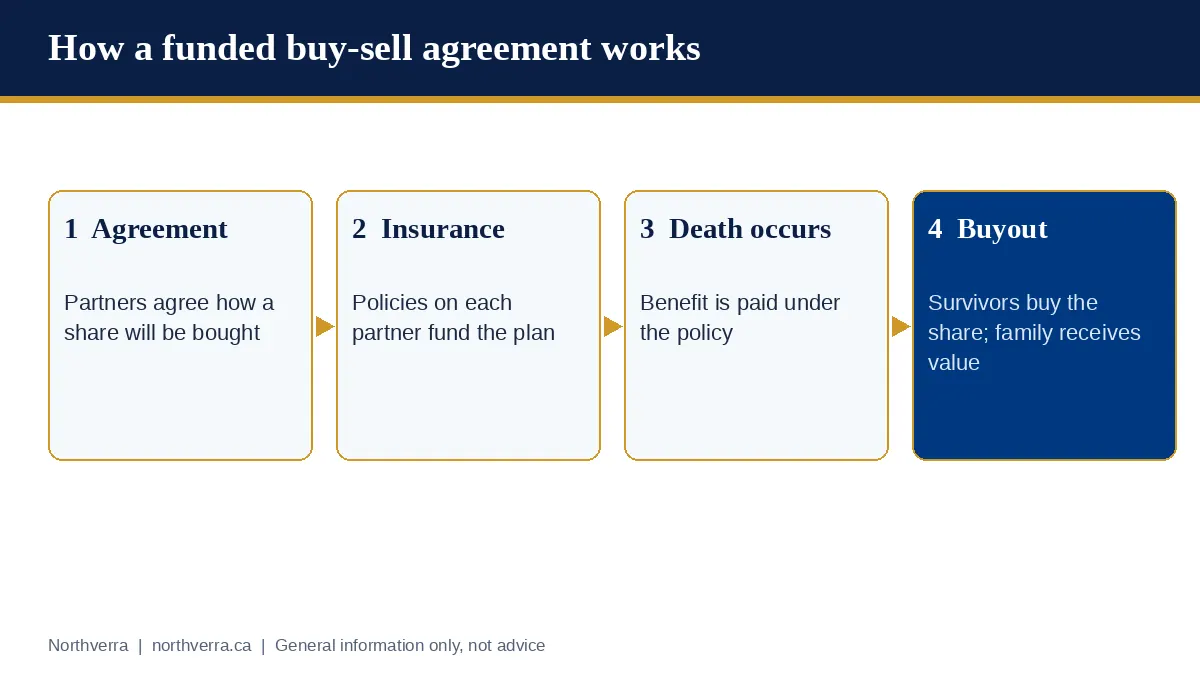
Short answer: Yes. A buy-sell agreement says what happens to a partner’s share if they die, and life insurance can provide the cash for the surviving partners or the company to buy that share. It helps the family get fair value and lets the business continue.
In this guide: What a buy-sell agreement is · How insurance funds it · Common structures · Mistakes to avoid · Steps · A simple scenario · What the agreement should cover · Disability can be the bigger risk · Tax and structure considerations · A checklist for owners · Ways to structure the funding · What happens without funding · FAQ
What a buy-sell agreement is
It is a legal contract among owners that sets out how a departing or deceased owner’s interest is valued and sold. Without one, the family of a deceased partner may end up co-owning with the survivors or be unable to sell.
How insurance funds it
Each partner, or the company, buys a policy on the other owners. When an owner dies, the benefit is paid, and the survivors or the company use it to buy the shares from the estate at the agreed price.
Common structures
- Cross-purchase: each owner owns a policy on the others
- Corporate redemption: the company owns the policies and redeems the shares
- Hybrid arrangements that combine features
Tax treatment differs, and a corporation’s Capital Dividend Account (CDA) may be involved. See incorporated business owners.
Mistakes to avoid
- Never updating the valuation formula as the business grows
- Letting policies lapse or not matching the coverage to the value
- Not having a lawyer draft the agreement
- Overlooking disability or critical illness buyouts
Steps
- Have a lawyer draft or update the agreement
- Agree on a valuation method
- Get coverage that matches it
- Review every year or two
See also how business owners use life insurance.
Next step
We can help you size and structure the insurance side.
A simple scenario
Two partners each own 50% of an Alberta fabrication company valued at $1.2 million, an illustrative figure. Their agreement says that if one dies, the survivor must buy the deceased partner’s shares, and the estate must sell. Each partner’s life is insured for about $600,000. If one partner dies, the money is used to buy the shares from the family. The survivor owns 100% of the business, and the family receives fair value in cash instead of a share of a business they do not run.
What the agreement should cover
- Triggering events: death, and often disability, retirement, divorce, bankruptcy or leaving the business.
- Valuation: a fixed price updated regularly, a formula, or an independent valuation at the time of the event.
- Funding: how each event will be paid for, whether life insurance, disability buyout insurance, savings or instalments.
- Who buys: the surviving owners, the corporation or a holding company.
- Timelines: when the sale must close and how payment is made.
Disability can be the bigger risk
An owner who becomes seriously ill or injured may be unable to work for years, while still owning shares. Disability buyout insurance can fund the purchase of a disabled owner’s shares after a waiting period. Without it, the remaining owners may struggle to keep paying a partner who cannot contribute.
Tax and structure considerations
How the shares are bought, by the survivors or through a corporate redemption, can change the tax result for the estate and the survivors. Rules such as the stop-loss rules, the Capital Dividend Account and the deemed disposition at death all interact. These structures need a lawyer and an accountant working together. Insurance should be put in place after the structure is chosen, so the ownership and beneficiaries match the agreement.
A checklist for owners
- Read your current shareholder agreement. Does it include a buy-sell clause?
- Check when the business value in the agreement was last updated.
- Make sure coverage amounts match each owner’s share of the current value.
- Confirm who owns each policy and who is the beneficiary.
- Consider disability as well as death.
- Set a reminder to review the agreement and the coverage every one to three years.
Ways to structure the funding
- Cross-purchase (criss-cross): each owner owns a policy on the other owners. Simple with two owners, but the number of policies grows quickly with more.
- Corporate-owned: the corporation owns a policy on each owner and uses the death benefit to buy back shares, often combined with the Capital Dividend Account.
- Hybrid: a combination of the two, designed to balance tax results for the estate and the survivors.
Each method has different tax results. The choice should come from the lawyer and accountant who design the agreement.
Keeping it current
A buy-sell agreement is only as good as its last update. If the business has doubled in value since the agreement was signed and the coverage has not changed, the survivors may not be able to pay the family the fair price.
What happens without funding
Without insurance or other funding, a surviving owner may need to borrow, sell assets, or pay the family in instalments over years. The family may wait a long time for the money, or end up as reluctant co-owners in a business they do not run. Relationships can suffer when there is no clear plan. A funded agreement turns a stressful negotiation into a set process that both sides agreed to in advance.
More questions people ask
Is a buy-sell agreement only for partnerships?
No. It applies to any business with more than one owner, including corporations with two or more shareholders.
What if one owner cannot get insurance?
The agreement can use other funding, such as instalment payments over several years. Plan for this up front.
Does the insurance money go to the family?
Under a cross-purchase plan, the surviving owners receive the benefit and use it to pay the family for the shares. The agreement sets the details.
How often should the agreement be reviewed?
Many advisors suggest every one to three years, or whenever the business value or ownership changes.
Related guides
Have a question? Start a conversation
Tell us a little about your situation. We will reply within one business day.
By submitting this form you agree that Northverra may contact you about your enquiry. Please do not include account numbers, health details or other sensitive information. See our Privacy Policy.
Important information. Life insurance products are subject to underwriting, eligibility, exclusions, limitations and the terms of the policy contract. Coverage, premiums and availability depend on your age, health, lifestyle and other factors. Nothing on this page is an offer of insurance or a guarantee of coverage or price. See our Disclosures.