
LIFE INSURANCE QUESTIONS
How can life insurance help protect my family?
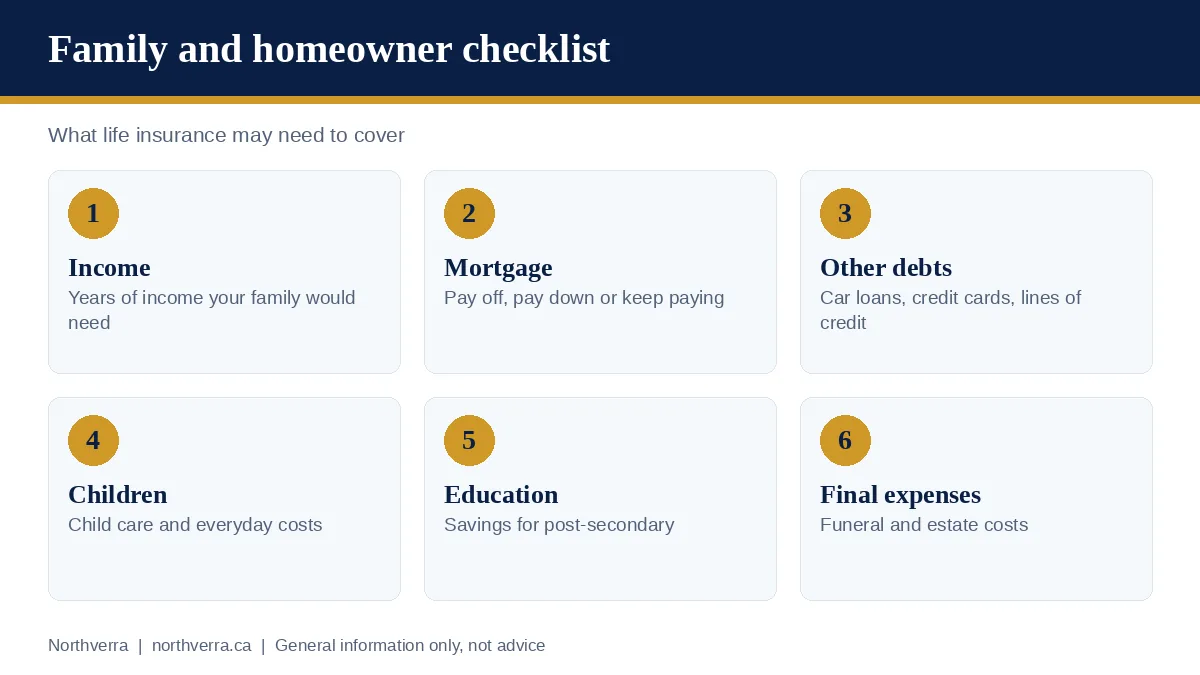
Short answer: Life insurance pays a lump sum to the people you name if you die. That money can replace lost income, pay off a mortgage and other debts, fund education, cover final expenses and give your family time and choices, so they do not have to make financial decisions in the middle of grief.
In this guide: Replace income · Pay debts and keep the home · Fund future goals · Support someone with special needs · How to get started · Scenarios: what protection looks like in real life · Beyond life insurance · A family protection checklist · Common mistakes · How fast is the money paid? · A hypothetical family example · Choosing a beneficiary and trustee · FAQ
Replace income
If your household depends on your paycheque, a death benefit can replace it for years, covering everyday costs like food, utilities and child care.
Pay debts and keep the home
A benefit can pay a mortgage, car loans and credit cards so the family keeps the home. See our guide on life insurance and a mortgage.
Fund future goals
- Education, which you can plan with an RESP, see what each account is for
- Retirement for a surviving spouse
- A cushion for the unexpected
Support someone with special needs
Families with a dependent adult child or a parent who needs care often need lifelong support. A permanent policy with a trust may help, and a lawyer can advise on structure.
How to get started
- Estimate your need with our coverage guide
- Choose a type, see term vs. permanent
- Check what you already have through work
- Name beneficiaries clearly and review them after life events
For new parents, see financial planning for new parents.
Life insurance for homeowners: protecting the mortgage
For many families, the mortgage is the largest debt. Life insurance can give your family the choice to pay it off, pay it down or keep making payments while they adjust. Two common ways to cover a mortgage are lender mortgage insurance and a personal term policy. A personal policy pays your chosen beneficiary, keeps the same death benefit and stays with you if you change lenders. Our guide to life insurance and your mortgage compares them.
Homeowners should also think beyond the mortgage balance: property taxes, home insurance, utilities and maintenance continue, and a surviving partner may need money to cover them on one income.
Coverage by family stage
| Family stage | Common needs | Coverage often considered |
|---|---|---|
| New homeowners, no children | Mortgage and shared costs | Term coverage on both partners sized to the mortgage and income |
| Young children | Income replacement, child care, mortgage, education | Larger term coverage on each parent, often 20 to 30 years |
| Teenagers | Mortgage balance, education, remaining income years | Review amounts; some coverage may be reduced |
| Empty nesters | Remaining debts, estate goals, a surviving spouse | Smaller term coverage or permanent coverage for estate needs |
Next step
We can help you build a plan around your family.
Scenarios: what protection looks like in real life
- Young couple with a new baby: both parents need coverage. The working parent’s income and the at-home parent’s work both cost money to replace.
- Single parent: coverage often needs to be larger, and choosing a guardian and a trustee is just as important as the policy.
- Family with a child who has a disability: permanent coverage and a properly structured trust can support the child for life. In some cases, a Henson trust can help protect eligibility for provincial benefits such as AISH in Alberta. A lawyer should set this up.
- Caring for aging parents: if you support a parent financially, coverage can make sure that support continues.
Beyond life insurance
Life insurance pays when someone dies. Families are more likely to face a long illness or disability before retirement. Two other types of coverage are worth considering alongside life insurance:
- Disability insurance: replaces part of your income if you cannot work because of illness or injury.
- Critical illness insurance: pays a lump sum if you are diagnosed with a covered condition, such as certain cancers, heart attack or stroke, and survive the waiting period.
An emergency fund, a will, powers of attorney and a personal directive complete the picture.
A family protection checklist
- Calculate how much coverage you need, using our needs guide.
- Make sure both partners are covered, not only the main earner.
- Name beneficiaries, and a trustee for any minor children.
- Write or update your will and name guardians for your children.
- Keep a list of policies and where to find them, and tell your executor.
- Review your coverage after a move, a new child, a new mortgage or a change in income.
Common mistakes
- Covering only the mortgage and not the lost income.
- Relying only on workplace coverage, which may end when the job does.
- Not insuring a stay-at-home parent.
- Naming minor children directly with no trustee.
- Buying a policy and never reviewing it.
How fast is the money paid?
Once the insurer receives the claim and the required documents, such as a death certificate and the claim forms, many claims are paid within a few weeks. Claims may take longer if the death happens during the contestable period, often the first two years, or if more information is needed. Keeping policy details organized helps your family claim quickly.
A hypothetical family example
Consider a Calgary couple in their mid-30s with two young children and a $450,000 mortgage. One earns $85,000 and the other works part-time and does most of the child care. If the main earner died, the family would need the mortgage handled and years of income replaced. If the other parent died, the family would need to pay for child care and might lose part-time income. Many couples in this position buy term coverage on both lives, with more on the main earner, for a term that lasts until the children are independent. The figures here are only an illustration; your own numbers will differ.
Talking about it as a family
These conversations are not easy, but they help. Share where policies and documents are kept, who the beneficiaries and guardians are, and who to call. A surviving spouse who knows the plan can act quickly when it matters most.
Choosing a beneficiary and trustee
Choose a primary beneficiary and a contingent beneficiary in case the first one dies before you. If children may receive the money, name a trustee you trust to manage it until they are older, or direct the money to a trust in your will. Tell the people you name, and give them the insurer’s name and policy number so they know who to contact.
More questions people ask
Is the payout taxed?
A death benefit paid to a named beneficiary is generally tax-free in Canada.
Can children be insured?
Yes. Some parents buy a small policy or a child rider to cover final costs and protect the child’s future insurability.
Should we buy term or permanent?
Many families use term for the years of highest need. See term versus permanent life insurance.
What if we cannot afford all the coverage we need?
Start with what you can afford, often a term policy, and add more when your budget allows.
Should life insurance cover the whole mortgage?
Many families aim for coverage that could pay off the mortgage, so a surviving partner can stay in the home with lower costs. Others prefer coverage that keeps payments going for several years. The right amount depends on your income needs and what would feel secure for your family.
Is mortgage insurance from my bank enough for a homeowner?
It covers the mortgage balance, but it usually pays the lender, the benefit can shrink as you pay down the loan, and it may not move with you if you switch lenders. Many homeowners prefer a personal term policy or use both.
How much life insurance do new parents need?
New parents usually need enough to replace income for many years, cover child care and the mortgage, and set aside money for education. A needs analysis, like the one in our guide on how much life insurance you need, gives a personal estimate.
Do both partners need life insurance if only one works?
Often, yes. If the partner at home died, the family could face large costs for child care and household help. Coverage on both partners protects the household either way.
Last updated: October 11, 2026
Related guides
Have a question? Start a conversation
Tell us a little about your situation. We will reply within one business day.
By submitting this form you agree that Northverra may contact you about your enquiry. Please do not include account numbers, health details or other sensitive information. See our Privacy Policy.
Important information. Life insurance products are subject to underwriting, eligibility, exclusions, limitations and the terms of the policy contract. Coverage, premiums and availability depend on your age, health, lifestyle and other factors. Nothing on this page is an offer of insurance or a guarantee of coverage or price. See our Disclosures.