
LIFE INSURANCE QUESTIONS
Can life insurance be used for retirement planning?
Short answer: It can play a supporting role, but it is not a replacement for RRSPs, TFSAs or pensions. Some permanent policies build cash value that can be accessed through loans or withdrawals, which may supplement retirement income. There are costs, tax rules and risks, so it suits only some people.
In this guide: How it can work · Possible advantages · Trade-offs and risks · What to consider first · Who it may suit · Three common strategies · A scenario to illustrate the idea · Questions to ask before relying on insurance for retirement · Common mistakes · How it compares with RRSPs and TFSAs · Planning for loan risk in retirement · FAQ
How it can work
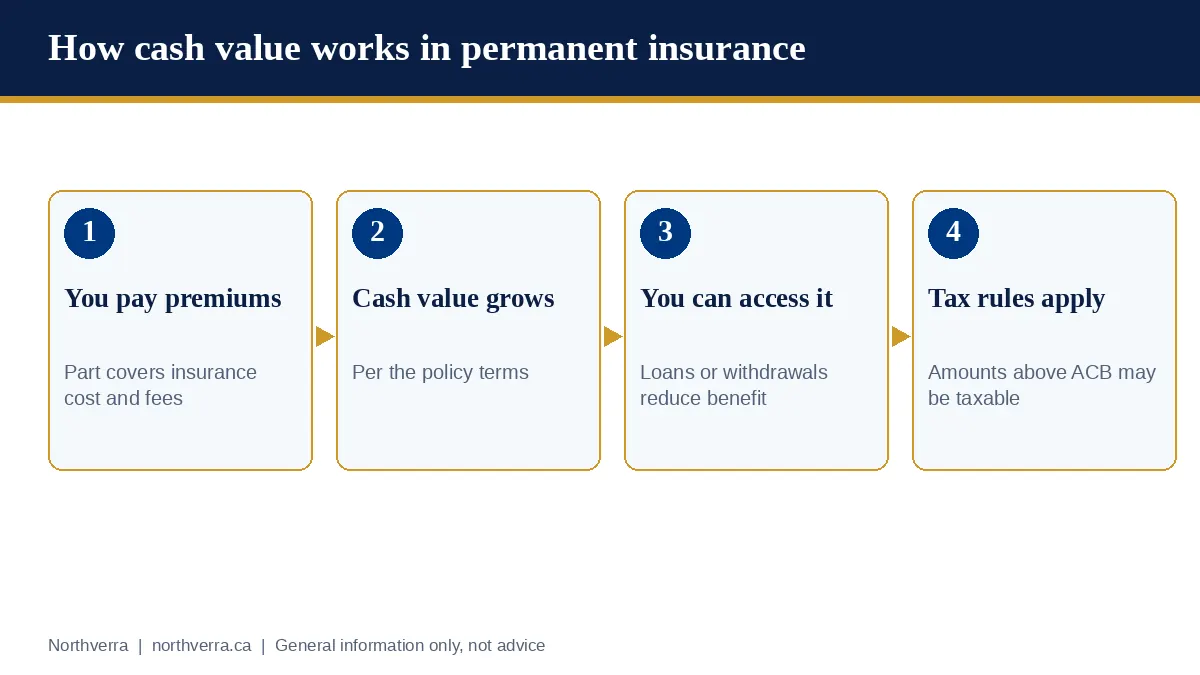
Permanent policies such as whole life and universal life can build a cash value. In retirement, some people take policy loans, use the cash value as collateral or make withdrawals. These reduce the death benefit and the remaining cash value, and tax rules apply to amounts above the policy’s adjusted cost basis (ACB).
Possible advantages
- Cash value grows tax-sheltered within the policy rules
- The death benefit can go to beneficiaries, generally tax-free
- Policy loans may offer flexible access to funds
Trade-offs and risks
- Costs and fees can be high, especially in early years
- Withdrawals and loans reduce the benefit, and unpaid loans with interest can cause the policy to lapse
- Universal life investment accounts can lose value
- Tax rules are complex and can change
- It is a long-term commitment, and early surrender may reduce your return
What to consider first
Registered accounts like RRSPs and TFSAs usually come first because of their tax features and lower complexity. Read what each registered account is for. Permanent insurance is often considered once those are used or when there is also a need for lifelong coverage.
Who it may suit
People with a lifelong insurance need, stable income and the ability to commit for decades. It does not suit someone who may need to cancel the policy or who is mainly looking for investment growth.
Next step
We can help you compare insurance-based and traditional approaches.
Three common strategies
Protecting the estate so you can spend other savings
A permanent policy can provide a set amount for heirs. Knowing the inheritance is covered, some retirees feel comfortable spending more of their other savings, or buying an annuity for steady income.
Accessing cash value in retirement
Cash value in a permanent policy may be accessed through withdrawals, policy loans or a bank loan that uses the policy as collateral. This is sometimes called an insured retirement strategy. Withdrawals and some policy loans can create a taxable policy gain, and loans add interest that can reduce the death benefit.
Pairing insurance with an annuity
Some people use part of their savings to buy a life annuity for guaranteed income, and a life insurance policy to replace the capital for the estate. Whether this makes sense depends on health, interest rates and the cost of the coverage.
A scenario to illustrate the idea
Consider a hypothetical couple in their late 40s who have already made full use of their TFSAs and RRSPs, have a long time horizon and want a lasting estate. They might fund a permanent policy for 20 years. In retirement, the cash value could be one more source of money to draw on, while the death benefit supports the estate. This only works if premiums can be paid for many years, and results depend on dividend or interest rates that are not guaranteed.
Questions to ask before relying on insurance for retirement
- Have I made full use of my RRSP, TFSA and any workplace pension first?
- Can I afford the premiums for the full funding period, even if my income drops?
- What is guaranteed in the illustration, and what is only projected?
- What happens if interest rates on a collateral loan rise in retirement?
- How would a withdrawal or a loan affect the death benefit and the tax owing?
- What would it cost to surrender the policy in the early years?
Common mistakes
- Buying a policy mainly as an investment without needing the death benefit.
- Underfunding a universal life policy so the cost of insurance eats the cash value.
- Taking large loans without a plan to manage the balance, which can cause the policy to lapse.
- Comparing an illustration’s projected values with guaranteed investments as if they were the same.
How it compares with RRSPs and TFSAs
- RRSP: contributions are deductible, and withdrawals are taxed as income. It is designed mainly for retirement income.
- TFSA: contributions are not deductible, but growth and withdrawals are tax-free, with flexible access.
- Permanent life insurance: premiums are not deductible, growth is generally sheltered inside an exempt policy, and the death benefit is generally tax-free. Access to cash value is less flexible and may be taxable.
For most people, registered accounts come first. Insurance can complement them when there is also a real need for lifelong coverage.
Planning for loan risk in retirement
If a plan relies on borrowing against a policy, build in safety margins. Borrow less than the maximum the lender allows, model what happens if interest rates rise by two or three percentage points, and decide in advance when to stop borrowing. Some people plan to pay the interest each year rather than let it build up. A conservative approach makes it more likely the policy stays in force and still leaves something for the estate.
More questions people ask
Is the cash value guaranteed?
Some whole life policies have guaranteed cash values plus non-guaranteed dividends. Universal life cash values depend on the investment options chosen. Ask which parts are guaranteed.
Can I use my RRSP and life insurance together?
Yes. Many plans use registered accounts for core retirement income and insurance for protection and the estate. See what each registered account is for.
Is borrowing against a policy taxable?
A bank loan secured by the policy is generally not income. Policy loans and withdrawals can create a taxable policy gain. Ask an accountant about your situation.
When does this strategy usually make sense?
Typically for people with a long horizon, steady income, maximized registered accounts and a real need for a permanent death benefit.
Related guides
Have a question? Start a conversation
Tell us a little about your situation. We will reply within one business day.
By submitting this form you agree that Northverra may contact you about your enquiry. Please do not include account numbers, health details or other sensitive information. See our Privacy Policy.
Important information. Life insurance products are subject to underwriting, eligibility, exclusions, limitations and the terms of the policy contract. Coverage, premiums and availability depend on your age, health, lifestyle and other factors. Nothing on this page is an offer of insurance or a guarantee of coverage or price. See our Disclosures.