
LIFE INSURANCE QUESTIONS
What is cash value life insurance?
Short answer: Cash value is a savings-like component inside some permanent life insurance policies, such as whole life and universal life. It builds over time under the policy terms, and you may be able to access it while you are alive, though doing so affects the policy and may have tax consequences.
In this guide: How it works · How you can access it · Tax considerations · Costs and limits · Questions to ask · Which policies have cash value · Cash value versus the death benefit · A hypothetical example · Ways to use cash value, compared · Common mistakes · Reduced paid-up and other options if you stop paying · Understanding the adjusted cost basis · FAQ
How it works
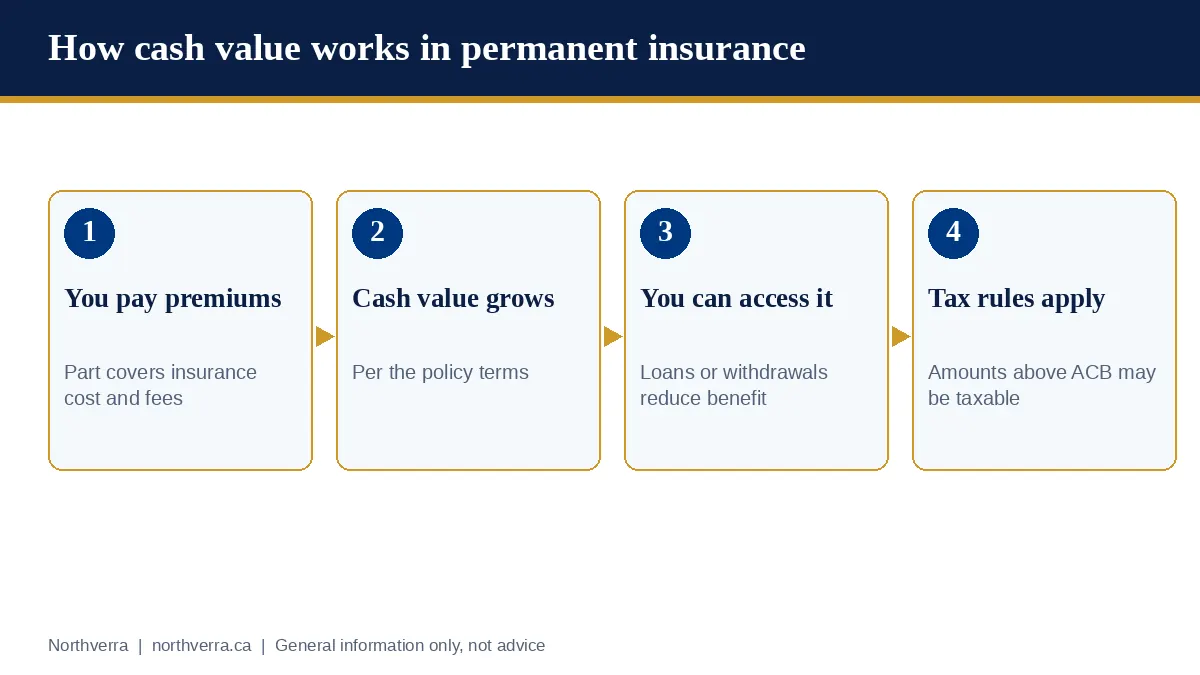
When you pay premiums on a permanent policy, part covers the insurance and expenses, and the rest goes into a cash value. In whole life, the growth is set out in the policy and may be supplemented by non-guaranteed dividends. In universal life, the growth depends on the investment options you choose.
How you can access it
- Policy loans against the cash value
- Withdrawals or partial surrenders
- Using it as collateral for a bank loan, see using life insurance as collateral
- Surrendering the policy for its cash surrender value
Tax considerations
Growth inside an exempt policy is generally not taxed while it stays in the policy. When you receive amounts, for example on a surrender or withdrawal, the portion above the policy’s adjusted cost basis (ACB) may be taxable income. Rules are technical, so speak with a tax professional.
Costs and limits
- Cash value may be small or zero in the first years
- Loans and withdrawals reduce the death benefit
- Unpaid loan interest can erode the policy
- Surrender charges can apply in early years
Questions to ask
- What are the guaranteed values versus the projected values?
- What fees apply, and how do they change over time?
- What happens to my policy if I take a loan and do not repay it?
- How is the ACB calculated?
Next step
We can walk through an illustration with you.
Which policies have cash value
- Term insurance: usually no cash value. You pay for protection for a set period.
- Whole life: builds cash value, often with a guaranteed schedule. Participating policies may add dividends that are not guaranteed.
- Universal life: builds a fund account based on the investment options you choose inside the policy, after the cost of insurance and fees.
- Term to 100: permanent coverage that usually has little or no cash value, in exchange for a lower premium.
Cash value versus the death benefit
The cash value and the death benefit are related but different. The death benefit is what your beneficiaries receive. The cash surrender value is what you would get if you cancelled the policy, after any surrender charges and outstanding loans. In many policies, if you take money out, the death benefit goes down. Some policies pay the cash value on top of the face amount at death, which costs more.
A hypothetical example
Imagine someone who buys a whole life policy at 35 and pays premiums for 20 years. In the first few years, the cash surrender value may be small or zero, because early costs are high. Over time, the cash value grows. By the time they retire, they could use it as collateral for a loan, take a policy loan, or keep it growing for the estate. The amounts depend entirely on the policy, the premiums and dividend or interest rates, which are not guaranteed.
Ways to use cash value, compared
- Policy loan: borrowed from the insurer, with interest. Unpaid interest is added to the loan. Part of the loan may be taxable if it exceeds the policy’s adjusted cost basis.
- Withdrawal: money taken out permanently. Part may be a taxable policy gain, and the death benefit is usually reduced.
- Collateral loan from a bank: the policy is assigned as security. The bank loan itself is generally not income, but the bank sets limits and can change terms. See using life insurance as collateral.
- Paying premiums: some policies let cash value or dividends cover future premiums.
- Surrender: cancelling the policy for its cash value ends the coverage and may be taxable.
Common mistakes
- Expecting meaningful cash value in the first few years.
- Letting loan interest build until the policy lapses, which can create an unexpected tax bill.
- Confusing the cash value with the death benefit.
- Surrendering a policy before checking whether a reduced paid-up option is available.
Reduced paid-up and other options if you stop paying
If you can no longer afford the premiums, cancelling is not the only option. Many whole life policies let you use the cash value to buy a smaller policy that is fully paid, called a reduced paid-up option. Some policies can use the cash value to keep full coverage in force for a period, or let you lower the coverage amount and the premium. Ask your insurer for each option in writing before you decide. Cancelling a policy with a large cash value can also create a taxable policy gain.
Understanding the adjusted cost basis
The adjusted cost basis, often shortened to ACB, is a tax figure that tracks roughly what you have paid into the policy, minus the cost of insurance over time and certain amounts you have taken out. When you withdraw or surrender cash value, the amount above the ACB is generally a taxable policy gain. Your insurer can tell you the current ACB. Ask for it before taking money out of the policy.
More questions people ask
Is the cash value mine?
As the policy owner, you can access it under the policy terms. If the policy has a collateral assignment, the lender has rights first.
Is the cash value paid to my beneficiaries?
Usually the beneficiaries receive the death benefit, not the cash value in addition. Some policies offer options that add it.
Can creditors take my cash value?
In some situations, naming certain family members as beneficiaries can provide protection under provincial insurance law. Ask a lawyer about your circumstances.
Does cash value grow tax-free?
Growth in an exempt policy is generally sheltered while it stays in the policy. Tax can apply when you take money out.
Related guides
Have a question? Start a conversation
Tell us a little about your situation. We will reply within one business day.
By submitting this form you agree that Northverra may contact you about your enquiry. Please do not include account numbers, health details or other sensitive information. See our Privacy Policy.
Important information. Life insurance products are subject to underwriting, eligibility, exclusions, limitations and the terms of the policy contract. Coverage, premiums and availability depend on your age, health, lifestyle and other factors. Nothing on this page is an offer of insurance or a guarantee of coverage or price. See our Disclosures.