
LIFE INSURANCE QUESTIONS
What is universal life insurance?
Short answer: Universal life is a flexible type of permanent insurance. Part of your premium covers insurance costs and part goes into an account that can be invested within the policy rules. You may be able to adjust premiums and coverage, but investment performance is not guaranteed and the policy needs monitoring.
In this guide: How it works · Flexibility · Risks · Compared with whole life · Questions to ask · Cost of insurance options · Investment options inside the policy · The exempt limit · Scenarios · Common mistakes · How to review a universal life policy · A hypothetical example · Death benefit options · FAQ
How it works
A universal life policy separates the insurance cost from the savings component. The policyholder chooses how the savings account is invested from options offered by the insurer, such as interest accounts or index-linked and market-based options. The account is tax-sheltered within policy limits.
Flexibility
- Premiums can often be adjusted within limits
- Death benefit options may be changeable
- You can often choose how the cash value is invested
Risks
- Investment results can be lower than illustrated, and the account value can fall
- If the account falls short, the policy may need higher premiums to stay in force
- Costs, which increase with age, are deducted from the account
- It requires regular review
Compared with whole life
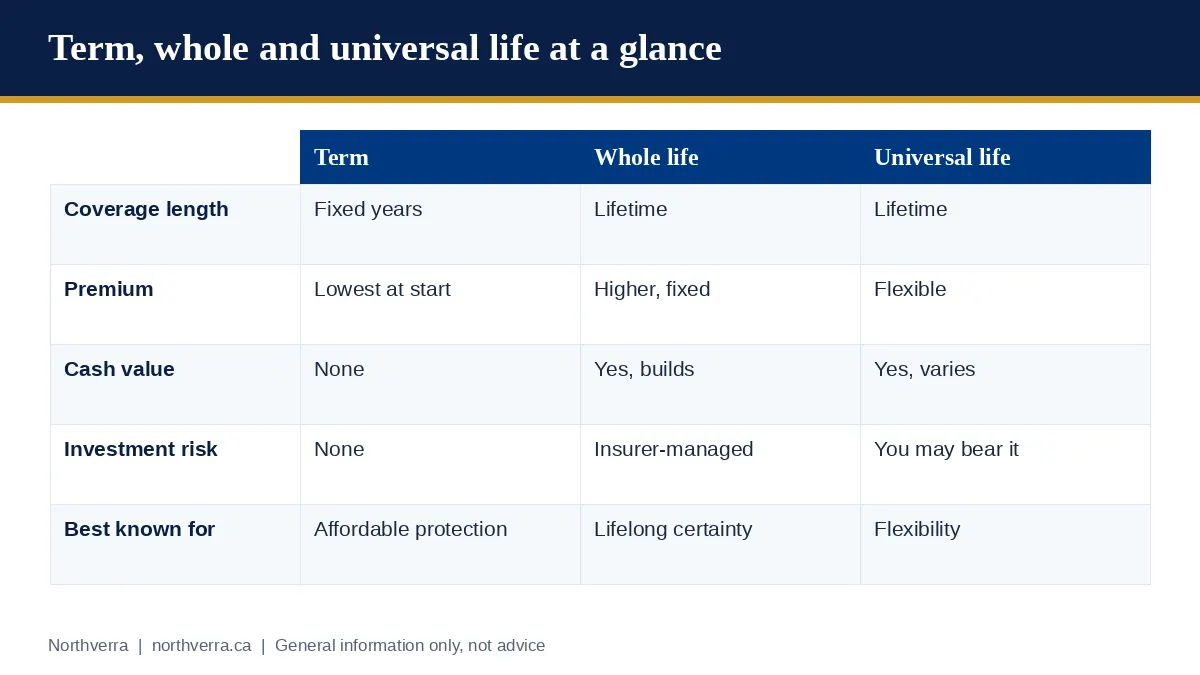
Whole life is more predictable, with level premiums and guaranteed values. Universal life offers more flexibility and potential upside but more risk and complexity. See participating whole life and term vs. whole life.
Questions to ask
- What is the policy designed to cost, and what if returns are lower?
- What investment options are offered and at what fees?
- What is the guaranteed minimum interest rate, if any?
- How often will I get a statement and review?
Next step
We can help you understand whether the flexibility is worth the trade-offs.
Cost of insurance options
Level cost of insurance
The cost of insurance is set to stay level for life or to a set age. It costs more in the early years but is often more predictable over the long term.
Yearly renewable term cost of insurance
The cost starts lower and rises each year as you age. It can leave more money in the account early on, but later in life the cost can become very high. If the account cannot cover it, the policy can lapse.
Investment options inside the policy
Universal life policies usually offer a choice of daily interest accounts, guaranteed interest accounts for set terms, and accounts that track market indexes or funds. Returns on market-linked options can go down as well as up. Fees and how returns are credited differ between insurers, so compare them before you choose.
The exempt limit
Canadian tax rules limit how much can be held in a policy and still keep its tax-sheltered status. Insurers monitor this exempt test. If you deposit a lot, the policy may need to increase coverage or move money outside the policy. Your advisor should explain how your policy handles this.
Scenarios
- Wants lifelong coverage at the lowest cost: a minimum-funded universal life policy with level cost of insurance can work like term to 100 with some flexibility.
- Wants to build cash value: funding above the minimum can build an account inside the policy, within the exempt limit.
- Irregular income: flexible premiums can help, as long as the account stays large enough to cover costs.
Common mistakes
- Paying only the minimum on a yearly renewable term policy for years, then facing a lapse later in life.
- Choosing aggressive investment options without understanding the risk.
- Not reviewing the policy every few years.
- Assuming a projected return in an illustration will happen.
How to review a universal life policy
- Ask for an in-force illustration showing what happens at current rates and at lower rates.
- Check the cost of insurance type and whether it can change.
- Confirm the fees on each investment option.
- Look at how many years the policy can stay in force if you stopped paying premiums.
A hypothetical example
Suppose a 40-year-old buys a universal life policy with a yearly renewable term cost of insurance and pays only the minimum premium. In the early years, the low cost leaves a small balance in the account. By their late 60s, the cost of insurance has risen sharply. If the account is too small to cover it, they would need to pay much higher premiums, reduce coverage or let the policy lapse. A level cost of insurance, or funding above the minimum, would have been more costly early but more predictable later. The numbers depend on the policy, but the pattern is a common reason to review universal life policies regularly.
Who universal life may suit
- People who want permanent coverage with flexible premiums
- Business owners who want to control the investment options inside a corporate policy
- People who are comfortable reviewing a policy regularly and taking on some investment risk
It may not suit people who want everything guaranteed and prefer a set-and-forget approach. For them, participating whole life or term to 100 may be easier to manage.
Death benefit options
Universal life policies usually let you choose how the death benefit is paid. A level death benefit pays the face amount, and the account value helps lower the cost of insurance over time. An increasing option pays the face amount plus the account value, which costs more but passes more to beneficiaries. Some policies offer a death benefit that grows with premiums paid. Choose the option that matches your goal: lowest cost, or the largest estate value.
More questions people ask
Can I skip premiums?
Often, if the account has enough value to cover the costs. If the value runs out, the policy can lapse.
Is universal life riskier than whole life?
It shifts more of the investment and cost risk to you. Whole life has more guarantees from the insurer.
Can I take money out?
Many policies allow withdrawals or loans. These can reduce the death benefit and may be taxable.
Is universal life good for estate planning?
It can be, especially with level cost of insurance. See life insurance and estate planning.
Related guides
Have a question? Start a conversation
Tell us a little about your situation. We will reply within one business day.
By submitting this form you agree that Northverra may contact you about your enquiry. Please do not include account numbers, health details or other sensitive information. See our Privacy Policy.
Important information. Life insurance products are subject to underwriting, eligibility, exclusions, limitations and the terms of the policy contract. Coverage, premiums and availability depend on your age, health, lifestyle and other factors. Nothing on this page is an offer of insurance or a guarantee of coverage or price. See our Disclosures.