
INVESTMENT QUESTIONS
How much should I invest each month?
Short answer: There is no single right number. A practical answer starts from your goals: work out what each goal will cost and when, subtract what you already have, and spread the gap over the months remaining, then check that the amount fits your budget after essentials, debt payments and an emergency fund. Many people use a percentage of take-home pay as a starting rule and adjust from there.
In this guide: Start from the goal: working backwards · Then check the budget: working forwards · Using percentage rules sensibly · Factors that change the right amount · Monthly vs lump sum contributions · Making it stick · Common mistakes · Questions to ask yourself · Splitting a monthly amount across several goals · FAQ

“How much should I invest each month?” is one of the most common questions people ask once they decide to start. Rules of thumb, such as investing a set percentage of income, are helpful starting points, but your amount should come from two directions at once: what your goals require and what your budget can sustain. This guide shows how to bring the two together.
Start from the goal: working backwards
For each goal, estimate:
- The amount needed, in today’s dollars to keep it simple.
- The date you need it.
- What you already have saved toward it.
The gap between what you need and what you have, spread across the months remaining, gives a rough monthly target before growth. Growth may reduce what you need to contribute, but because returns are not guaranteed, it is wiser to plan conservatively and treat any growth as a bonus. Our guide to setting financial goals can help you list them.
Example (hypothetical): A couple wants $30,000 for a down payment in five years and has $6,000 saved. The gap is $24,000 over 60 months, or about $400 a month before any growth. If that is too much, they can extend the timeline, lower the target or find room in the budget. These numbers are illustrative only.
Then check the budget: working forwards
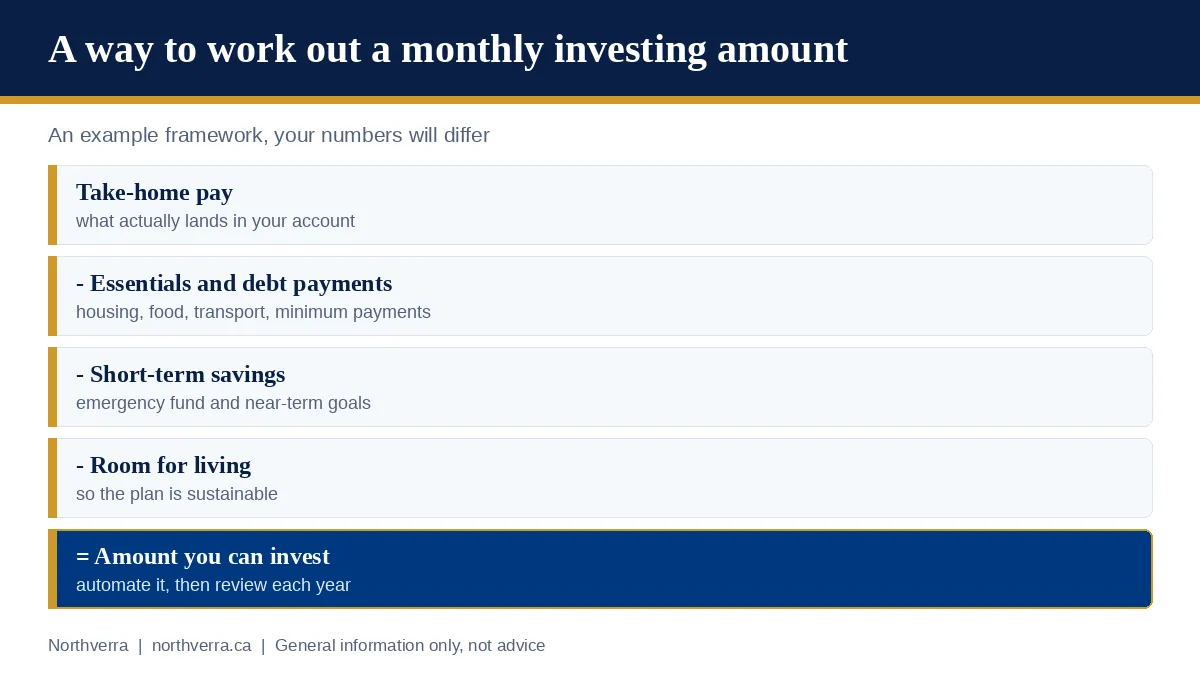
Next, look at what your budget can actually sustain:
- Start with take-home pay, the amount that actually arrives in your account.
- Subtract essentials: housing, food, transportation, insurance and utilities.
- Subtract minimum debt payments, and extra payments on high-interest debt.
- Set aside money for short-term savings, including your emergency fund.
- Leave room for everyday living, so the plan is realistic.
- What remains is the amount you can comfortably invest.
If the goal-based number is higher than the budget-based number, you have a decision to make: adjust the goal, the date or the spending. That trade-off is a normal part of planning, not a failure. Our budgeting basics article walks through building the budget.
Using percentage rules sensibly
Percentage rules give a quick benchmark. Some people aim to save a set share of gross income for retirement, and some popular budgets split take-home pay into needs, wants and savings. These are guides, not requirements. Someone with a defined benefit pension at work may need to save less on their own, while a self-employed person with no workplace plan may need to save more.
Factors that change the right amount
- Workplace pension or group RRSP: employer contributions count toward your savings.
- Age and timeline: starting later usually means saving more each month for the same goal.
- Number of goals: retirement, a home and a child’s education compete for the same dollars.
- Debt: high-interest debt often comes first. See paying off debt vs investing.
- Government benefits: CPP and OAS may cover part of retirement income, depending on your history. See retirement income sources in Canada.
- Grants and matches: RESP grants and employer matches add to what you contribute.
Monthly vs lump sum contributions
Investing a fixed amount on a regular schedule is sometimes called dollar-cost averaging. It means you buy more units when prices are lower and fewer when they are higher, and it removes the temptation to time the market. It does not guarantee a profit or protect against loss. If you receive a lump sum, such as a bonus or inheritance, the decision on whether to invest it at once or gradually is worth discussing with a professional.
Making it stick
- Schedule the transfer for the day after payday.
- Increase the amount automatically each year or with each raise.
- Separate accounts by goal so you can see progress.
- Review the plan annually, not daily.
- Keep your emergency fund topped up so you do not need to stop contributions.
Our pay yourself first guide explains the automation habit in more detail.
Common mistakes
- Picking an amount so high that it cannot be sustained, then stopping altogether.
- Counting on high assumed returns to make a small contribution “enough”.
- Forgetting about irregular expenses such as car repairs or annual insurance premiums.
- Leaving an employer match unclaimed.
- Never increasing contributions as income rises.
Questions to ask yourself
- What would happen to my plan if I lost my income for three months?
- Which goal matters most if I cannot fund them all?
- Is my amount based on my real budget or on a guess?
- When will I review and raise it?
Splitting a monthly amount across several goals
Most households are saving for more than one thing at once. One practical approach is to rank your goals and assign each a share of the monthly amount. For example, a household might first make sure its emergency fund is complete, then direct part of the monthly amount to retirement through an RRSP or workplace plan, part to a TFSA or FHSA for a home and, if there are children, part to an RESP to collect government grants. The split can change over time. Once a goal is funded, its share can move to the next one. Our guides on the FHSA and RESP explain those accounts.
Next step
If you would like help turning your goals into a realistic monthly amount, we can build the numbers with you.
More questions people ask
Is it better to invest weekly, biweekly or monthly?
It usually matters less than consistency. Many people match contributions to their pay schedule so the money moves before it is spent.
Should I invest more when the market is down?
Some people do if their plan and budget allow it, but it is not required. Sticking with your regular amount is a reasonable approach for most.
What if I can only afford a small amount?
Start with what you can. See investing with little money for low-cost ways to begin.
Does my workplace pension count?
Yes. Include your contributions and your employer’s when you look at how much you are saving for retirement in total.
Related guides
Have a question? Start a conversation
Tell us a little about your situation. We will reply within one business day.
By submitting this form you agree that Northverra may contact you about your enquiry. Please do not include account numbers, health details or other sensitive information. See our Privacy Policy.
Important information. Investing involves risk, including the possible loss of the amount invested. The value of investments can go down as well as up, and past performance does not guarantee future results. Nothing on this page is a recommendation or a promise of any return. Diversification and asset allocation do not ensure a profit or protect against loss. See our Disclosures.