
INVESTMENT QUESTIONS
What is dividend investing in Canada?
Short answer: Dividend investing means building a portfolio of shares or funds that pay part of company profits to shareholders as dividends. Some Canadians use it for regular income, others reinvest the dividends to buy more shares. Dividends can be appealing, but they are never guaranteed: companies can reduce or stop them, and share prices can still fall.
In this guide: What a dividend is · Key terms · Ways to invest for dividends · Dividend reinvestment plans (DRIPs) · How dividends are taxed in Canada · The risks of dividend investing · Is dividend investing right for you? · Questions to ask · Common mistakes · Building a diversified dividend approach · FAQ

Dividend investing in Canada has a long following, partly because many established Canadian companies, such as banks, utilities, pipelines and telecom firms, have a history of paying dividends. Before building a plan around income from shares, it is important to understand how dividends work, how they are taxed and why a high payout is not the same as a safe investment.
What a dividend is
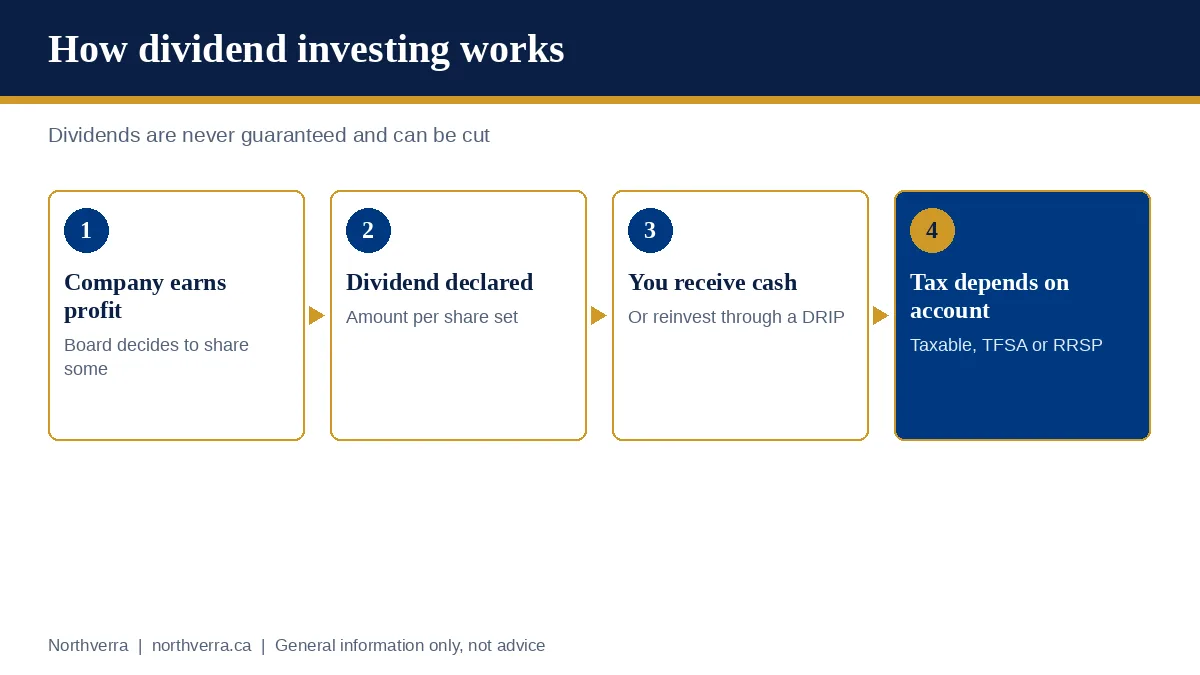
A dividend is a payment a company makes to its shareholders, usually from profits. The company’s board of directors decides whether to pay a dividend, how much and how often, commonly every quarter. A company may raise its dividend when business is strong and cut or suspend it when times are hard. Shareholders have no legal right to a dividend until it is declared.
Key terms
- Dividend yield: the annual dividend divided by the share price. If the price falls, the yield rises, which can make a struggling company look attractive.
- Payout ratio: the share of profits paid out as dividends. A very high ratio may leave little room for the company to reinvest or to keep paying in a downturn.
- Ex-dividend date: you generally need to own the shares before this date to receive the next dividend.
- Dividend growth: the history of increases over time, which some investors watch closely.
Ways to invest for dividends
- Individual dividend-paying shares, which require research and careful diversification.
- Dividend-focused ETFs and mutual funds, which hold many dividend payers in one fund.
- Preferred shares, which usually pay a set dividend and rank ahead of common shares.
- Balanced or income funds that combine dividend stocks with bonds.
Funds offer instant diversification. Compare options in mutual funds vs ETFs.
Dividend reinvestment plans (DRIPs)
Many companies and brokerages offer DRIPs, which use your dividends to buy more shares automatically, sometimes without commission. Reinvesting can help a holding grow over time through compounding, as explained in compound growth explained. In a non-registered account, reinvested dividends are still taxable in the year paid, and they increase your adjusted cost base, which you need to track.
How dividends are taxed in Canada
The account you hold dividend investments in makes a big difference:
- TFSA: Canadian dividends are generally not taxed.
- RRSP or RRIF: dividends are not taxed when received, but withdrawals are taxed as regular income later.
- Non-registered account: eligible dividends from Canadian corporations are “grossed up” and then reduced by the federal and provincial dividend tax credit, which often results in a lower tax rate than interest income at the same level.
- Foreign dividends: generally fully taxable in a non-registered account, and foreign withholding tax may apply. The treatment varies by country and account type.
The dividend gross-up can increase your net income for some income-tested benefits, which matters for retirees. See non-registered investment accounts and speak with a tax professional about your situation.
Example (hypothetical): A retiree holds a diversified Canadian dividend ETF in a TFSA and takes the distributions as cash each quarter to help cover expenses. If the fund’s distributions fall during a downturn, the retiree’s income falls too, so they keep a cash reserve as a buffer. This is a general illustration, not a recommendation.
The risks of dividend investing
- Dividend cuts: companies can reduce or eliminate dividends without notice.
- Yield traps: an unusually high yield may signal that the market expects trouble.
- Concentration: Canadian dividend payers cluster in a few sectors, such as financials, energy and utilities, which can leave a portfolio less diversified.
- Interest rate sensitivity: some dividend stocks, like utilities, can be affected by rising rates.
- Price risk: a share can fall in value even while paying a dividend.
Is dividend investing right for you?
Dividend investing can suit people who want income or who like the discipline of owning profitable businesses. But total return, which combines dividends and price changes, is what ultimately matters. A portfolio built only for income may miss growth from companies that reinvest profits instead of paying them out. Many investors blend dividend payers with other holdings as part of an overall asset allocation.
Questions to ask
- Is the dividend supported by earnings and cash flow?
- How has the company handled its dividend in past downturns?
- How diversified is my income across sectors and countries?
- Which account is the best home for these holdings, considering tax?
- Do I need the income now, or should I reinvest it?
Common mistakes
- Buying a stock only because the yield is high.
- Treating dividends as guaranteed, like interest from a GIC.
- Overloading on a few Canadian sectors.
- Forgetting to track the adjusted cost base when dividends are reinvested in a taxable account.
- Ignoring the effect of dividend income on benefits in retirement.
Building a diversified dividend approach
If dividends are part of your plan, diversification still matters. Spreading holdings across sectors and countries reduces the chance that a problem in one industry cuts most of your income at once. A broad dividend fund can help, but check how concentrated it is, since some Canadian dividend funds hold large positions in a few banks and energy companies. Consider adding international holdings, and remember that total return, dividends plus price changes, is the fairest way to judge results. Reviewing your income sources once a year helps you spot when a few holdings have grown to dominate.
Next step
Thinking about using dividends for income in retirement? We can look at how they fit with your other sources of income.
More questions people ask
Are dividends better than interest?
They are different. Interest from a GIC is contractual, while dividends are discretionary. In a non-registered account, eligible Canadian dividends are often taxed at a lower rate than interest.
How often are dividends paid?
Many Canadian companies pay quarterly. Some pay monthly, semi-annually or annually. Funds set their own distribution schedules.
Can I live off dividends?
Some people use dividends as part of their retirement income. It requires a large, diversified portfolio and a plan for periods when payments fall. See retirement income sources in Canada.
What is a DRIP?
A dividend reinvestment plan uses your dividends to buy more shares automatically instead of paying cash.
Related guides
Have a question? Start a conversation
Tell us a little about your situation. We will reply within one business day.
By submitting this form you agree that Northverra may contact you about your enquiry. Please do not include account numbers, health details or other sensitive information. See our Privacy Policy.
Important information. Investing involves risk, including the possible loss of the amount invested. The value of investments can go down as well as up, and past performance does not guarantee future results. Nothing on this page is a recommendation or a promise of any return. Diversification and asset allocation do not ensure a profit or protect against loss. See our Disclosures.