
INVESTMENT QUESTIONS
What should I do when the stock market drops?
Short answer: When the stock market drops, the most useful first step is often to pause rather than react. Check when you need the money, confirm your emergency fund can cover near-term costs, review whether your investment mix still matches your plan, and rebalance or keep contributing if your plan supports it. Decisions made in a panic are often the ones investors regret.
In this guide: Why markets fall · A calm checklist · Mistakes that tend to cost the most · If you are close to or in retirement · Preparing for the next drop · Questions to ask yourself or your advisor · Talking to your family about market drops · FAQ

Market declines are a normal part of investing, even though they never feel normal while they are happening. Knowing what to do when the stock market drops, before it happens, is one of the most valuable things an investor can prepare. This guide offers a practical checklist, explains why declines happen and highlights the mistakes that tend to cost the most. Nothing here is a prediction of what markets will do next.
Why markets fall
Prices fall for many reasons: economic slowdowns, rising interest rates, company or sector problems, political events, global crises or simply a change in investor mood. Some declines are brief, others last much longer. Historically, broad markets have recovered from past declines over time, but the timing has varied widely and there is no guarantee that future declines will follow the same pattern.
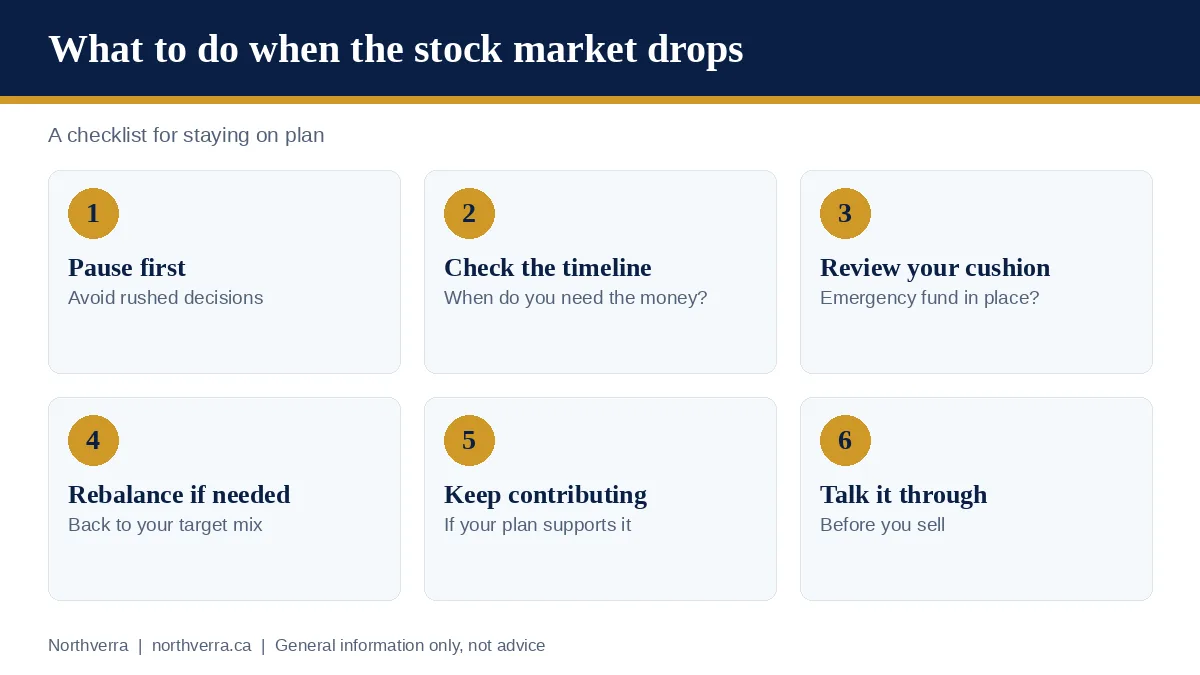
A calm checklist
1. Pause before acting
Avoid making decisions on the day of a big drop or after reading alarming headlines. Give yourself time to think and, if helpful, talk it through with someone you trust.
2. Check your timeline
Money you will not need for many years has time to recover. Money you need in the next year or two should ideally not be in investments that can fall sharply. If it is, that is a lesson for your plan going forward. Our risk and time horizon guide explains why timing matters.
3. Review your cushion
An emergency fund lets you cover a job loss or unexpected expense without selling investments at a low point. If you are retired, a reserve of cash or short-term GICs for upcoming withdrawals plays the same role.
4. Look at your mix
A drop in stocks changes your asset allocation. If your plan calls for a set mix, rebalancing, by moving some money from investments that held up into those that fell, brings you back to target. This can feel uncomfortable, which is partly why a written plan helps. See asset allocation by age.
5. Keep contributing if you can
If your job and budget are secure, continuing regular contributions means you buy more units at lower prices. This does not guarantee a profit, but it keeps your plan on track.
6. Look for planning opportunities
In a non-registered account, a decline may create an opportunity to realize a capital loss for tax purposes, within the rules, including the superficial loss rule. Converting or contributing to certain accounts may also be worth discussing. See capital gains in Canada and speak with a tax professional.
Example (hypothetical): When markets fell in a hypothetical year, Leo’s balanced portfolio dropped in value. He had two years of planned withdrawals in a cash reserve, so he did not need to sell. Instead, he rebalanced once, kept his monthly contributions going and reviewed his plan with his advisor. This is a general illustration, not a prediction or recommendation.
Mistakes that tend to cost the most
- Selling everything in a panic: this can lock in losses and leave you out of any recovery.
- Waiting for the “all clear”: recoveries can begin before the news improves, and it is hard to know when to get back in.
- Abandoning your plan: switching strategies after a drop often means buying what has already risen and selling what has fallen.
- Checking your balance constantly: it can heighten anxiety without improving decisions.
- Chasing “safe” products with hidden risks: be careful with anything promising high returns with no risk.
If you are close to or in retirement
A drop shortly before or early in retirement can have a larger effect, because withdrawals at low prices reduce the money left to recover. Strategies some retirees use include holding a cash or GIC reserve, adjusting withdrawals temporarily and keeping a balanced mix. Our guides to RRSP to RRIF conversion and retirement income sources cover income planning, and some people consider products with guarantees, such as segregated funds.
Preparing for the next drop
- Write down your goals, timeline and target mix.
- Decide in advance how you will respond, for example “rebalance if my mix drifts by more than a set amount”.
- Keep an emergency fund or retirement cash reserve.
- Know how much of a decline you could tolerate without changing course.
- Review your risk tolerance honestly after each experience.
Questions to ask yourself or your advisor
- Has anything changed in my goals or timeline, or only in the market?
- Do I need to sell anything to cover expenses in the next year?
- Is my portfolio still diversified the way I intended?
- Would I make this decision if the market had not just fallen?
Talking to your family about market drops
If you share finances with a partner, talk about market declines before they happen. People often react differently: one may want to sell while the other wants to buy. Agreeing on a plan in calm times, including what you will and will not do in a downturn, reduces stress and arguments later. If you have older children, a market drop can also be a useful moment to explain that investments rise and fall, and why a long-term plan matters more than any single day.
Next step
Feeling uneasy about recent market moves? We can review your plan with you and make sure it still fits your goals.
More questions people ask
Should I move my money to cash until the market recovers?
Moving to cash removes the risk of further declines but also the chance to participate in a recovery, and it creates a second decision about when to reinvest. Discuss it in the context of your plan.
Is a market drop a good time to invest?
Some investors add money during declines if they have it, but no one can reliably predict the bottom. Regular contributions are a disciplined alternative.
How long do market downturns last?
It varies. Some have been short, others have taken years to recover. Past patterns are not a guarantee.
Should I stop my RRSP contributions?
If your income is secure, many people continue. If your job is uncertain, building cash first may be wiser.
Related guides
Have a question? Start a conversation
Tell us a little about your situation. We will reply within one business day.
By submitting this form you agree that Northverra may contact you about your enquiry. Please do not include account numbers, health details or other sensitive information. See our Privacy Policy.
Important information. Investing involves risk, including the possible loss of the amount invested. The value of investments can go down as well as up, and past performance does not guarantee future results. Nothing on this page is a recommendation or a promise of any return. Diversification and asset allocation do not ensure a profit or protect against loss. See our Disclosures.