
INVESTMENT QUESTIONS
What are segregated funds in Canada?
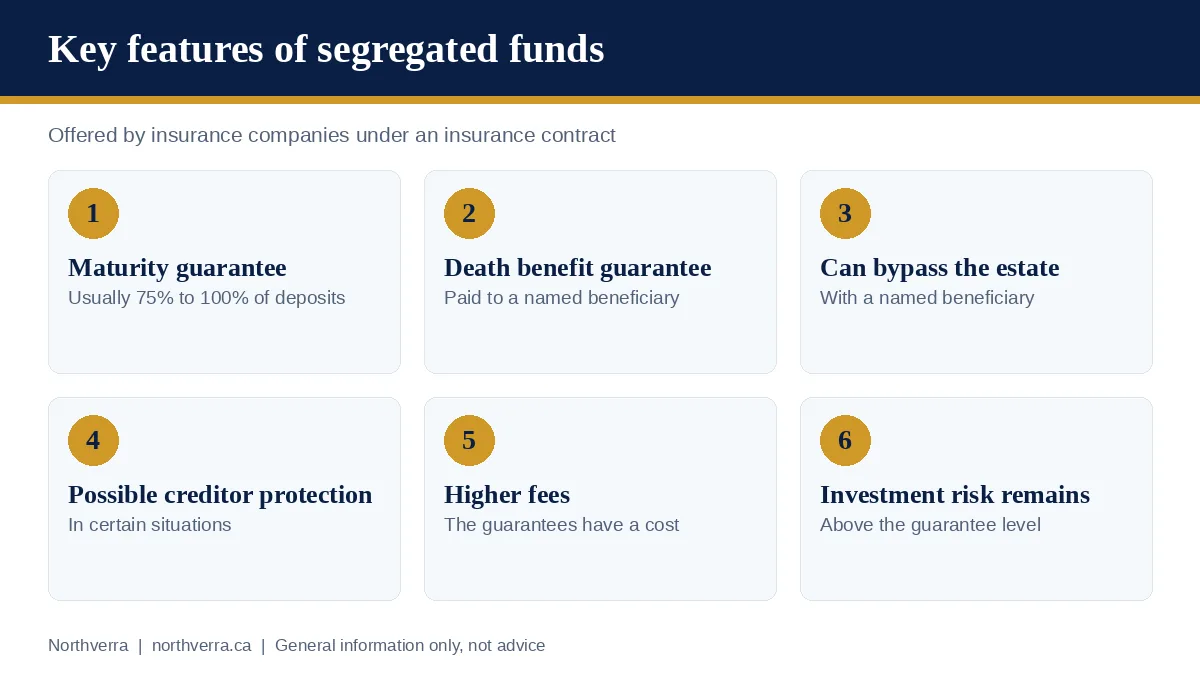
Short answer: Segregated funds are investment funds offered by Canadian life insurance companies as part of an insurance contract. They invest much like mutual funds, but add guarantees: typically between 75% and 100% of your deposits is protected at maturity and on death, subject to the contract. They may also pass directly to a named beneficiary outside the estate. These features usually come with higher fees.
In this guide: How segregated funds work · The guarantees · Estate and beneficiary features · Possible creditor protection · The costs · Who tends to consider segregated funds · Segregated funds vs mutual funds · Questions to ask before you buy · Common mistakes · How segregated funds fit into a wider plan · FAQ

Segregated funds in Canada are sometimes described as “mutual funds with an insurance wrapper”. That is a helpful start, but the differences go further. Because they are insurance contracts, they have their own rules on guarantees, beneficiaries and, in some situations, creditor protection. This guide explains how they work, who tends to consider them and what to weigh before buying. Segregated funds are sold by licensed life insurance representatives.
How segregated funds work
You invest money into a contract with an insurance company. The insurer pools money from many contract holders and invests it in underlying funds, which can hold stocks, bonds or both. The assets are held separately, or “segregated”, from the insurer’s general assets. The value of your contract rises and falls with those investments, except for the guarantee levels described below.
The guarantees
Maturity guarantee
If you hold the contract until its maturity date, often at least ten years after the deposit, the insurer guarantees that you will receive a set percentage of your deposits, commonly 75% or 100%, even if the market value is lower. Withdrawals reduce the guarantee, usually in proportion.
Death benefit guarantee
If the annuitant dies, the named beneficiary generally receives the greater of the market value or the guaranteed percentage of deposits, less withdrawals. Some contracts have age limits for higher guarantee levels.
Resets
Some contracts allow you to lock in market gains by resetting the guarantee to a higher value, which usually restarts the maturity period. Rules vary by contract.
Example (hypothetical): Sam deposits $100,000 into a segregated fund contract with a 100% death benefit guarantee and a 75% maturity guarantee. If markets fall and the value is $85,000 when Sam dies, the beneficiary would generally receive $100,000, less any withdrawals. If Sam is alive at maturity and the value is $70,000, the maturity guarantee would top it up to $75,000. These amounts are illustrations only; actual results depend on the contract.
Estate and beneficiary features
Because segregated funds are insurance contracts, a named beneficiary can generally receive the death benefit directly, without it passing through the estate. This can reduce delays, keep the transfer private and, in Alberta, avoid the death benefit being counted in the estate for probate fees, which are modest in Alberta compared with some provinces. Our estate planning with life insurance guide explains the beneficiary concept in more detail.
Possible creditor protection
Under provincial insurance law, contracts with certain family-class beneficiaries, or an irrevocable beneficiary, may be protected from the owner’s creditors in some situations. This is not automatic and can be challenged, for example if the contract was bought to avoid existing creditors. Business owners and professionals considering this feature should get legal advice.
The costs
The guarantees are not free. Segregated funds generally have higher management expense ratios than comparable mutual funds, and fees can be higher for 100% guarantee options. There may also be deferred sales charges or other fees depending on the purchase option. Over long periods, higher fees reduce returns, so it is worth asking whether you need the guarantees you are paying for.
Who tends to consider segregated funds
- Investors close to or in retirement who want downside protection on part of their savings.
- People who want money to pass to a beneficiary quickly and outside the estate.
- Business owners or professionals interested in potential creditor protection.
- Investors who would be tempted to sell after a market drop and find a guarantee reassuring.
Segregated funds vs mutual funds
- Who offers them: insurance companies vs fund companies.
- Guarantees: yes, on maturity and death vs none.
- Beneficiary designation: generally available on all contracts vs only inside certain registered accounts.
- Fees: usually higher vs usually lower.
- Protection if the provider fails: Assuris protects Canadian life insurance policyholders within limits vs CIPF for eligible dealer accounts.
Compare them with other options in mutual funds vs ETFs.
Questions to ask before you buy
- What percentage is guaranteed at maturity and on death, and when is the maturity date?
- How do withdrawals affect the guarantees?
- What are all the fees, including for the guarantee level I choose?
- Are there any charges if I withdraw early?
- Are resets available, and what do they do to the maturity date?
- Who should I name as beneficiary, and does that affect creditor protection?
Common mistakes
- Paying for a 100% guarantee you may not need.
- Assuming the guarantee applies if you withdraw before maturity.
- Overlooking the impact of higher fees over many years.
- Assuming creditor protection is absolute.
How segregated funds fit into a wider plan
Segregated funds are rarely an all-or-nothing choice. Some people use them for one portion of their savings, such as money intended for a beneficiary, while holding lower-cost funds elsewhere. Others use them in retirement for the part of a portfolio they would find hardest to see fall. Before buying, compare the guarantee you are paying for with how long you plan to hold the contract and how likely you are to need it. A ten-year maturity guarantee is most valuable to someone who will actually hold for ten years and would otherwise be tempted to sell in a downturn. Ask for the fees for each guarantee level side by side so you can see the cost of the extra protection.
Next step
Curious whether guarantees make sense for part of your savings? We can compare segregated funds with other options for your situation.
More questions people ask
Are segregated funds covered by CDIC?
No. They are insurance contracts. Assuris is the industry protection organization for Canadian life insurance policyholders, within set limits.
Can I hold segregated funds in a TFSA or RRSP?
Many insurers offer segregated fund contracts as TFSAs, RRSPs and RRIFs, as well as non-registered contracts.
Do segregated funds avoid tax?
No. Growth and income are taxable outside registered plans. The guarantee top-up may also have tax consequences. Ask a tax professional.
Are segregated funds the same as cash value life insurance?
No. They are investment contracts with insurance features, while cash value life insurance is a life insurance policy with a savings component.
Related guides
Have a question? Start a conversation
Tell us a little about your situation. We will reply within one business day.
By submitting this form you agree that Northverra may contact you about your enquiry. Please do not include account numbers, health details or other sensitive information. See our Privacy Policy.
Important information. Investing involves risk, including the possible loss of the amount invested. The value of investments can go down as well as up, and past performance does not guarantee future results. Nothing on this page is a recommendation or a promise of any return. Diversification and asset allocation do not ensure a profit or protect against loss. See our Disclosures.
Important information. Life insurance products are subject to underwriting, eligibility, exclusions, limitations and the terms of the policy contract. Coverage, premiums and availability depend on your age, health, lifestyle and other factors. Nothing on this page is an offer of insurance or a guarantee of coverage or price. See our Disclosures.