
MORTGAGE QUESTIONS
How does mortgage amortization work?
Short answer: Mortgage amortization is the total time it would take to pay off your mortgage in full if the rate and payments stayed the same, commonly 25 or 30 years. A longer amortization lowers your regular payment but increases the total interest you pay. Early in the mortgage, most of each payment goes to interest; over time, more goes to principal.
In this guide: How amortization works · Term vs amortization · 25 years vs 30 years: a worked example · Maximum amortization rules in Canada · Ways to shorten your amortization · When a longer amortization can make sense · Common mistakes to avoid · What happens to amortization at renewal · Reading your amortization schedule · FAQ

Mortgage amortization is easy to confuse with the mortgage term, but they are different. The term is how long your current contract and rate last, often five years. The amortization is the full repayment timeline, which usually spans several terms. Choosing your amortization is one of the few decisions that affects both your monthly budget today and the total cost of your home over decades.
How amortization works
Each regular payment is split into two parts: interest, calculated on the balance you still owe, and principal, which reduces that balance. Because the balance is largest at the start, interest takes most of the early payments. As the balance falls, less goes to interest and more to principal, so your equity grows faster in later years. Canadian fixed-rate mortgages calculate interest with semi-annual compounding, which our mortgage calculator uses when it shows your payment and balance.
Term vs amortization
- Term: the length of your current agreement and rate, typically one to ten years. At the end of the term you renew or pay off the balance.
- Amortization: the total time to repay the whole mortgage, typically 25 or 30 years at the start.
At each renewal, your remaining amortization carries on unless you change it. Our guide to how to choose a mortgage term covers the term side of the decision.
25 years vs 30 years: a worked example
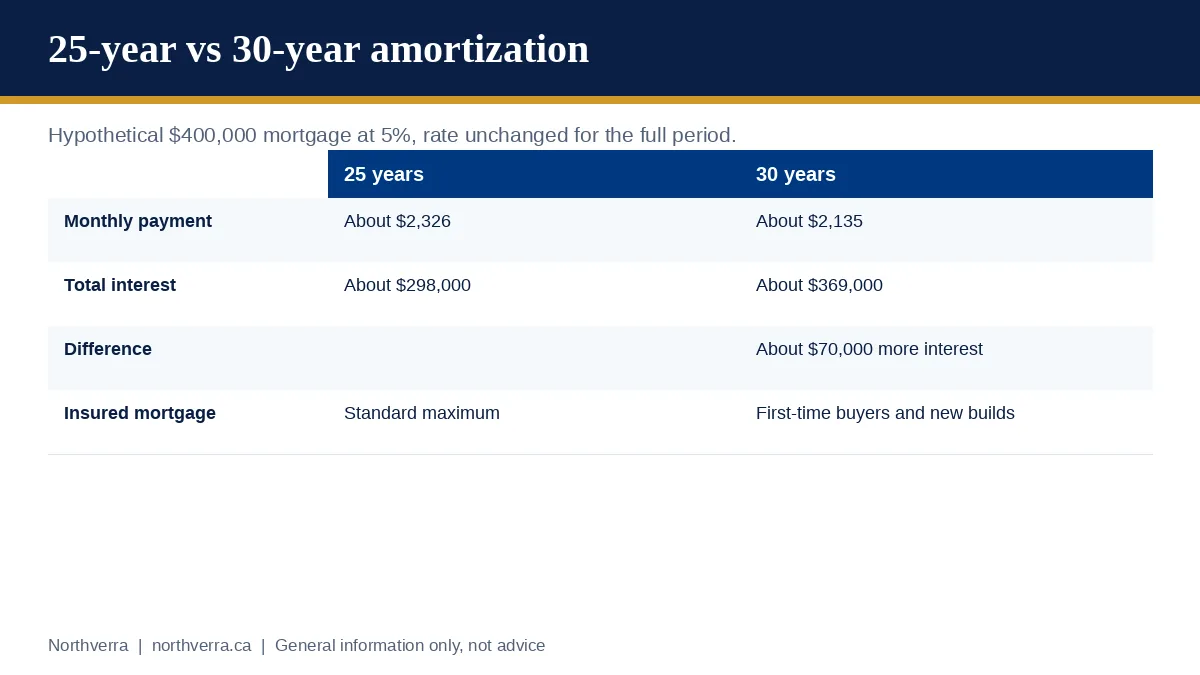
Example (hypothetical): On a $400,000 mortgage at 5%, a 25-year amortization has a monthly payment of about $2,326, and the total interest over the full amortization would be about $298,000 if the rate never changed. A 30-year amortization lowers the payment to about $2,135, saving about $192 a month, but the total interest rises to roughly $369,000. That is about $70,000 more for the lower payment. These are hypothetical, rounded figures; real costs depend on the rates at each renewal.
The example shows the core trade-off. A longer amortization buys monthly flexibility at a long-term cost. That can still be a sensible choice, especially if you use the extra room for an emergency fund or high-interest debt, or if you plan to make prepayments when you can.
Maximum amortization rules in Canada
- Insured mortgages (less than 20% down) are generally limited to 25 years. Since December 15, 2024, first-time home buyers and buyers of newly built homes can choose up to 30 years on an insured mortgage, according to the Department of Finance. CMHC adds 0.20% to the premium when the amortization is longer than 25 years; see CMHC mortgage insurance.
- Uninsured mortgages (20% or more down) commonly allow up to 30 years, depending on the lender.
A longer amortization can also slightly increase the amount you qualify for, because the payment used in the mortgage stress test is lower.
Ways to shorten your amortization
You do not have to stay on your original schedule. Common ways to shorten it include:
- Choosing accelerated bi-weekly or weekly payments.
- Increasing your regular payment using your prepayment privileges.
- Making annual lump-sum prepayments, for example from a bonus or tax refund.
- Choosing a shorter amortization at renewal, if the payment fits your budget.
Our guide to how to pay off your mortgage faster compares these strategies with examples.
When a longer amortization can make sense
- Your budget is tight in the first years of ownership, but your income is likely to grow.
- You want to keep more money for an emergency fund, retirement or a business.
- You plan to prepay when you can, so the longer amortization is a safety net rather than a plan.
- You are consolidating higher-interest debt into your mortgage, while understanding the long-term cost.
Common mistakes to avoid
- Confusing the term with the amortization.
- Choosing the longest amortization automatically, without comparing the total interest.
- Extending the amortization at every renewal so the mortgage never shrinks.
- Forgetting the extra insurance premium for insured mortgages over 25 years.
What happens to amortization at renewal
When your term ends, your lender will usually offer to renew based on your remaining amortization. If you have made prepayments, the remaining amortization will be shorter than originally planned, and keeping your payment the same at renewal can help you finish early. If rates are higher at renewal, the payment needed to stay on schedule will rise. Some borrowers ask to extend the amortization to keep payments manageable. That can be a useful safety valve, but each extension adds interest and delays the day you are mortgage-free. Lenders may also set conditions or require requalifying for an extension. Reviewing your amortization at each renewal, along with your rate and term, keeps it a deliberate choice.
Reading your amortization schedule
Your lender can provide an amortization schedule showing how each payment is split and what you will owe at the end of the term. It is worth looking at the balance at the end of your first term: on a typical mortgage, the amount of principal repaid in the first five years can be smaller than people expect, because interest takes a large share early on. Seeing the numbers makes the value of early prepayments clear, since every extra dollar of principal paid early stops generating interest for the rest of the amortization.
Next step
If you are choosing between 25 and 30 years, we can show you the payment and long-term interest for each, and how prepayments could change the picture.
More questions people ask
Can I change my amortization later?
Yes. You can often shorten it at any time by paying more, and you can request changes at renewal. Extending it may require requalifying, and for insured mortgages there are limits.
Does a longer amortization mean a higher interest rate?
Not necessarily, but some lenders price longer amortizations differently, and insured mortgages carry a higher premium for amortizations over 25 years.
What is the remaining amortization on my statement?
It is the time left to pay off the mortgage at your current rate and payment. It can change if your rate or payment changes.
Is a 35-year amortization possible?
Not for new insured mortgages under current rules. Some lenders may offer longer amortizations on uninsured mortgages, but they are uncommon.
Related guides
Have a question? Start a conversation
Tell us a little about your situation. We will reply within one business day.
By submitting this form you agree that Northverra may contact you about your enquiry. Please do not include account numbers, health details or other sensitive information. See our Privacy Policy.
Important information. Mortgage approval, interest rates, terms and eligibility depend on the lender, your financial profile, the property and current market conditions, and are not guaranteed. Mortgage products and rates change. Nothing on this page is a commitment to lend or a quote of any rate. See our Disclosures.