
INVESTMENT GUIDE
Retirement Planning in Alberta
Short answer: Retirement planning in Alberta means deciding when you want to retire, estimating what your lifestyle will cost, and building income from government benefits, workplace pensions and your own savings to cover it. Alberta-specific points include provincial seniors programs and Alberta rules for locked-in pension money. Starting early and reviewing the plan regularly matter most.
Quick facts
- CPP retirement pension can start as early as age 60 or as late as 70; starting earlier reduces the monthly amount and delaying increases it.
- Old Age Security (OAS) normally starts at 65 and can be deferred to 70 for a higher amount; it is reduced for higher incomes.
- You must convert or close your RRSP by the end of the year you turn 71.
- Locked-in pension money in Alberta usually sits in a LIRA and later moves to a LIF, under Alberta pension rules.
- Alberta offers provincial benefits for lower-income seniors; check alberta.ca for current programs and eligibility.
In this guide: Step 1: Picture the retirement you want · Step 2: Estimate your retirement income needs · Step 3: Understand your income sources · Step 4: Close the gap with savings · Step 5: Plan the timing · Alberta-specific considerations · Step 6: Protect the plan · Common retirement planning mistakes · FAQ

Retirement planning is about making sure the money you have, and the income you will receive, can support the life you want after you stop working full time. For Albertans, the core building blocks are the same as anywhere in Canada, but a few provincial details matter. This guide walks through the main decisions in plain language, in the order most people face them.
Step 1: Picture the retirement you want
Start with lifestyle, not numbers. Where will you live? Will you travel, spend winters away, help children or grandchildren, or work part time? Each choice changes how much income you will need. Many people find their spending falls in some areas, such as commuting, and rises in others, such as travel and health costs.
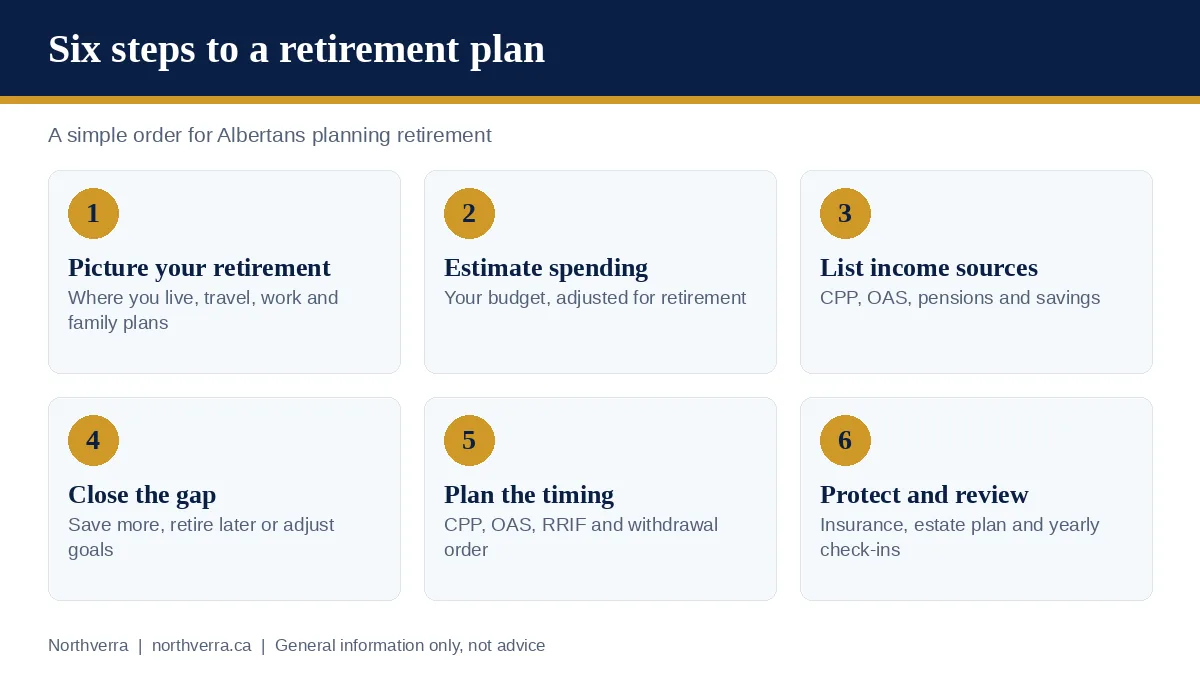
Step 2: Estimate your retirement income needs
A common starting point is to estimate your current spending and adjust it for retirement. Some planners use a percentage of your pre-retirement income as a rough guide, but your own budget is more reliable. Our guide to how much money you need to retire shows a simple way to estimate a target.
Step 3: Understand your income sources
Most retirees in Alberta draw income from a mix of sources. Our guide to retirement income sources in Canada covers each in more detail.
| Income source | How it works | Planning points |
|---|---|---|
| Canada Pension Plan (CPP) | Based on your contributions over your working life | Choose a start age between 60 and 70 |
| Old Age Security (OAS) | Based mainly on years lived in Canada after age 18 | Normally starts at 65; reduced for higher incomes |
| Guaranteed Income Supplement (GIS) | For lower-income OAS recipients | Income-tested each year |
| Workplace pension | Defined benefit or defined contribution plan | Check survivor options and bridge benefits |
| RRSP, RRIF, LIRA and LIF | Your registered savings | Withdrawals are taxable income |
| TFSA | Tax-free savings | Withdrawals are tax-free and do not affect income-tested benefits |
| Non-registered investments | Taxable investment accounts | Only growth and income are taxed, not your original contributions |
Step 4: Close the gap with savings
Compare the income you expect from pensions and government benefits with what you need. The difference is the gap your savings must fill. Ways to close it include saving more each month, retiring a little later, working part time in early retirement, paying off debt before you retire, or adjusting your lifestyle goals. Our guide on how much to invest each month can help you set a savings target.
Step 5: Plan the timing
Timing decisions can change your income for decades:
- When to start CPP and OAS.
- When to convert your RRSP to a RRIF, which must happen by the end of the year you turn 71. See RRSP to RRIF conversion.
- Which accounts to draw from first, and how to manage tax brackets each year.
- Whether to split eligible pension income with a spouse or common-law partner.
Alberta-specific considerations
- Locked-in pensions: Alberta has its own rules for LIRAs and LIFs, including how much you can withdraw each year. Learn more in our guide to the LIRA in Alberta.
- Provincial seniors programs: Alberta provides income support for lower-income seniors and seniors health benefits. Check alberta.ca for the current programs.
- Cost of living: housing, property taxes and utilities in Calgary and Edmonton can take a large share of a retirement budget.
- Spending winters away: if you plan to travel for long periods, check the residency rules for Alberta health coverage and budget for travel medical insurance.
Step 6: Protect the plan
Insurance and estate planning help protect the plan you build. Consider whether you still need life insurance, how you would pay for long-term care, and whether your will, powers of attorney and beneficiary designations are up to date. Our article on insurance and wealth building explains how protection fits into a financial plan.
Example (hypothetical): Lena and Mark, both 58, live in Calgary. They want to retire at 63. Their plan uses Mark’s workplace pension and their RRSPs for the first few years, delays CPP until 65, and keeps their TFSAs as a reserve for large expenses like a new roof or a car. They review the plan each year.
Common retirement planning mistakes
- Waiting too long to start saving.
- Underestimating how long retirement can last.
- Forgetting about inflation and health costs.
- Holding too much or too little investment risk close to retirement. See risk and time horizon.
- Drawing from accounts in an order that creates unnecessary tax.
Key takeaways
- Start with the life you want in retirement, then work out the income it needs.
- Most Albertans draw retirement income from several sources, not one.
- Timing decisions for CPP, OAS and RRSP withdrawals can change your lifetime income and taxes.
- Plan for health costs, inflation and a retirement that could last 25 to 30 years or more.
- Review your plan at least once a year, and after any big life change.
Who this guide is for
- Albertans in their 40s and 50s who want to know if they are on track.
- People within 10 years of retirement deciding when to stop working.
- Anyone with a workplace pension, LIRA or RRSP wondering how to turn savings into income.
- Couples planning retirement together.
Questions to ask a financial advisor
- Am I saving enough to retire when I want to?
- When should I start CPP and OAS in my situation?
- How should I draw from my RRSP, TFSA and non-registered savings?
- How does my workplace pension fit into the plan?
- What happens to the plan if one of us lives much longer than expected?
Frequently asked questions
When should I start planning for retirement in Alberta?
As early as you can. Saving in your 20s and 30s gives compound growth the most time to work. That said, it is never too late: people in their 50s can still make meaningful progress by increasing savings, reducing debt and planning the timing of government benefits.
Should I take CPP at 60 or wait until 65 or 70?
It depends on your health, other income, savings and whether you need the money now. Taking CPP early gives you smaller payments for longer; delaying gives larger payments for life. People with good health and other income to live on often consider delaying, but there is no single right answer.
Is OAS taxable, and can it be clawed back?
Yes, OAS is taxable income. If your net income is above a threshold set each year, part or all of your OAS is recovered through the OAS recovery tax. Check the current threshold on the Government of Canada website.
What Alberta programs help seniors in retirement?
Alberta offers provincial support for lower-income seniors, such as the Alberta Seniors Benefit, as well as seniors health and drug coverage programs. Rules and amounts change, so check alberta.ca for current eligibility.
What happens to my locked-in pension money in Alberta?
Money moved out of a workplace pension is often locked in, usually in a LIRA. Later it can move to a LIF, which pays income within minimum and maximum limits. Our guide to the LIRA in Alberta explains the rules.
Can I retire early in Alberta?
You can, but early retirement means your savings have to last longer and you may start CPP at a reduced rate. A detailed income plan that covers the years before government benefits start is especially important.
Should I pay off my mortgage before I retire?
Many people aim to, because it lowers monthly costs and reduces risk. Others keep a small mortgage and invest instead. The right choice depends on your interest rate, income, taxes and comfort with debt. See debt repayment vs. investing.
How do I turn my savings into retirement income?
Common tools are RRIFs, LIFs, annuities, TFSA withdrawals and non-registered investments. The order you draw from them affects your taxes and how long your money lasts, which is why a written withdrawal plan is helpful.
Last updated: October 11, 2026
Related guides
- Planning for retirement in your 40s and 50s
- Retirement income in Canada: where does it come from?
- RRSP to RRIF conversion: when should I convert?
- What is a LIRA in Alberta?
- How Much Money Do You Need to Retire in Canada?
- All investment questions, answered
Talk it through with us
Every situation is different. If you would like to talk about how this applies to you, we are happy to walk through your questions with no obligation.
Have a question? Start a conversation
Tell us a little about your situation. We will reply within one business day.
By submitting this form you agree that Northverra may contact you about your enquiry. Please do not include account numbers, health details or other sensitive information. See our Privacy Policy.
Important information. Investing involves risk, including the possible loss of the amount invested. The value of investments can go down as well as up, and past performance does not guarantee future results. Nothing on this page is a recommendation or a promise of any return. Diversification and asset allocation do not ensure a profit or protect against loss. See our Disclosures.
Important information. The information on this page is general in nature, is provided for educational purposes only, and is not personalized financial, insurance, legal, tax or mortgage advice. Your circumstances are unique. Please speak with a properly licensed professional before making decisions. See our Disclosures.