
INVESTMENT GUIDE
Financial Planning for Business Owners
Short answer: Financial planning for business owners means coordinating your business and personal finances so both stay healthy. It covers how you pay yourself, building savings outside the business, planning retirement without an employer pension, protecting the business and your family with insurance, managing taxes, and planning how you will eventually exit or pass on the business.
Quick facts
- Many business owners have most of their wealth tied up in the business itself.
- A salary creates RRSP contribution room and CPP contributions; dividends do not.
- Self-employed Canadians who are not incorporated pay both the employee and employer portions of CPP.
- Earnings left in a corporation are taxed at corporate rates until they are paid out, which can create a tax deferral.
- Corporate and tax rules are complex and change; a qualified accountant should review your structure.
In this guide: Why business owners need a different kind of plan · The five pillars of a business owner’s financial plan · 1. Cash flow and separating business from personal money · 2. How you pay yourself · 3. Retirement without an employer pension · 4. Protecting the business and your family · 5. Succession and exit planning · Common mistakes business owners make · FAQ

Running a business often means your personal finances and your company’s finances are tightly linked. Your income may vary, you may not have a workplace pension, and much of your wealth may be tied up in the business. A financial plan built for business owners helps you manage those links on purpose rather than by default.
Why business owners need a different kind of plan
Employees often have predictable pay, group benefits and a pension plan. Business owners usually have to build those pieces themselves. At the same time, they have more control over how and when they are paid, and more options for saving and planning. A good plan uses that flexibility while reducing the risk of having everything riding on one asset.
The five pillars of a business owner’s financial plan
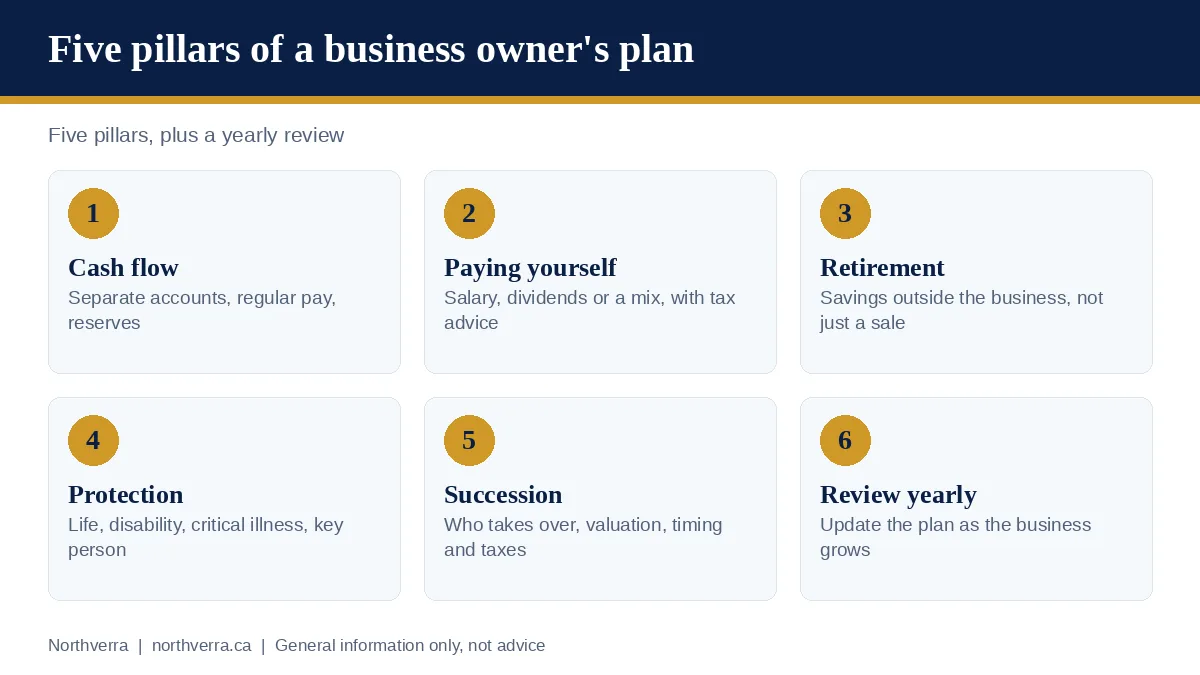
1. Cash flow and separating business from personal money
Use separate bank accounts and credit cards for the business. Pay yourself on a regular schedule, even if the amount changes, so your household budget is predictable. Keep a business reserve for slow months and a personal emergency fund. Our guide to budgeting basics can help with the household side.
2. How you pay yourself
If your business is incorporated, you can usually pay yourself a salary, dividends, or a combination. The choice affects your taxes, your RRSP room and your future CPP benefits.
| Feature | Salary | Dividends |
|---|---|---|
| Deductible to the corporation | Yes | No; paid from after-tax corporate profits |
| Creates RRSP contribution room | Yes | No |
| CPP contributions and benefits | Yes | No |
| Payroll administration | Required | Not required |
| Helps show income to lenders | Usually straightforward | Often accepted, with more documentation |
The right mix depends on your income needs, the corporation’s profits and your long-term plans. This is an area where an accountant’s advice is important.
3. Retirement without an employer pension
Many owners plan to fund retirement by selling the business. That can work, but it puts a lot of weight on a single, uncertain event. Building savings outside the business, through RRSPs, TFSAs and personal or corporate investment accounts, gives you a base that does not depend on finding the right buyer at the right time. Our guide to retirement planning in Alberta covers the income side of retirement.
4. Protecting the business and your family
Ask what would happen if you, or a key partner, could not work for six months, or died. Insurance can provide money when it is needed most:
- Life insurance to protect your family and fund a buy-sell agreement between owners. See buy-sell agreements.
- Key person insurance to help the business through the loss of someone essential.
- Disability and critical illness insurance to replace income if you cannot work.
- Business overhead expense coverage to help pay fixed costs while you recover.
For incorporated owners, how a policy is owned and who pays for it can matter. See life insurance for incorporated business owners.
5. Succession and exit planning
Every owner eventually leaves the business. Planning ahead lets you choose how. Questions to work through include who could take over, what the business is worth, how you would be paid, how taxes on the sale would be handled, and how long the transition would take. Some owners may qualify for a lifetime capital gains exemption on qualifying shares; the rules are detailed, so professional advice is important.
Example (hypothetical): Jordan owns a heating and plumbing company in Calgary with a partner. They set up a shareholder agreement with a buy-sell clause funded by life insurance, so the surviving partner could buy the other’s shares. Jordan also pays himself a mix of salary and dividends and contributes to his RRSP every year, so his retirement does not depend only on selling the company.
Common mistakes business owners make
- Mixing business and personal expenses.
- Reinvesting everything in the business and saving nothing personally.
- Having no plan if an owner becomes ill or dies.
- Leaving succession planning until a few months before retiring.
- Not reviewing pay, tax and insurance decisions as the business grows.
Key takeaways
- Keep business and personal finances separate from day one.
- Decide how you pay yourself with your retirement and tax picture in mind.
- Build wealth outside the business so your future does not depend on one asset.
- Use insurance to protect the business, your partners and your family.
- Start succession planning years before you plan to step back.
Who this guide is for
- Owners of small and medium-sized businesses in Calgary and across Alberta.
- Incorporated professionals and self-employed tradespeople.
- Business partners who share ownership.
- Owners thinking about selling or passing on their business in the next 10 years.
Questions to ask a financial advisor
- Should I pay myself a salary, dividends or a mix?
- How much should I be saving personally each year?
- What happens to the business if I become ill or die?
- How could insurance fund a buy-sell agreement with my partners?
- What would a realistic exit plan look like for me?
Frequently asked questions
Should a business owner pay themselves salary or dividends?
Each has trade-offs. A salary is a deductible expense for the corporation, creates RRSP contribution room and builds CPP benefits, but it requires payroll and CPP contributions. Dividends are simpler to pay and do not require CPP contributions, but they do not create RRSP room. Many owners use a mix, chosen with an accountant.
How do business owners save for retirement without a pension?
Common tools include RRSPs, TFSAs, investments held inside the corporation, and for some owners an individual pension plan. The key is to save consistently rather than counting on the sale of the business to fund retirement.
Should I keep money in my corporation or take it out?
Leaving profits in the corporation can defer personal tax, but large amounts of passive investment income inside a corporation can affect the small business tax rate. How much to keep inside and how to invest it is worth reviewing with an accountant and advisor each year.
What insurance does a business owner need?
It depends on the business. Common types include life insurance to protect the family and fund a buy-sell agreement, key person insurance, disability insurance to replace your income, critical illness insurance, and business overhead expense coverage. See how business owners use life insurance.
What is succession planning?
It is planning how ownership and control of the business will pass to someone else, whether a family member, partner, employee or buyer, and how you will be paid. Good succession plans start early and cover valuation, taxes, timing and who will run the business.
How much emergency money should a business keep?
Many owners aim for a reserve that covers several months of fixed business expenses, separate from their personal emergency fund. The right amount depends on how seasonal and predictable your revenue is.
Can the sale of my business be my retirement plan?
It can be part of it, but relying on it alone is risky. The sale price is uncertain, buyers may be hard to find, and timing may not suit you. Building savings outside the business gives you more choices.
Do I need a separate will for my business?
Your will should address your business interests, and your shareholder or partnership agreement should cover what happens on death or disability. A lawyer can advise on structures, such as multiple wills, that may apply in your province.
Last updated: October 11, 2026
Related guides
- How can business owners use life insurance?
- Can life insurance help fund a buy-sell agreement?
- How does life insurance work for incorporated business owners?
- Retirement Planning in Alberta
- How much should I invest each month?
- All investment questions, answered
Talk it through with us
Every situation is different. If you would like to talk about how this applies to you, we are happy to walk through your questions with no obligation.
Have a question? Start a conversation
Tell us a little about your situation. We will reply within one business day.
By submitting this form you agree that Northverra may contact you about your enquiry. Please do not include account numbers, health details or other sensitive information. See our Privacy Policy.
Important information. Investing involves risk, including the possible loss of the amount invested. The value of investments can go down as well as up, and past performance does not guarantee future results. Nothing on this page is a recommendation or a promise of any return. Diversification and asset allocation do not ensure a profit or protect against loss. See our Disclosures.
Important information. The information on this page is general in nature, is provided for educational purposes only, and is not personalized financial, insurance, legal, tax or mortgage advice. Your circumstances are unique. Please speak with a properly licensed professional before making decisions. See our Disclosures.