
LIFE INSURANCE QUESTIONS
Term vs. whole life insurance: Which is better?
Short answer: Neither is better for everyone. Term insurance usually costs far less and suits needs that have an end date, like raising children or paying a mortgage. Whole life costs more but lasts your lifetime and builds cash value, which can suit lifelong needs such as estate planning.
In this guide: Side-by-side comparison · When term tends to fit · When whole life tends to fit · Using both · Questions to ask · A simple way to think about the choice · A worked comparison · What term insurance does not do · What whole life insurance does not do · Which one tends to fit which person · Can you change your mind later? · FAQ
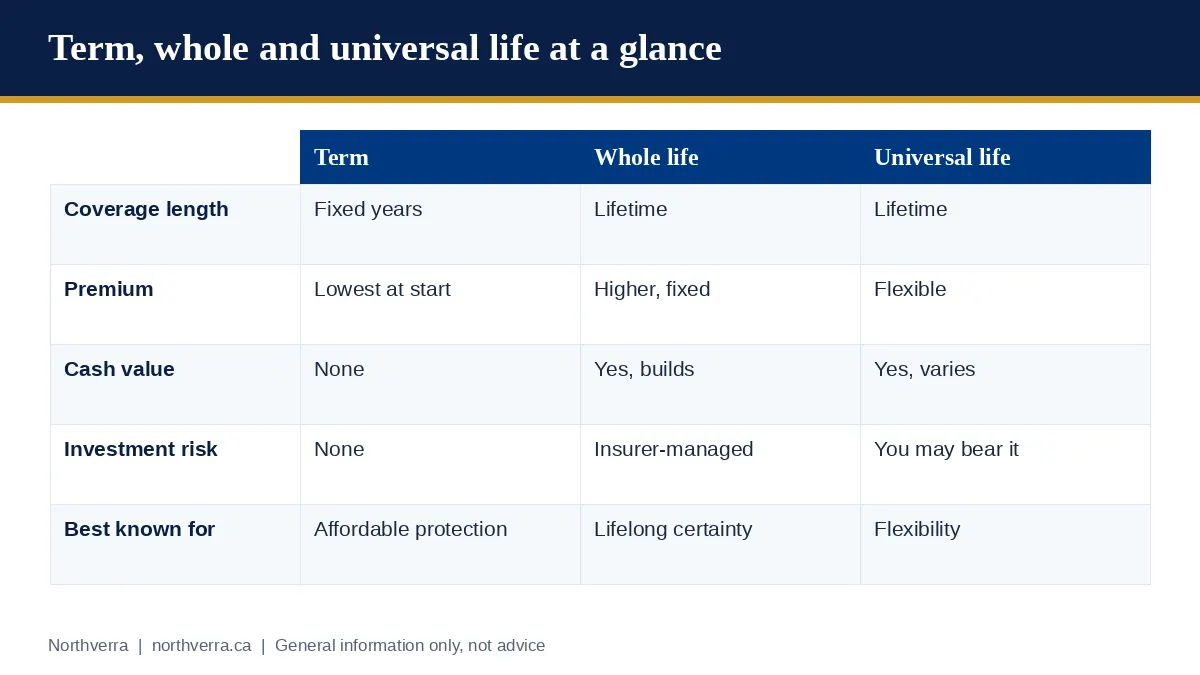
Side-by-side comparison
- Length: term covers a fixed period such as 10, 20 or 30 years, whole life is designed to cover you for life
- Cost: term premiums are typically much lower at the start, whole life premiums are higher but generally level
- Cash value: term has none, whole life builds a cash value under the policy terms
- Flexibility: term can often be renewed or converted, whole life is a long commitment
- Dividends: some whole life policies are participating and may pay dividends that are not guaranteed
When term insurance tends to fit
- You need a large amount of coverage on a tight budget
- The need has an end date, such as raising children or paying off a mortgage
- You want to buy more coverage now and revisit it later
Consider: coverage ends at the end of the term unless renewed, and renewal premiums can be much higher. Look for a conversion option that lets you switch to permanent coverage without a new medical exam.
When whole life insurance tends to fit
- You want coverage that will not expire
- You have estate planning or legacy goals
- You value predictable, level premiums and are comfortable with a long-term commitment
Consider: it is a long-term product, and surrendering early can reduce what you receive. Learn more in our guides on cash value and participating whole life.
Using both
Some people combine a base of permanent coverage with additional term coverage during the years of highest responsibility. This ‘layering’ can balance cost and lifetime protection.
Questions to ask before you choose
- How long do the people I protect depend on my income?
- What can I afford to pay every year for decades?
- Would I rather keep insurance simple and invest the difference separately?
- Does the policy have a conversion option, and until what age?
For the cost side, see how much life insurance costs in Alberta.
Next step
We can compare the options against your goals and budget.
A simple way to think about the choice
Imagine two goals. The first is to protect your family during a specific stretch of years. The second is to guarantee that a benefit will be paid whenever you die. Term insurance is built for the first goal, and whole life is built for the second. Many mistakes come from buying a product for the wrong goal, not from choosing a bad product.
A worked comparison
This example is an illustration only and uses round numbers. Suppose a healthy 35-year-old wants $500,000 of coverage. A 20-year term might cost a modest monthly amount. A whole life policy for the same amount could cost many times more each month, because it is designed to last for life and to build cash value.
One approach, sometimes called ‘buy term and invest the difference’, is to buy the lower-cost term policy and put the savings into a TFSA or RRSP. It can work well for disciplined savers, but investment returns are not guaranteed. Another approach is to buy whole life for its forced savings and guaranteed features, accepting the higher cost for certainty. Neither is automatically better; it depends on your discipline, your goals and your comfort with risk. Read about compound growth if you plan to invest the difference.
What term insurance does not do
- It does not pay if you outlive the term
- It does not build cash value
- Renewal can be very expensive because the insurer prices by your age at that time
- If your health declines, replacing it with a new policy may be difficult or costly
That last point is why a conversion option is valuable. It lets you switch to permanent coverage later without proving good health, within the policy’s rules.
What whole life insurance does not do
- It is not cheap, and it can strain a budget
- Early cash values may be small, so cancelling in the first years can mean a poor result
- Dividends, if any, are not guaranteed
- It is not a substitute for RRSPs and TFSAs, which have their own tax benefits
Which one tends to fit which person
- A young family on a budget often starts with term
- Someone with a lifelong dependant may need permanent coverage
- A business owner planning succession may use permanent coverage for estate liquidity
- A high-income earner who has used up registered accounts may explore whole life or universal life as part of a plan
Each of these is a tendency and not a rule. A licensed advisor can model your situation, and you can compare the numbers side by side.
Can you change your mind later?
Often, yes. Many term policies include a conversion option that lets you switch some or all of the coverage to a permanent policy without new medical questions, up to a set age. This means you can start with affordable term coverage now and move to whole life later if your budget grows or your needs become permanent. Check the conversion deadline and which permanent plans are available before you choose a term policy.
Common questions
Can I convert term to whole life later?
Many term policies include a conversion option, usually until a certain age or policy anniversary. The new policy is priced at your age at conversion. Ask for the details before you buy.
Do I have to choose one?
No. Some people hold both, using term for temporary needs and a smaller permanent policy for lifelong needs.
Is whole life a good investment?
It is primarily insurance with a savings feature. It may suit certain goals, but many people find registered accounts more efficient for pure investing. Compare the guaranteed values, not only the projections.
What about universal life?
Universal life is another permanent option with more flexibility and more investment risk. Read what universal life is.
Related guides
Have a question? Start a conversation
Tell us a little about your situation. We will reply within one business day.
By submitting this form you agree that Northverra may contact you about your enquiry. Please do not include account numbers, health details or other sensitive information. See our Privacy Policy.
Important information. Life insurance products are subject to underwriting, eligibility, exclusions, limitations and the terms of the policy contract. Coverage, premiums and availability depend on your age, health, lifestyle and other factors. Nothing on this page is an offer of insurance or a guarantee of coverage or price. See our Disclosures.