
INVESTMENT GUIDE
Investment Risk and Wealth Management
Short answer: Investment risk is the chance that your investments do not deliver what you need, whether through losses, inflation, or needing money at the wrong time. Wealth management is the process of managing those risks across your whole financial life: setting goals, choosing a suitable investment mix, protecting your income and assets, and planning for taxes and your estate.
Quick facts
- Every investment carries some kind of risk, including cash, which can lose value to inflation.
- Risk tolerance is how much ups and downs you can live with; risk capacity is how much loss your finances can absorb.
- Time horizon is one of the biggest factors in how much risk is appropriate.
- Diversification and asset allocation reduce some risks but do not eliminate them.
- Wealth management combines investing with cash flow, insurance, tax and estate planning.
In this guide: The main types of investment risk · Risk tolerance, risk capacity and risk need · How time horizon changes the picture · What wealth management includes · Managing your own behaviour · When to review your risk level · FAQ

Every investment decision involves risk, but risk is not just the chance that a stock goes down. It is the chance that your money is not there, in the amount you need, when you need it. This guide explains the main kinds of investment risk, how to judge how much risk is right for you, and how a wealth management plan brings the pieces together.
The main types of investment risk
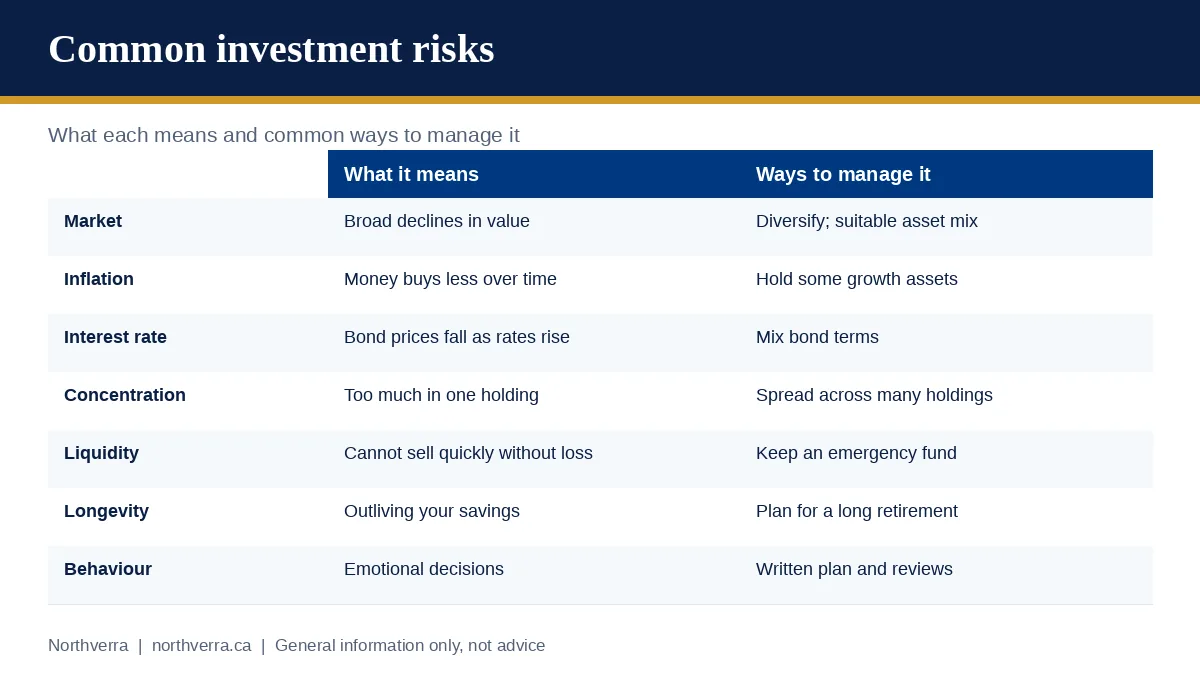
| Risk | What it means | Common ways to manage it |
|---|---|---|
| Market risk | Investment values fall because of broad market declines | Diversification, a suitable asset mix, a long time horizon |
| Inflation risk | Your money buys less over time | Owning some growth investments; reviewing your savings rate |
| Interest rate risk | Bond prices fall when interest rates rise | Mixing bond terms; matching bonds to when you need money |
| Concentration risk | Too much in one company, sector or asset | Spreading money across many holdings |
| Liquidity risk | You cannot sell quickly without a loss | An emergency fund; keeping short-term money in cash |
| Currency risk | Exchange rates reduce foreign returns | Balancing Canadian and foreign holdings |
| Longevity risk | Outliving your savings | Planning for a long retirement; lifetime income sources |
| Behaviour risk | Emotional decisions hurt returns | A written plan and regular reviews |
Risk tolerance, risk capacity and risk need
Three questions help decide how much risk is appropriate:
- Tolerance: How would you feel, and what would you do, if your investments fell 20% in a year?
- Capacity: Could your finances absorb that drop without changing your plans? Capacity depends on your time horizon, income stability, savings and debts.
- Need: How much growth do you need to reach your goals? Sometimes a lower-risk portfolio is enough; sometimes more growth is needed to stay on track.
When these point in different directions, a good plan usually leans toward the more cautious answer and looks for other ways, such as saving more, to close any gap.
How time horizon changes the picture
Short-term money should not be exposed to large swings, because there may not be time to recover. Long-term money can usually accept more ups and downs in exchange for the potential for higher growth. Our article on risk and time horizon explains this in more detail.
What wealth management includes
Wealth management takes a step back from individual investments and looks at the whole plan:
- Goals and cash flow: what you are saving for and how much you can set aside.
- Emergency fund: a cash reserve so you are not forced to sell investments at a bad time. See building an emergency fund.
- Investment strategy: asset mix, diversification and rebalancing. See building a diversified portfolio.
- Protection: life, disability and critical illness insurance.
- Tax planning: using RRSPs, TFSAs and other accounts efficiently.
- Retirement and estate planning: turning savings into income and passing on what you leave behind.
Managing your own behaviour
Some of the biggest losses come from decisions made during market stress: selling after a fall, then buying back after prices recover. A written plan, automatic contributions and scheduled reviews help keep decisions tied to your goals rather than headlines.
Example (hypothetical): When markets fell sharply, Aisha felt the urge to move everything to cash. Her plan showed she would not need the money for 15 years and that her emergency fund covered six months of expenses. She kept her mix unchanged and used her monthly contributions to rebalance.
When to review your risk level
- When you are within a few years of a major goal, such as buying a home or retiring.
- After a change in income, family situation or health.
- When markets have moved your portfolio far from its target.
- At least once a year as part of a regular review.
Key takeaways
- Know which risks matter most for each of your goals.
- Base your risk level on both your comfort and your financial capacity.
- Use diversification, an emergency fund and insurance to manage different kinds of risk.
- Behaviour, such as selling in a panic, is one of the biggest risks investors face.
- Review your plan when your life, not just the market, changes.
Who this guide is for
- Investors who want to understand the risks in their portfolio.
- People building wealth who want a plan beyond picking investments.
- Pre-retirees worried about a market drop just before they retire.
- Business owners and families with several goals at once.
Questions to ask a financial advisor
- How much risk am I taking now, and is it appropriate for my goals?
- What would happen to my plan if markets fell sharply next year?
- How does insurance fit into my wealth plan?
- How are my investments taxed, and can that be improved?
- How often will we review my plan?
Frequently asked questions
What is the difference between risk tolerance and risk capacity?
Risk tolerance is emotional: how much ups and downs you can accept without losing sleep or selling. Risk capacity is financial: how much loss your plan can absorb based on your income, savings, time horizon and obligations. A suitable portfolio respects both.
Is it possible to invest without risk?
No. Even cash and GICs carry inflation risk, meaning their returns may not keep pace with rising prices. Lower-risk investments reduce the chance of losses but usually offer lower long-term growth.
What is sequence of returns risk?
It is the risk that poor returns happen just before or early in retirement, when you start withdrawing money. Losses at that time can have a larger effect on how long your savings last than the same losses later. Holding a cash reserve and a balanced mix are common ways to manage it.
How does wealth management differ from investment management?
Investment management focuses on choosing and managing investments. Wealth management looks at your whole financial picture, including budgeting, debt, insurance, retirement, taxes and estate planning, and coordinates them.
Does insurance belong in a wealth management plan?
Yes. Insurance manages risks that investments cannot, such as death, disability or serious illness, which could force you to sell investments at a bad time. See how protection fits into your plan.
How can I reduce investment risk?
Common steps include diversifying, matching your asset mix to your time horizon, keeping an emergency fund, avoiding concentrated positions, using registered accounts wisely and sticking to a long-term plan rather than reacting to headlines.
Should I take less risk as I get older?
Many people gradually reduce risk as they approach the time they need their money. But retirees still often need some growth, because retirement can last decades and inflation continues. See asset allocation by age.
What is concentration risk?
It is the risk of having too much money in a single company, sector or asset, such as your employer’s shares or one rental property. If that one holding does badly, it can do outsized damage to your plan.
Last updated: October 11, 2026
Related guides
- Risk and time horizon
- Insurance and wealth building
- What should I do when the stock market drops?
- Robo-advisor vs financial advisor
- How to Build a Diversified Investment Portfolio
- All investment questions, answered
Talk it through with us
Every situation is different. If you would like to talk about how this applies to you, we are happy to walk through your questions with no obligation.
Have a question? Start a conversation
Tell us a little about your situation. We will reply within one business day.
By submitting this form you agree that Northverra may contact you about your enquiry. Please do not include account numbers, health details or other sensitive information. See our Privacy Policy.
Important information. Investing involves risk, including the possible loss of the amount invested. The value of investments can go down as well as up, and past performance does not guarantee future results. Nothing on this page is a recommendation or a promise of any return. Diversification and asset allocation do not ensure a profit or protect against loss. See our Disclosures.
Important information. The information on this page is general in nature, is provided for educational purposes only, and is not personalized financial, insurance, legal, tax or mortgage advice. Your circumstances are unique. Please speak with a properly licensed professional before making decisions. See our Disclosures.