
INVESTMENT GUIDE
How to Build a Diversified Investment Portfolio
Short answer: A diversified investment portfolio spreads your money across different asset classes, such as stocks, bonds and cash, and across regions, sectors and many individual companies. The goal is to reduce the impact of any single investment doing poorly. You build it by choosing an asset mix that fits your goals and risk, using broad funds, and rebalancing regularly.
Quick facts
- Diversification spreads risk; it does not remove it or ensure a profit.
- The biggest driver of a portfolio’s behaviour is usually its mix of stocks, bonds and cash.
- Broad ETFs and mutual funds can hold hundreds or thousands of companies in one fund.
- Many Canadian investors hold a large share in Canadian stocks, which is known as home bias.
- Rebalancing brings your portfolio back to its target mix after markets move.
In this guide: What does diversification actually mean? · The four layers of diversification · Step 1: Set your goals and time horizon · Step 2: Choose an asset mix · Step 3: Pick diversified building blocks · Step 4: Use the right accounts · Step 5: Rebalance and review · Common diversification mistakes · FAQ

Diversification is often described as not putting all your eggs in one basket. In practice, it means building a portfolio where no single company, sector, country or type of investment can do too much damage on its own. This guide explains the layers of diversification and a simple process for putting a diversified portfolio together.
What does diversification actually mean?
Different investments respond differently to the same events. When interest rates rise, bonds and stocks may move in different directions. When one sector struggles, another may do well. By owning a range of investments, you reduce the chance that one setback derails your plan. Diversification spreads risk; it does not eliminate it.
The four layers of diversification
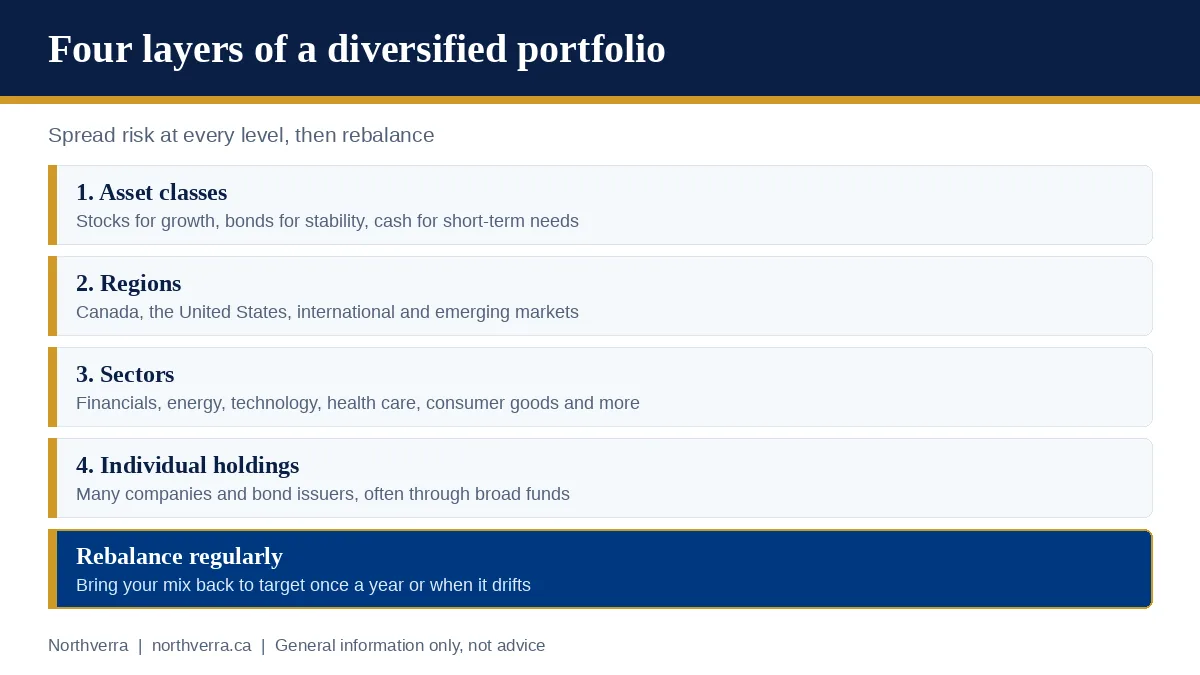
- Asset classes: stocks for long-term growth, bonds for income and stability, and cash or GICs for short-term needs. See stocks vs bonds and how GICs work.
- Regions: Canada, the United States, other developed markets and emerging markets.
- Sectors: technology, health care, financials, energy, consumer goods, industrials and others.
- Individual holdings: many companies and bond issuers rather than a few.
Step 1: Set your goals and time horizon
Money you need in two years should be invested very differently from money for retirement in 25 years. Write down each goal, when you will need the money, and how much a temporary drop in value would affect you.
Step 2: Choose an asset mix
Your asset mix is the share of your portfolio in stocks, bonds and cash. It is the single most important decision you make. A younger investor saving for retirement might hold mostly stocks, while someone near retirement might hold more bonds. Our guide to asset allocation by age explains common approaches.
| Asset class | Main role | Typical trade-off |
|---|---|---|
| Stocks and equity funds | Long-term growth | Larger ups and downs |
| Bonds and bond funds | Income and stability | Lower long-term growth; affected by interest rates |
| Cash and GICs | Safety and short-term needs | Returns may not keep up with inflation |
| Real estate funds | Income and diversification | Sensitive to rates and property markets |
Step 3: Pick diversified building blocks
For most people, broad funds are the simplest way to diversify:
- Index ETFs and index mutual funds that track a whole market.
- Asset allocation ETFs that hold a ready-made mix of stock and bond funds in one product.
- Actively managed funds, where a manager chooses investments, usually at a higher fee.
Our guide to mutual funds vs ETFs compares the options. Whatever you choose, check for overlap between funds and keep fees in view.
Step 4: Use the right accounts
Diversification also applies to where you hold investments. Spreading money across a TFSA, RRSP and non-registered account can give you flexibility with taxes and withdrawals later. Learn more in RRSP vs. TFSA and non-registered accounts.
Step 5: Rebalance and review
Over time, markets move your portfolio away from its target. If stocks rise strongly, your portfolio becomes riskier than you planned. Rebalancing means selling some of what has grown and buying what has lagged, or directing new contributions to the underweight areas.
Example (hypothetical): Sam’s target is 70% stocks and 30% bonds. After a strong year for stocks, his portfolio is 78% stocks. He directs his next few months of contributions into his bond fund until the mix is back near 70/30, without selling anything.
Common diversification mistakes
- Holding too much of one company, often an employer’s shares.
- Investing only in Canada.
- Owning several funds that hold the same companies.
- Chasing last year’s top performers.
- Never rebalancing.
Key takeaways
- Start with your goals and time horizon, then choose an asset mix.
- Diversify across asset classes, regions, sectors and companies.
- Broad, low-cost funds are a simple way to diversify.
- Rebalance on a schedule or when your mix drifts too far.
- Owning many funds that hold the same things is not true diversification.
Who this guide is for
- Beginner investors setting up their first portfolio.
- Investors whose money is concentrated in a few stocks or one sector.
- Employees holding a large amount of their employer’s shares.
- Anyone reviewing an existing portfolio.
Questions to ask a financial advisor
- What asset mix fits my goals and time horizon?
- How much overlap is there between the funds I own?
- What am I paying in fees across my portfolio?
- How and when should I rebalance?
- Which accounts should hold which investments for tax reasons?
Frequently asked questions
How many stocks do I need to be diversified?
There is no exact number, but owning a handful of companies leaves you exposed to each one. A broad index fund or ETF can give you exposure to hundreds or thousands of companies at once, which is much simpler than building a diversified portfolio of individual stocks.
Is a single all-in-one ETF diversified enough?
An asset allocation ETF holds several underlying funds covering stocks and bonds in different regions, so it can be a diversified core holding. Check its stock and bond mix, its regional split and its fees to make sure it suits your goals.
Does diversification protect me in a market crash?
It can soften the impact, but it does not prevent losses. In sharp downturns many investments can fall together. Bonds and cash often hold up better than stocks, which is why the mix matters. See what to do when the stock market drops.
How often should I rebalance?
Many investors rebalance once a year, or when an asset class drifts more than a set amount from its target, such as 5 percentage points. Rebalancing within registered accounts avoids triggering capital gains tax.
Should I invest outside Canada?
Canada is a small share of global stock markets and is concentrated in a few sectors such as financials and energy. Adding US and international investments spreads your risk across more economies and industries. Foreign investments can add currency risk.
Is real estate part of a diversified portfolio?
Your home is a major asset but is not easy to sell in pieces and is tied to one local market. Some investors add real estate through funds. Our guide to real estate vs stocks compares the two.
What is over-diversification?
Owning so many funds or stocks that they overlap heavily, or that your portfolio becomes hard to manage, without adding real diversification. Five funds that all track large Canadian companies are not much more diversified than one.
Do fees matter in a diversified portfolio?
Yes. Fees reduce your return every year, and the effect compounds over time. Comparing the management expense ratio of each fund helps you understand what you are paying.
Last updated: October 11, 2026
Related guides
- What is asset allocation by age?
- Mutual funds vs ETFs: what is the difference?
- Stocks vs bonds: what is the difference?
- What are the main types of investments in Canada?
- Investment Risk and Wealth Management
- All investment questions, answered
Talk it through with us
Every situation is different. If you would like to talk about how this applies to you, we are happy to walk through your questions with no obligation.
Have a question? Start a conversation
Tell us a little about your situation. We will reply within one business day.
By submitting this form you agree that Northverra may contact you about your enquiry. Please do not include account numbers, health details or other sensitive information. See our Privacy Policy.
Important information. Investing involves risk, including the possible loss of the amount invested. The value of investments can go down as well as up, and past performance does not guarantee future results. Nothing on this page is a recommendation or a promise of any return. Diversification and asset allocation do not ensure a profit or protect against loss. See our Disclosures.
Important information. The information on this page is general in nature, is provided for educational purposes only, and is not personalized financial, insurance, legal, tax or mortgage advice. Your circumstances are unique. Please speak with a properly licensed professional before making decisions. See our Disclosures.